Instagram Post Text
Attention! Translation was done using AI, mistakes are possible
On March 1, in the most prominent spot in the center of Borovsk, I painted a picture titled “Stop the War.” It showed two helmets pierced by bullets, with ribbons in the colors of the Russian and Ukrainian flags. Three days later, the painting was painted over.
When I went to restore the work, police immediately pulled up. They’d been stationed there specifically. They took me to the station. I said I didn’t support the war and was expressing a civic stance through my paintings. They didn’t take any measures at the time, but issued me a warning not to damage building facades.
On March 25, I painted a girl under bombs, and that time it went to court. If the first painting was an impulse in response to shock, this one was a deliberate reaction to the war.
In April, I was fined 35,000 for discrediting the army. There’s not much to grieve — I think the outcome of my case was predetermined. The ruling didn’t specify a payment deadline; I decided to wait for a reminder, but six months have passed. In the end, I never paid it.
As soon as the court’s decision became known, people started coming to my home offering to pay the fine. Money came from everywhere, not just Borovsk, and an enormous sum accumulated — enough for 5 to 7 fines.
With those donations, I published three albums of my works. I tried to find out who’d sent me money and gave them the books for free. I also sent albums to the Museum of the History of the Gulag, to the local school, and to the library. The rest are sold in stores around town.
I didn’t stop there. On the retaining wall of the cathedral, I wrote in large letters “Z — madness.” They painted over it. I wrote in the same spot: “Z — disgrace.” Also painted over. The last time, I wrote: “Z — enough.”
In response to partial mobilization, I painted a cemetery. Above it — several cranes and the words of Rasul Gamzatov: “And in those ranks there is a small gap — perhaps that place is meant for me.” Meaning the place for the conscript.
Then I had a whole series — I’d paint the portrait of a cultural icon and include an anti-war line of theirs. That’s how Vysotsky, Tsoi, Galich, Yevtushenko, Shevchuk, and Kim appeared. They painted over all of them except Tsoi.
I took the design of a Soviet-era poster that symbolized the friendship between Ukraine and Russia — two girls standing and holding hands. I called the painting “Nostalgia.” In response to the massive bombardment of Ukraine, I painted “Sky Without Missiles.” These are the only two anti-war works that remain untouched.
After these works, I was summoned to the police again. An FSB major walked into the room. Together, we wrote up an official explanation. I said the war is an extremely vile venture, a disgrace to the entire country. I said the person who set all this in motion is a criminal, and this has already been recognized worldwide.
The major reacted very calmly, showed no emotions. I asked him what would happen next; he said that opening a case wasn’t within their jurisdiction — the explanation would be forwarded to the police chief. They drove me home, and that was it. Talking to him wasn’t frightening; I’d already gotten used to such conversations.
The police treat me with a kind of respect. They call and ask: “So, will you come in, or…?” I say: “Let’s go with 'or.'” Then they come pick me up, take me to the station, then home. They take my age into account.
My grandfather and uncle were executed, and my father was imprisoned in 1937 for 10 years. When he returned from Kolyma, he wasn’t allowed to live within 100 kilometers of major cities. So he bought half a house in Borovsk (located 115 kilometers from Moscow), and now I live in it.
I’ve created several wall memorials with portraits of people repressed in the Borovsk district, but the authorities destroyed them. They won’t let me publish a memorial book of the repressed; they won’t let me create an exhibition at the local history museum either. The Kaluga authorities refused to give me access to the MVD and FSB archives (the FSB Directorate for Kaluga Oblast).
They’ve opened administrative cases against me multiple times in response to my paintings on the theme of repressions. Under the article for hooliganism. As if I simply damaged a wall and there’s no politics involved.
I’m not afraid. I’m 84 years old; I have nothing to lose. I won’t lose my job; my loved ones won’t turn their backs on me. I’m not particularly worried about my family — they’re adults, independent. And besides, if I’m afraid and stay silent, that makes me an accomplice to the crimes.
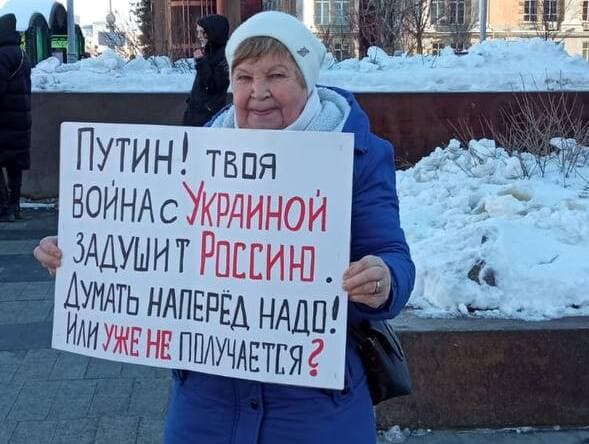
I paint on walls because I don’t see another way to express my stance. Given my capabilities, it’s the most effective method. No newspaper will publish anything of mine; as a public speaker, I’m nothing special; going out on a single-person picket with a sign — is that really the way?
I choose locations where the greatest number of people can see the paintings. It’s important to me that people stop and think when they see them. I don’t feel any hostility from the residents of Borovsk. Perhaps some are against my paintings, but they stay silent and walk by.
I don’t intend to stop. My most recent painting is about repressions. I wrote “1937” and below it: “Continues.”