Instagram Post Text
Attention! Translation was done using AI, mistakes are possible
My mother told me I was a traitor, a deserter of the homeland. She wished for me to die here (in Ukraine — S.P.) at the hands of fascists. After February 24, I wrote to my mother that her wish might come true — only I wouldn’t die at the hands of the imaginary fascists from her fantasies, but at the hands of very real ones: Russian fascists. I have virtually no contacts left in Russia now. It’s my choice — this radical, even with my parents. I view it as a betrayal. They don’t believe their own daughter who is being bombed in Kyiv.
We slept in the metro from February 24 until early April. The first two days were very hectic, chaotic — it felt like the occupiers were about to come down to us at any moment. Then we gradually started settling in: we brought sleeping pads, sleeping bags; we had a speaker, a laptop.
For the first two weeks, there were about 150 to 200 people at the station.
Then they brought in a train car and moved women and children there, because it was warmer inside the car, while the platform itself was quite cold. We organized board game nights in the evenings. We knew for a fact that at 8 p.m. we had a game session. We created a group chat for everyone sheltering at the station. We even held tea ceremonies.
I have a Russian passport. And in the metro, they checked documents every time. At first, I was very worried. Then I became a local celebrity — everyone already knew me; I was the only one like that there. The police at the entrance sympathized with me. Sometimes they’d jokingly ask if I wanted to go back to Russia. I’d say: “No, it wouldn’t go well for me there.” They’d joke and say: “Look, here’s a surefire plan: tell them where Bandera is hiding, and you’ll be a Hero of Russia.”
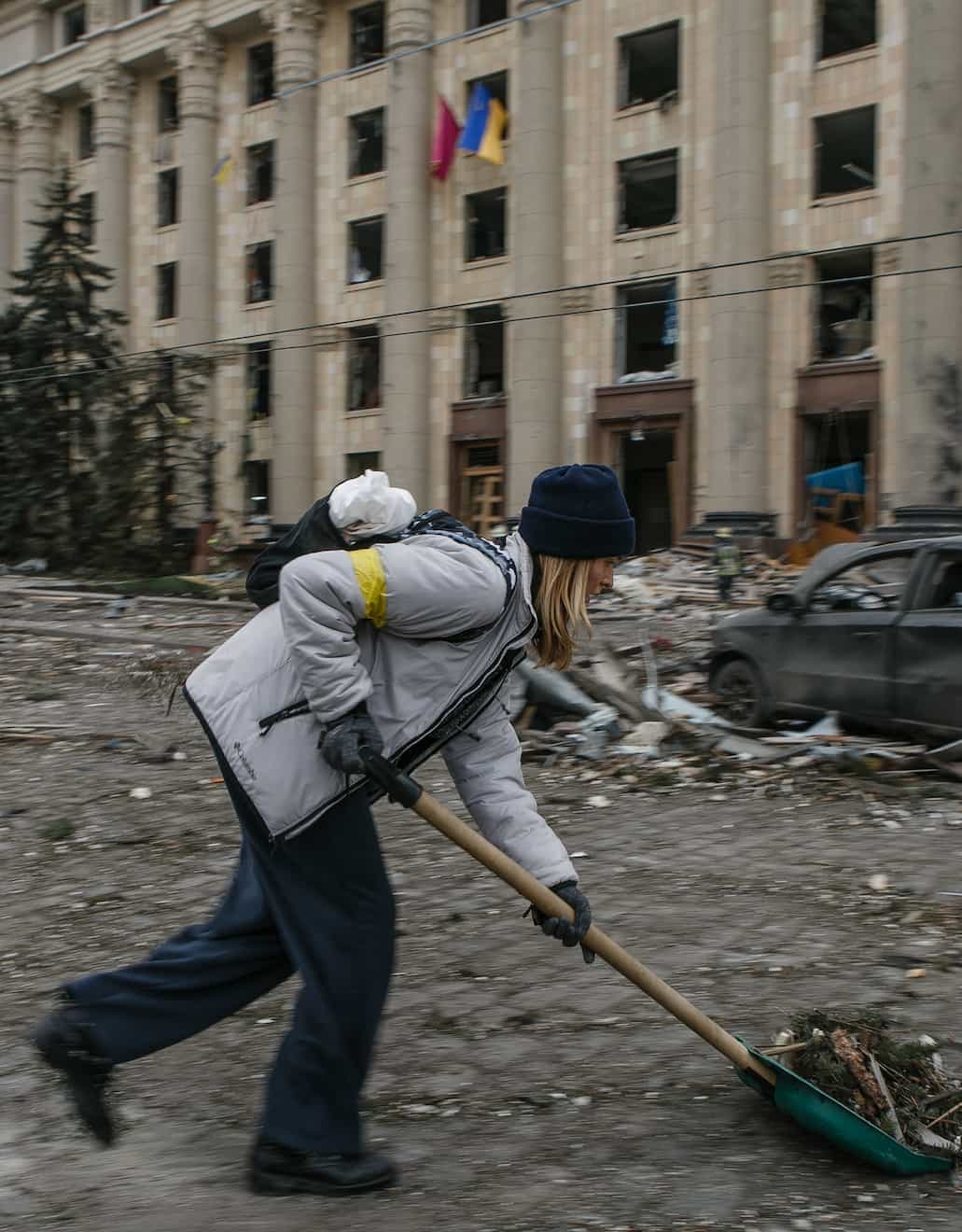
I learned about the volunteer movement Repair Together from a friend. I wrote to the organizers, making sure to mention that I had a Russian passport. If that was a problem for anyone, I’d accept it calmly. They replied: “It’s not a problem if you want to help us.” We got on a bus and went to clear rubble.
We usually go for two days. They give us tools: shovels, rakes. Most of the time we carry out bricks — the whole ones we keep, the broken ones we haul away. They feed us, and we spend the night right there in the village. On average, about 200 volunteers gather. In one trip, you can clear seven or eight houses.
We have rules, including about safety. From what I understand, they (Russian soldiers — S.P.) scattered mines everywhere. We’re warned that there’s a specific patch of ground that has been de-mined for sure, and that’s where we work. There haven’t been any accidents during these trips, but we’ve found fragments of munitions.
The first time I cleared rubble was in Lukashivka (a village in Chernihiv Oblast — S.P.). About 50/50 of it was still standing. Judging by all the destroyed houses, there was no rational logic to the shelling. Two houses could be completely shot to pieces, and the next one would be intact.
In the center of the village stands a church of the Moscow Patriarchate (the Ascension Church — S.P.). For the locals, it’s a relic — they had preserved that building; the church survived the German occupation. The Russian occupiers turned the church into their headquarters: they grilled barbecue there, and their burned-out military equipment stood next to it.
There are locals who remember the German occupation — they say it was better back then. If the Germans came to someone’s yard to take chickens and eggs, they’d leave half for the locals. But here, people said the soldiers could show up and just shoot all the chickens — not take them, just shoot them.
In the neighboring village of Yahidne, we helped with repairs. The houses are standing, they’re fine, but there’s a hole in the roof from shelling here, a damaged wall there. We self-organized, pooled money, and decided to finish the houses we’d already started — get them to the point of hanging wallpaper, painting ceilings, so everything would be nice and complete.
In Yahidne, we met Uncle Misha — we call him “Sonechko” (sunshine — Ukr., S.P.), he’s just so positive. His house is on the edge of the village. There’s not a single untouched spot in his yard. They shot at the chicken coop, at the house — because along the wall of the house runs a pipe painted in blue and yellow. He talks about his village and his house with such love, how they built it. You can see that it’s his whole life.
During the occupation, he was in the basement in Yahidne (referring to the basement of the local school, where Russian soldiers held villagers for 26 days — S.P.). He says it was hard — some people died, some were shot.
Recently, our team took on a new house for repairs. There I met Pani Maria. During the occupation of Yahidne, Russian soldiers killed her son. They shot him in his house — she saw it all. He said he was in his own home and wouldn’t obey them — so they shot him. She was glad we’d come, she fed us, she laughed. But you could see the pain in her…
When you’re clearing rubble, you detach yourself from the reason you’re even there. It’s as if something just happened to a house, and I’m sorting bricks. But when you find a chipped mug, a piece of charred carpet on the floor, you realize that this was a home — a home that had a carpet in the kitchen, cups, little cat figurines, a clock. This was a good home where there was life, where people invested everything they had. It’s like picking through the fragments of someone’s life.
The organization I go with brings performers or stand-up comedians to villages every Sunday. I happened to catch a concert by Onuka (a Ukrainian artist — S.P.). It’s very important for the locals that people talk about them and don’t forget them. And this kind of activity helps keep the focus on people’s problems — from humanitarian aid to rebuilding homes. You’d think — what’s an Onuka concert when there’s a war going on, people are being killed — but the local residents themselves come to these events, and there are always tons of children.
Kyiv and Ukraine have become my home. During the mass shellings, when the air raid alerts blared constantly, I sat on the cold floor of the metro and understood that I didn’t want to live through this war anywhere else. Because this is my home — I love Ukraine and Kyiv beyond words. I had many opportunities to go abroad, but I didn’t know when I’d be able to return to Ukraine, and for me that’s catastrophic. So if a rocket hits me or I get shot, at least I’ll die at home. On my own terms.