Back
To be near the treasures like a mother with her children — to protect, to tend, to cherish
A curator of the Kherson Museum stayed under occupation to protect the collection
Anna Skrypka, chief custodian of the Kherson Art Museum, describes how she stayed in the occupied city after the full-scale invasion began in order to protect the collection. She shares memories of the first searches and threats from Russian soldiers, attempts to maintain the cover story about 'evacuated collections, ' pressure from collaborators, and the looting of the museum in October–November 2022. With the help of Anna and her colleagues, Ukrainian forces were able to trace exactly where the stolen exhibits had been taken by the Russians. Anna continues to catalog the missing items and search for the looted works after the liberation of Kherson.
Interview
Transcript
Transcript
Attention! Translation was done using AI, mistakes are possible
КА: Katya Aleksander
АС: Anna Skripka
КА: I want to find out from you what the museum was like before the start of the full-scale invasion by Russia into Ukraine, so that you could try to describe it to me in quite some detail, tell me about it, what it was like before Russia interfered with its work.
АС: The Kherson Oblast Art Museum named after Alexey Shovkunenko began its work in the building where it is now located and was before the war. This building was transferred to the museum in 1978, this year the museum will celebrate 45 years since its opening, literally in a couple of weeks we will have an anniversary. Unfortunately, we won't be able to celebrate it the way we would have liked, as we planned, but we'll proceed based on the realities of our life. Our museum building represents historical value, this is the building of the former city duma, town hall, was built in 1905-1906, and was intended for the assembly of the city administration. The building is in classical style, there are various elements of empire style as well. The building itself represented value, it preserved its genuine decorative moldings, the main staircase, which was from those times. The building was maintained in the condition in which the museum received it – they treated it with care. The museum didn't start from scratch. In our city there is a local history museum, in which part of the artistic works were concentrated in a separate department. When it expanded, this part was already very large, and they decided to separate it into an art museum. Part of it was transferred to our museum at opening from the Kherson local history museum. And the stars also aligned: for our museum's opening, a collection from Leningrad collector Maria Ivanovna Kornilovskaya was prepared and transferred, about five hundred artistic works. Various things were represented there: sculpture, graphics, painting, and decorative art objects. I'm dwelling so long on how it began, because around this the further development proceeded. Maria Ivanovna Kornilovskaya's collection – this was a gathering of objects of artistic value, relating to the XIX and first half of the XX century. Then the major part of the museum's collecting was focused precisely on this period, we consciously chose this niche afterwards and worked on it. Therefore, a very large exhibition part represented precisely this entire collection and what later fit this period – end of XIX-beginning of XX. This includes impressionism, and the Peredvizhniki, and already new art, and cubism – various moments that are concentrated in this period. Then in the museum collection several inclusions were represented – this is southern Ukraine of course, because we are located here. Authors were represented who were born, lived and worked, passed their creative path in Kherson, in the Kherson region. Mykolaiv, Odesa – the south, our colorful south was also represented by authors: both Kostandi, and Stilianudi, and our local ones, also from the end of XIX-beginning of XX, – this is Skadovsky, who worked here with us, and did much for the development of artistic art in the Kherson region. Kharkiv and Kyiv art schools of the same period were also represented. Our pride – these are paintings by Pimonenko, the famous Ukrainian artist, who represented the Russian Empire at international biennales then, his paintings were completely devoted to Ukraine and carried Ukrainian content, received silver medals at these international exhibitions back then. The paintings very colorfully convey both Ukrainian costume and Ukrainian holidays, our Christmas celebrations and Easter. Also widely represented was art of practically all union republics of the former Soviet Union: this is Armenia, and Azerbaijan, and Georgia, and Tajikistan, that is, they worked on this too, a large part was collected from former Soviet republics. By separate brushstrokes, so to speak, the Baltic republics were represented, we had direct separate work with the Baltics. And one of the treasuries – this is Western European art, starting from the XVI-XVII centuries, even if just a few, one or two works each, but XVI, XVII, XIX, XX, England, France, Germany. We had something to be proud of.
КА: Yes, it sounds like a very large collection.
АС: We also had iconography represented, more than 60 icons, starting somewhere from the XVI century to the XIX and beginning of XX. Various works were represented, covered different periods and represented the diversity of the entire world of artistic art. This is in brief.
КА: A very large, colorful collection.
АС: Yes, it was possible to vary in the exhibition halls on different themes, you just need desire and inspiration.
КА: And how did your story with the museum begin? How and when did you start working in the museum?
АС: To my regret, I caught a very small period of peaceful life, I came to work at the museum in May 2021.
КА: I understand that you are the chief curator, yes?
АС: Yes, now yes.
КА: Can you tell me how you began to interact with this collection, how you fell in love with it, how this happened for you?
АС: I came to work consciously. There was a choice, two departments: either the storage funds department or the mass department. Although both types of work are interesting to me, I, in principle, had started studying excursion work for several months and worked a bit in the mass department as a tour guide, I wanted to immediately dive into both that work and this. For myself I still placed more emphasis on what's dear to me – to preserve and be near those treasures, and protect them like a mother her children, to cherish and nurture, so that they could remain in our museum as long as possible so that later it would be possible to show them, take them out of storage and delight our guests, residents of the city and region. The collection, in order to understand in numbers, when I came and began my work, the collection numbered up to 14 thousand items. In January 2022 I took charge of the collection. These six months, right up until the war actually, I had acquaintance by departments: painting, graphics, sculpture, decorative-applied art, gradually delving into all the nuances of each department separately. Six months went to simply viewing, seeing, understanding what is located there and what I would be responsible for. So it happened that literally on the eve of the war the chief curator, who was preparing me, left her job, and I remained alone in this department. I met the war already alone in this department. I had to do a lot all at once, because in October we began working intensively with moving our collection from the exhibition halls. We have a three-story building, on the second and third floors we had exhibition halls, storage facilities were also on the second and third. It was necessary to not just move all this, but pack and relocate to the first floor for long-term storage, because restoration period was beginning on the second and third. Our museum was among the few that received a large sum of money for restoration from the presidential team, it was supposed to come in different tranches, this is a program of museum restoration throughout Ukraine. We entered the number of museums that received money for this work. It was necessary to remove everything, move, place in those storage facilities that we made on the first floor. This work also had to be done literally on the eve, October-November, on the eve of all these military events. Partly this helped us, that it was already standing in a conserved state, and then this served as cover for us when the Russian troops entered.
КА: Do I understand correctly that right before the start of the full-scale invasion there was supposed to begin such a new life for the museum – renovation, restoration?
АС: Yes, absolutely new, a new project was prepared – to make our building, without destroying anything, but simply lightening the structures, using new modern materials, to make it modern. It was hard for people with disabilities [to climb] to the third floor, so they planned to install a magnificent elevator, and conveniences on all floors so that people could visit them, even having health problems. Besides that, they wanted to improve the exhibition halls themselves, equipping them with modern equipment, rotating-illuminated display cases. They wanted all this, it was all planned.
КА: Your personal acquaintance with the collection continued for several months. You said a very important phrase: "protect like a mother her children." How did this feeling toward the collection appear for you, how did love for this collection develop?
АС: I saw, first of all, the time frames, the represented works of authors whom I myself had studied from books, such classics, masters, that very good works are represented, which illustrate the life of more than one generation both in ceramics, and in faience, in porcelain, and in paintings, that is, in everything, and in sculpture, we had Kasli casting... I simply cannot convey everything to you. When I myself entered each of these departments, when I immersed myself, studying technique, studying the authors of works, time frames in context – this so captivated me! When I even climbed the steps of our museum, it always seemed to me that I was going to a ball or entering some fairy-tale palace. And indeed a fairy tale would begin, and this fairy tale was illustrated by those artistic treasures that were in it. For me it was always a thrill to enter the museum, to enter the storage facility, where only the initiated enter. All this so delighted and amazed me! At first I even had difficulty forcing myself to approach and take something, from unfamiliarity my heart was beating so hard that I could touch all this. Then the documentation, when I began to process the first accession books, I saw the first museum workers, leafing through the archiving, history, when I saw with what love they began this. Everything was still written by hand, it was all so primitive, but people wanted to preserve this, people collected it and it reached us. Doubly or triply [I wanted] to treat this with reverence and love, because they preserved this for us. I felt responsibility, that I should perform my duties in exactly the same way, so that I could show all this now, and then, after me, someone could use it, bring it to exhibition and show it to a wide audience.
КА: I understand that with such a collection it's very difficult to choose, but maybe there's some painting that was your favorite, that evoked special reverence? Some most personal exhibit, perhaps?
АС: Here you can't single anyone out. I tried to answer such a question for myself. Yes, at first it was very amazing when you get acquainted with the classics: Savrasov, Polenov, Kramskoy, Aivazovsky was represented with us. When you approach works by these authors, time directly breathes on you. You try to catch with what feeling they painted these works, that such turbulent life was around them, and they captured precisely this. Then you approach other works, close to us, works by Odesa residents, Kostandi – this is brightness of colors, such sunny days, I don't know. Orlovsky in exactly the same way, Kyiv, his paintings. Pimonenko – this is a separate story. Whether it's a portrait, or a landscape, in each department there will be some work, one, two, three, it's impossible to single out...
КА: Something one.
АС: Something one, yes. When I got into sculpture, this plasticity is so mesmerizing, in the decorative-applied art department both clay, and faience, and porcelain, and ceramics – different variations are represented. There's a tender attitude toward porcelain, toward clay and painting another, everything is so individual, you simply love everything at once. My eyes constantly ran in all directions, I couldn't collect myself together.
КА: This is very great love, truly, it sounds very strongly in your words. And in general, where does such great love for art come from in you?
АС: I've always, first of all, liked this same period, end of XIX-beginning of XX. In general I'm a history teacher by education, and history for me – this is not simply a succession of events, but content, concrete people, concrete creativity and reflection in this creativity of the life period in which the master creates. Now for me history is in pictures, that's why I say that in our collection there's not only artistic value, but also historical, because events of Ukraine, the Soviet Union, different countries are captured. Military themes were widely represented. And old Kherson, we lost many works that illustrate the life of old Kherson, those old streets, little houses, which artists, knowing that they might meet the fate of destruction, drew in their paintings. Also a loss for us from this side, much historical aspect too, besides artistic value.
КА: Let's then now move to the moment of Russian invasion into Ukraine. How did the full-scale war begin for you, as a curator who had already deeply penetrated and loved the collection, and, unfortunately, occupation almost immediately?
АС: Our museum collective, when it gathered, decided practically from the beginning for ourselves that we would try with all our strength, everyone who worked, to preserve the collection and as long as possible maintain Ukrainian spirit within ourselves and look like a beacon, so to speak, of indestructibility in the eyes of the city as well. That we would not go into collaboration, we would not give anything away and would not allow anything to be taken out, if suddenly such a question arose. Then everyone began to relate to this differently. On one hand it was good that we had renovation beginning. We had scaffolding around the building, mosquito netting was stretched so that debris wouldn't fall on the street, around the building everything was fenced and a large banner hung saying that reconstruction had begun. All this, this entire setting helped us for some time to maintain the legend. It initially arose among all of us, we then adhered to it, that the building was prepared for renovation, for the beginning of these works the collection was taken out. We initially kept all this secret, in secret. Naturally, this couldn't continue for long, but nevertheless, for about five months we were able to tell ourselves this, and very convincingly told this more than once. They tried to break in twice, the first time on March 2nd, when the city was already occupied by troops. Russian troops began to survey every building more or less suitable for establishing something militarily. Since we have a three-story building and it offers a good view of a neighboring city district, we feared that they would start placing military personnel in it. Again, the begun reconstruction helped us, because all the floors were torn up. Having entered the building on the 2nd, Russian military surveyed it, looked around, and, to our happiness, decided that it was unsuitable.
КА: And can you tell about this first invasion, first interaction with the occupiers, how it was for you?
АС: Now I'll tell you. It happened that I live not far from the museum and I had contact with our police guard. It happened that the director called me and said I needed to come to the museum, she arrived later. Of course, it was already a bit scary to go, having heard the news that Russian troops had entered and were in the museum, tried to open something there. While I walked, flew to this museum, I already thought through a bunch of thoughts. What happened to us there: when I came to the museum, I saw that our keys from all the rooms were lying in a pile. The guard who was there, he didn't even know, they simply took them from him, and they were lying just like that. They took his documents, took his phone, expelled him, we learned this from him the next day, because he came the next day. I went in, the director and a person who found us, passing by our building, simply a random passerby, a man whom, we later learned, was named Vladimir. He saw that the courtyard was open, the fence was open, went further, saw that the door was open. He was the first to discover that the building was empty. At reception, there where the guard sat, he saw the employee list, called the director, the director found me. Then the three of us together with this Vladimir, because he was the only man we had, we walked around the entire building, looked at all the entrances-exits, strengthened them as we could – somewhere with a stick in the door besides the lock, somewhere we dragged construction bags with construction debris that we had in the courtyard. We locked ourselves in the building, we spent that night in the museum, in order to understand the situation. The next day, when the policeman came, he told what happened to him and that they expelled him.
КА: That is, you spent the night in the museum after you first contacted the occupiers, correct?
АС: I didn't see them. It turns out, the museum experienced their arrival on itself, they surveyed it. We entered an empty [museum], then stayed in it to now keep the situation under control. The next day our policeman returned, they sent him to the post. He then stayed with us, both he and all the guys, were with us for a long time, the policemen.
КА: What thoughts were in your head when you learned that the occupiers had broken into the museum?
АС: It was very scary to see open and broken doors. I didn't want to see a looted museum. The first thing I do according to instructions and as if by intuition – we walked around all the rooms, looked at them, whether the locks were intact, not opened, whether doors were broken. At that moment everything was in place, closed. Probably, either there wasn't time, or there wasn't desire to pick keys, because there are many keys, many rooms, many doors. They had their own goal – simply to survey the building.
КА: Do I understand correctly that after the first invasion by the occupiers, you managed to maintain the legend that the storage was empty?
АС: Yes, both the first time and the second time. The second time there was already live communication with representatives of this new some kind of authority. I was at work, this was May 21st, I fulfilled my duties and left. Here again the guard called me, said that we had guests. He couldn't talk long, but he left the phone on speaker, and I heard their conversation. He did this on purpose, because he's a policeman, they understood how to warn. He simply gave me time so I could come to myself, gather my thoughts and understand how to act further. He warned me that people want to talk with someone from the museum representatives, behave not very adequately – don't show documents, but constantly threaten with weapons. He gave me a moment to somehow prepare for this. I took a 30-minute pause, said that I was a bit far away. During these 30 minutes I tried to call representatives of my collective to ask someone else to come to me. One colleague agreed, this is our clerk, agreed to come, and we two then fought back, you could say. I came first, three people were working with me, the guard says one stayed with him, so there were four of them. They were in masks, in civilian clothes, that is, I didn't see any identification marks, any chevrons, I only saw military trousers. On top a sweater was worn, a hoodie, and simply military trousers. I began asking the same questions as the guard: "Show documents, whom do you represent? Did you come from the military administration or from the new city administration?" That is, I tried to ask questions differently to at least somehow get an answer. I didn't get a single answer, while they demanded documents from me. I have a certificate that I work, like a pass to the museum. They demanded a passport, wrote down passport data. They began threatening that they would take me away, a car was standing near the museum entrance, if I didn't agree to talk with them in some office. I didn't want to let them into the museum itself, I said, let's do it here, on the street. No, either we go to your office, or you come with us and we'll talk at the commandant's office in a different tone. To my question: "Why are you behaving this way?", they say: "What, don't you want to talk with people with weapons?" I was already morally ready, but when it's right up close to you, you're probably never ready for this. I was forced to lead them to my office, because they also refused to talk in the lobby. I asked, let's stay here – no, let's go to the office. Three people were with me in the office, I assume that two of them were FSB agents, because the behavior was very much like that: they constantly watched my movements, my facial expression. I saw, caught studying glances on myself from different sides. I immediately understand that these are special service workers. One of them conducted conversation with me, who, by the way, was a Buryat and introduced himself, when I had already said insistently several times: "You know what my name is, but how should I address you?" He said: "My name is Alexey", and that's all, nothing more. They began asking: how the museum works, how many collective members come, what's in the museum, what remained in the museum. I again confirmed to them that information which was circulating around the city – that our building was prepared for renovation and there's no collection. This was already the second half of May, our director was able to break through the checkpoints in early May, she wasn't there at that time. She gave permission to give her phone number, give my contacts. I had another reason to say that the collection was taken out in parts: first time they took it out before renovation, and the second time the director took it with her. But nevertheless, clarifying questions began to be asked, through which fund they took it out, because I said that a fund helped us take it out. "And through which fund? Let's check by name on the internet right now." Fortunately, we didn't have internet working in the museum. So, of course, they could have caught me on many things right then. The conversation ended with me saying that we only had works by our local authors left, that is, we decided not to take them out. The last phrase they said to me: "Next time we'll come with a commission or inspection, to make sure once more in what condition the remaining museum exhibits are being preserved. If they are being preserved in improper condition, we'll think about moving them to Crimean territory and further into the Russian Federation." They wrote down all my data, director's data, and said they would contact her as well. I understand this was reconnaissance in force, to find out what remained here, how the collective guards or doesn't guard this collection, whether it's ownerless and to incline toward collaboration. Although there weren't direct questions about this, but since they wanted to see the administration, probably these questions were planned to be asked to the director.
КА: And in general, at the moment of the full-scale invasion, when it became clear that Kherson was occupied, how many museum employees remained? Who left, how many of you remained in the city?
АС: The thing is, a decision was made: the director by her order transferred scientific workers and curators who were still on staff to remote work. The collective came to work once a week, either to learn news or work out some action plan. According to the order, several people were supposed to come to work with me: this is our engineer, who knows the building completely and could be useful for any questions, two representatives of technical personnel, and a clerk, because documents, orders still needed to either be announced or somehow communicated to people. Everyone else could visit the museum no more often than once a week, or even less frequently, actually no one was needed anymore. I came because I needed to ventilate and turn on lighting. I serviced my rooms myself, so I didn't need assistants here either. We decided, the less our museum doors open and someone sees that it opens at all, the better our legend would work, that there's no one here, nothing here.
КА: Do I understand correctly that from the moment of occupation, considering your legend, the museum worked only on maintenance, ventilation...
АС: Yes, precisely this is what I was occupied with and as needed there were several people who could help me with something or maintain cleanliness.
КА: Here's already twice encountering the occupiers. Can you try to remember what you experienced at that moment, knowing that they could find the full collection at any moment, how you feared for the exhibits?
АС: I thought every time what to do with the keys to all the rooms, this was actually every time. I even took them home for a while, although this is, of course, forbidden. I understood that I was putting my family in danger, all the same my apartment would become the first place to be searched by representatives of Russian law enforcement structures, that is, I understood that this wasn't a solution. Then a decision was made: I kept all the keys that were from all the rooms simply with me in a special box, locked it. Only when people came, I needed to open, they all got in through me. If I wasn't at work, the guard called me, I came, opened for people and took this key. I kept it with me, knowing that people are weak and, if someone is pressured, he might say where, so I kept all the keys with me. I understood that this was dangerous, but I understood that this would at least postpone, I could somehow at least push back this moment of opening, breaking or robbery. At least for some time, well, that's how I reassured myself.
КА: As a curator who has a very strong connection with the collection, did you go, perhaps in the evening, when there were no occupiers around, to check the collection?
АС: Yes, I'll tell you now. I live six-seven minutes away, and I had a ritual: we had curfew, you could go at four, at five o'clock, look around, and I even looked from different sides – both through the second exit, and through another fence, where one could penetrate. I looked whether they were entering from different points where one could get into the museum. I was interested in the integrity of the windows. There was such an incident, such a storm, wave arose, that they were taking out, looting the museum, because around the museum stood such protective concrete blocks, this is part of construction work, which were placed specially: if some cars would drive, to soften the impact or something like that. And when the Russians entered, they needed to set up checkpoints on some streets, and we have such a landmark intersection. Here's what it all arose from: some large crane came and began taking away these concrete blocks. They then took them somewhere and set up a checkpoint somewhere in the city center. People were very worried that with these cranes now our collection would be unloaded from the second, from the third floor through windows. I was also nervous, walked around, and there was also cordoning, I needed to go around two blocks right-left to look, enter from the back side. Every day practically two-three times a walk around the museum – this was like the Lord's Prayer. I needed not to miss the moment, at least know when to sound the alarm, at least tell someone something, that this process is going – either somehow stop it, or at least record that it had begun.
КА: And did you think that at any moment could come when the occupiers would discover the collection? Did you think about what to do if this happened?
АС: We thought. We discussed this situation. I had close contact with policemen, these are our Ukrainian policemen, they remained with us. At first these were regular police employees, and then, when we understood that this was a threat even to the life of the policemen themselves, a decision was made that these would be representatives of paramilitary security. These are former policemen who have great work experience and could provide me with some help or be beside me. We discussed several times how we would resist this, what our actions would be, and it all came down to us denying to the last, to the last pretending, excuse me, not very smart and standing our ground, that the collection was still taken out. And then we'll see how it goes.
КА: And when it seemed to you, perhaps, that this situation was about to happen, what did you experience at that moment? What emotions are these, when they might encroach on the most precious thing, on the collection?
АС: I'll tell you, maybe this will clarify the picture. If at the beginning the entire collective was unanimously for showing only Ukrainian position, then after time, namely this was March-April, when Ukrainian authorities began delaying payments, because there was no internet, the banking system was already evacuated, there were very many difficulties with transferring Ukrainian cash, then already in the city Russians tried to establish some of their contacts, primarily in military structure, order or no order, but to make some manipulations. No one cared how people lived. We constantly stood in lines, because what was brought, you needed to manage to buy. I'm saying this because people began little by little to change their opinion, and this was visible in the collective. They began to split into groups, which among themselves already discussed: "Look, it's been such a month already that Russian power is in the city, probably it will also start to establish something, we need to think in that direction too." When the collective gathered, there were such contradictory... I tried to suppress as I could, said let's be patient, let's wait. Volunteers sent us monetary help through international organizations, through Kyiv ones several times, helped us with food packages several times. That is, they supported Ukrainian spirit and that we weren't abandoned, no one forgot us. From May 1st the neighboring local history museum went into collaboration, and some of our museum employees had close ties with that museum. They heard that people went to work, made agreements with Russians, they pay them money. And we had the most such thing: ten thousand Russian rubles they gave to everyone who came and said I want to receive this help. They were throwing money at people initially with these handouts. When our collective stood on the position that we won't take, and the neighbors went into collaboration, our collective also began to succumb to fermentation. What you're talking about, this feeling that they'll come to conquer or take away our museum – it was scary. But it wouldn't have been so scary if there was a monolithic collective. When you understand that there's someone in the collective who might go into collaboration and pulls people there, and you'll already remain in the minority – this is hard. It's hard to understand that your colleague, with whom you worked, very quickly changed her views, and now it's all the same to her what flag, all the same what guard is at the museum. Because one of, as it later turned out, collaborators, told me several times: "Let's go to the commandant's office, let's go ask for Russian paramilitary guard already, to live peacefully, not to shake for the collection, this is primarily what you need." I said: "I'm not going anywhere." So it happened that because some of our colleagues went, so to speak, to establish ties with representatives of the "Russian world" through the neighboring museum, this ultimately led to a representative from the Russian Ministry of Culture, as he introduced himself, coming to us at the end of May or beginning of June. Just on the day when I was supposed to distribute food rations to people. Knowing that the collective would gather, precisely for this day this comrade was invited.
КА: That is, someone said that you would be gathering, they knew about this?
АС: Yes, someone said that we would be gathering, that practically the entire collective would be there, you could catch them precisely on this day and propose something. We were specifically offered these same ten thousand simply as help, they offered to think about how to live further, maybe it's worth switching to work under a different flag, under a different sign, that no one obliges anyone to anything, you'll work as you worked with your same collection, if like the collection exists. This was a visit to get acquainted with the collective and to offer material help, knowing that we had delays with payments from Ukrainian authorities.
КА: How did you react to this invasion?
АС: The thing is, I initially didn't want to let them past the gates at all. They told me literally five minutes before his arrival, because, probably, they knew my reaction. I said I wouldn't let him in. Then I understood that I'm not alone, there's a collective, and I say: "Let's ask the collective." And when I turned to ask the collective, this comrade was already at the door, so I had no choice. I say: "Fine, let the collective then decide for itself what it will do with this information that it will receive."
КА: And how many employees did you have at that moment?
АС: At that moment there were about ten or eleven people, somewhere like that.
КА: How did this meeting go, what was everyone's reaction? АС: Everyone had an ambiguous reaction again. The person who sat closer to me didn't want to listen to the comrade at all, that is, "what did you come here to tell us." The engineer had his own reaction, he said outright: "I don't even want to be present at this meeting," he went and took care of his own business. He had a reason, as it were, he needed to do something, but nevertheless, it could have been postponed, but he said: "No, I don't want to get dirty, I don't even want to warm my ears here and listen to what's going on." But I needed to at least understand how far the process had gone. Here I realized that the connection was already really established, that it wasn't just that a person came – a person came and brought money to those who had already agreed to take this money. There was a phrase in the conversation with this comrade: "The list is compiled, several people agreed, but this list is still open. If someone after our meeting wants more, they can add themselves to this list and they too will receive." He understood that many don't want to bring Russian money home, he even offered such an option that if you don't want to – here are exchange offices. For a very long time both currencies were circulating with us, you can go to the market, exchange it right there and bring Ukrainian money home, that is, unsoiled money, so that no one would judge you. The picture of further cooperation was painted a bit like this, in terms of "after some time passes, Russian power has finally gotten to cultural issues, to the work of cultural institutions, so gradually we'll decide what to do with you. Plans are being prepared, if there's your decision, as it were, your will, then Kherson, Kherson region will become part of the Russian state, then the conversion of documents to Russian legislation." That is, long-term prospects were being painted.
КА: And why was it important for you all this time to remain in Kherson, important to stay in the museum?
АС: First, as a curator, second, as simply a concerned person and resident of Kherson, I wanted to understand what would happen to the collection, whose hands, at least one or two faces or positions who would take care of this, so it would be clear who to ask questions of later. I needed to document this for myself, that's one thing. Second, I told you that the museum began with the collection of Maria Ivanovna Kornilovskaya, this gift was not only to the museum, this gift was to the city of Kherson. This was so symbolic for me, that this was a gift to the city, it shouldn't disappear from this city. Even later, when the Russians captured our museum, our former Kherson mayor Saldo filmed a video in our museum and said himself that this collection belongs to the city, I dealt with it before when I was mayor, and I'll deal with it now, I won't let it be taken anywhere. Somehow I thought that he'd have enough conscience, wouldn't have enough audacity to export all this after all. I needed to see what scoundrel would take on all this – either maintaining it or exporting it, in general, I had to see this myself in order to later know whom to make claims against.
КА: And when you thought about this – whom to make claims against, that is, it was clear that sooner or later it would happen...
АС: Yes, yes. The process was drawn out over time for me, but I never doubted for a minute that yes, truth should triumph, that Ukraine would return, that Kherson would be ours. We lacked just a few days. They started exporting the museum from October 31 to November 4, and Kherson was liberated on November 11. We lacked a week.
КА: Were you in the city all this time?
АС: Not only did I remain in the city, by agreement with our director from Ukraine, we, myself and two other people, went to work with the Russian authorities. Our director negotiated this with the police, negotiated with the SBU [editor's note: Security Service of Ukraine], so everyone would know that we didn't go to work just like that.
КА: And how was this decision made and how was it experienced in general? This is quite a difficult decision.
АС: Yes, a difficult decision, there are many different aspects here. But again, I needed to see for myself who would be standing on the other side, on the other side of the barricades. I needed to see this myself, and not know from someone else's words. When the question arose, I called the director, immediately said that they had captured our museum. Literally in a few days an article appeared on our museum's website that Kherson in the art museum no longer has Ukrainian territory, that this territory is already captured by Russians. The article was written from my words. When the conversation turned to the fact that the collective agreed to work, practically none of the new people were there, all those who had been in the museum before agreed to work. And I told the director: "Let me not stand out from the general mass then, I'll just go to work like everyone else." Well, and the director told me: "Good, if you can, if you're ready morally, I won't force you." There was one agreement – our security structures would know about this, that I'm not just going to work. It was mutually agreed upon.
КА: And how was it for you personally? And why did you still make this decision? Was this decision connected to the fact that you didn't want to leave until the very end...
АС: Yes.
КА: Can you tell me a bit more in detail about this?
АС: I can. I already felt like both a key keeper then, when I collected all the keys, and a guard, and a bodyguard – whatever you want. I understood that I was really like a captain who should leave his ship last. For me this was obvious, it didn't cost me much effort to talk with myself and decide this. And my family supported me, supported me very much. I talked about this at home too, that the situation could be different, that they might expose me. And such things happened, because when they entered the museum, they saw that the funds were in place, but there was no paper documentation, which we had hidden, there was no hard drive on which the entire collection was recorded – how to work with it? It's in digital format, many questions could arise. And they did arise, when I said that I don't know where this and that is, the first thing that came to everyone's [mind] – was to come search my place. I had a search, they looked for the hard drive, but I managed to convince them that I gave it to the director, who left. This should be according to instructions, as it were, and so I acted according to instructions – we removed it and the director took it away. On one hand, this played in my favor, that I didn't act on my own, as it were, only under the director's directive. Another problem, as it turned out later in the city, the Russians had no support among the local population, essentially no one wanted to cooperate. And they didn't have their own people, qualified personnel, either. Therefore, knowing that I was the only one working in the funds, they took me to work. FSB representatives worked with me, they took all my documents, my phone was completely examined for two weeks, then I was asked questions about my contacts and my correspondence. And they took me to work only so that I would prepare personnel to replace me, someone from the museum simply to replace me, that is, they didn't just take me, no one was waiting for me with open arms. They gave me time, I wanted to postpone this, said that according to all instructions, according to the number of exhibits we have in the museum – it's from three to six months. To which the FSB worker told me: "You'll manage in three months, you'll prepare a person in three months." These three months, our work began in July, September-October was exactly when my dismissal awaited me.
КА: Still, I want to show in a bit more detail this quite complex and frightening choice. You had the opportunity to leave by different routes, to abandon all this and go to safe, government-controlled territory. Why...
АС: Such a question didn't arise. I only had a question about the child's education, we needed to attend at least online school, and we started having problems with the internet. But we found a solution here, we used Russian internet, but through VPN. I didn't see the possibility of leaving for myself, because I understood that they might stop me, knowing that I could do something: either export information, or already knowing information about what was happening with the museum. For some reason I thought they might stop me. But I also didn't want to encounter any checkpoint, any filtration camp, because I know myself, I know the child, we would have shown our pro-Ukrainian position, I could have simply burned myself. Knowing that I'm such a categorical person, I decided – it's better I'll be here, it's better they'll at least know in which solitary confinement they're keeping me, but at least it will be on the spot. We even talked about the fact that if there's such a most difficult period, so that they could later seek review of some court cases, if that's even possible in that state. Generally for me this isn't difficult, the choice was unambiguously in favor of Ukraine, and only a question of time, it was hard to wait. It was hard to wait.
КА: I mean the complexity specifically of going to cooperate.
АС: It was hard to work with colleagues, but I gave myself the instruction – not to express any emotions at all. I simply felt like a robot. Conversations were conducted only about how the Ukrainian army is conducting military operations incorrectly, about why the people are so stupid, excuse me, in Kherson, they don't want to switch to Russian rails. I gave myself the instruction simply not to interfere.
КА: And how did you, with your such straightforward character, which could manifest at any checkpoint, set yourself up for this? This is difficult, and at any moment you could put yourself in a basement.
АС: There was one way out – to keep all emotions to myself. Yes, it was hard. Several times, when seeing me off to work, relatives said: "Well, don't go, stay home!" It was difficult for me to go, but I forced myself, in order to be in the center of events on the spot and see everything with my own eyes, what was happening. For me this was most important.
КА: Do I understand correctly, that largely what influenced you staying in Kherson, what influenced you going to cooperate, was the importance of being in the museum near the collection?
АС: Exactly so, to see what happens step by step. I say again, at least to see one, two people, who will deal with this, if, God forbid, plundering.
КА: We also missed an important moment. Can you tell a bit about how the museum was captured in general? For quite a long time they didn't touch it.
АС: On one of the work days we had reduced [visits] to once a week. When this one time we had, armed people came, here no one was hiding anymore. True, no one showed us any documents. Three people worked with me and the engineer, three people worked closely near us. Having entered the museum, one remained near the guard, was with him, and several people worked with us. In terms of delaying the moment of opening all doors, we began with my engineer a tour of the building from the third floor. And what kind of tour this was: they forced us to open all doors, starting from the roof, so that the building would be examined. We were told that soon a new director from Russian authority would arrive, and the building needed to be examined for explosive substances and deposits of Ukrainian military warehouses or something else, explosives. Before letting in their new director, they had to examine the building. They took our phones, documents, all personal belongings, so we couldn't record all this on any media. We started from far away, from the roof, from the third floor, and gradually the intensity of passions gained momentum as we descended down to our main fund storage rooms. Near each door it was practically frightening to open, because I understood that this door wasn't so important, but the next one, the next one would be more important and more important... Gradually I was playing a performance, I understood that besides me no one would do this, I started including being slow, and that I'm not the smartest person, and I only do what they tell me right now. They said: give this key – I gave it, that is, not everything at once, but I gave out in portions. The last floor, on which we have work rooms, offices and fund storage rooms, were still under alarm. Of course, where there was construction, the alarm didn't work anymore, motion sensors didn't work, but on the first floor everything was still connected. And when I didn't want to give the key to one of the offices, which was first on the way, this office was broken into and the alarm went off, I simply said: "Well, you see, I warned you that this will happen now with each door, alarm activation. Let's call the collective, each will come, open their door, because each has their own entrance and key." To which they told me: "We won't wait for anyone" and brought me over, asked where the control panel was, went to the control panel and cut the electrical wire. Now the alarm didn't bother anyone, I understood that doors would now be broken into each office, I started giving out keys to offices. Our fund storage rooms ended up at the very end, I wasn't opening them. When we reached this very last door, they asked me what was there, I said: "Funds" – so calmly. They said: "We've been asking you about this from the very beginning!" I say: "You didn't ask, you said: let's do offices – I opened offices for you." To act like something stupid, probably I succeeded, because everyone, even those who knew me before, said that I was like a zombie. But I was like a zombie, I kept repeating that the collection had been exported. This threw the new director into panic, who had just arrived when we were examining the first floor. She began feverishly calling in frantic movement this collaborator of ours, who had surrendered the museum, the former head of the exhibition department. They no longer believed a single word of mine, only after waiting for her to come and look, she said: "no, everything is in place." But other claims began against me: regarding the hard drive and regarding paper media. Here new threats began in terms of me sitting here, writing all exhibits by hand until I rewrite everything. They'll arrange round-the-clock work for me here, everyone will come and go, and I'll live here, the child won't see mama for a long time. And if I behave somehow else, they'll talk with me in another place.
КА: And how did you experience all this in general? The moment when you went from the third floor to the fund storage, when you approached and had to say: funds, because where else to go – what were you experiencing at that moment? How was this in general?
АС: I don't know, hands were shaking, thoughts constantly worked in the direction "what to do, what to do, how can this be avoided, what to do next, what to say so as not to harm either myself or the museum." All this for the first time and without any instruction, here there was just no clear instruction, I needed to simply stick to some one line already. I understood that if I still had to go to work, I was already pushing some thought then, then I need to behave now like not a very smart person, so that this would later play a role for me, that I'm simply a good executor. This directly won everyone over, that I until the very end... For some reason it was also pleasant to me, you know, that I still insisted that I act according to instructions. According to instructions I shouldn't let you in, I should only talk with representatives specifically of some authority, with some document and so on. I'm also like a teacher, like a legal scholar, for some reason I comfort myself with hope that I was talking with civilized people and they would act exactly the same way, according to some rules of the game. But it turned out they had no rules, and there was no one to talk with. Already later I understood that there could be no talk of any double protection, Ukrainian and Russian, until clarification, what I had drawn for myself I had to simplify very much in my head. There's no one to talk with there and I simply need to adapt to what exists – they need workers who simply walk around and do something, and I need to be inside and fulfill my role, my internal mission, which I must do.
КА: This internal mission, could you try to somehow formulate it now?
АС: Yes, I've already repeated it to you many times.
КА: I just want to develop it a bit.
АС: To be, as much as possible, as much as I'll be needed, important for the museum, for the collection, in order to see everything that happens to it, in order to at least record, if possible, on some media, and if not, then at least in my head. Yes, to be the only witness. At least to simply later know at least whom to ask.
КА: At this moment of making a very frightening decision to go cooperate with Russia, when they could send you to a basement at any moment, learning that you're doing this insincerely – what was the most frightening for you at that moment, what did you fear most?
АС: I feared for my family and, probably, feared that in Ukraine they might not understand me correctly, might not interpret correctly the fact that I'm working for the Russians. I had such a moment. Before the export from our museum began, they started exporting valuables from the neighboring museum, literally the day before. I encountered one of my acquaintances there, she's an activist of the city, and she, knowing that I worked in the museum, she stung me: "You work with this authority, you see, they're starting to export the neighboring museum, your museum will be next, and you'll become a collaborator!" It was so offensive, disgusting for me to listen to, I wanted to scream in her face that I work there undercover, that I'm not just in this museum for nothing, I really wanted to somehow justify myself in her eyes. But I restrained myself, because otherwise it wouldn't work, otherwise I'd have to prove a lot anyway. People were all angry, people were all suspicious. Even to share with someone, besides my family, why I work, I couldn't. And this was hard, I wrote to the other side and the director answered me: "We'll prove to everyone later and tell them, hold on as much as you can, hold on and don't pay attention. Know that I support you and know that everyone here knows what you're doing." I had to report what was happening. After the export began, I reported this, and the director again wrote an article from my words. I was also scared later, because learning that the museum was being exported and writing all this from my words, the Russians understood who had taken information out of the museum. I was scared, that's when it was really scary, that they'd find me and take me along with this collection, take me there. That was more frightening for me.
КА: Do I understand correctly that they never came for you?
АС: No, we simply changed our place of residence. We changed our place of residence in the city, but which few people knew about. I later came, after the museum was already ours, I saw on the table in the reception room a paper, part of my passport with registration. I understood that they looked for me at home, but we had changed our place of residence.
КА: Can you remember the moment when they began plundering the museum? First, how was this? And second, how did you experience all this?
АС: I already touched on the fact that the day before they started exporting from the neighboring museum. Simply during one of my evening walks around my museum I saw that they started exporting the neighboring one. A truck was standing and they simply didn't close the gates of the inner courtyard, and I saw that this truck was being loaded. I started shaking, that I wouldn't see what happens to my museum, because we hadn't gone to work for two weeks already. The Russians announced evacuation on October 19, their retreat had already begun, and they started evacuating people to the other side of the Dnipro. And therefore, having gathered the collective, the new director from Russian authority said that she kind of allows everyone else not to go to work, except several people who were close to her. Everyone else, including me, were forbidden to go to work. Then the most difficult days began, because I no longer had access to work, and I understood that something was being prepared, that this could be any day. Just in these days I walked two, and sometimes three times, so as not to miss the moment when there would be export, when there would be movement around, so that at least to see, since they don't let me in, at least to signal something somewhere. And seeing that the neighboring museum was being exported, I already began worrying about mine. Right then, literally on this same day I encounter this new director from Russian authority, I asked if I could get into the museum, she says: "No, you don't go to work, your duties are performed by another comrade – ventilation, lighting and so on." I understand that they don't trust me. I showed initiative, as a very vigilant employee, that my funds have been standing for two weeks already, I turned the conversation in this spirit. But I understood that she was sitting and discussing the next actions that would be in our museum. She was sitting with the deputy minister of culture for Kherson Oblast, I also knew him from media. The next day in the morning she called me and invited me to work, the director. I asked: "Why," she said: "Just come to work." I drew different pictures for myself, that I'll come now, I'll see, I won't see... But what I saw, of course, exceeded my colorful expectations. I saw many people in the museum, not museum workers, who weren't just sitting, they were already moving, they were already doing something, they were already carrying, moving something, that is, work was going full swing. Already later I learned that work had been conducted the day before too, that is, I got to the museum on the first, and work had begun on the 31st. They introduced me, brought me around, about ten people – these are representatives from Russian authority, representatives of cultural workers who know museum work, who kind of understand something about art and will help us in exporting our collection. And here my first thought was – to take several steps back and run from this hell. And here they continue introducing me: here are two representatives who help, reinforced security, two armed Chechens in uniform. And when, visibly, it was written on my face that I wanted to leave, they told me: "No one leaves from here now, until we finish the export work." How long this would last, how this would drag on – no one told anyone anything, they simply said: no one leaves from here until we finish work with the export. For me this ended after a day and a half, I came to work on the first, left on the second in the evening already, around five or six in the evening.
КА: The first of October?
АС: November. We all spent the night in the museum. These ten or so people spent the night in the director's office, there were also sleeping mats there, there was also their dining table there, and there our more valuable objects began to be packed. I was interested in who would help, because the director who was appointed in our museum, she was in no way a museum worker, they simply found her from those very sympathetic to Russian authority, she was a vocal teacher at the cultural college, and simply went to this position. I understand that no one agreed, and that collaborator who was in our museum, she wanted not to show herself, said that she would help her do everything, but didn't go as director. That is, she was a bit embarrassed, still she didn't want to take the position on herself, calculating moves, I don't know there, retreats or something else. And I was interested, who would deal with this whole process? And I learn that this collaborator, having made many mental moves, had already fled to the other side of the Dnipro, she's no longer there, and all work in the museum was handled by yet another of our traitors, collaborator, a mass activities department worker, a young girl, 25-26 years old, I don't know, around 30 years old, who had once started working in the funds and storage department. They [chose] her precisely because of her youth, because of her sympathy for Russian authority and, probably, because of her zeal to give away the most valuable things. I was struck when I saw who was giving out valuables from the museum. And there was also our IT department worker, who simply helped film, simply performed the function of executor. But the fact that a former colleague... I encountered her many times during these day and a half. She showed places where the most valuable things were on the first day. I saw empty places, and then they showed me that yes, on the 31st they exported the most valuable things, what was on the priority list of museum valuables. She led specifically to the most iconic places, where museum valuables hang, lie, are placed. And she personally led me by the hand to the safe where silver covers from our icons lay. This is another blow. I thought I could handle everything, but when a person who worked with you, even if for a short time, but somehow established himself as kind of a normal knowledgeable employee, and here such a simple transformation into a monster. I couldn't, honestly, I sat there, looked at her, and also worked all these day and a half in one office... I simply sat and looked at these two people, how they had sunk to such a life. Honestly, I tried to understand what drives them, then understood that I probably wouldn't calculate it. Again, I became a robot. They told me once: go bring something from there, I said that I don't know where it lies, I haven't worked long, in general, I pretended as I could. Therefore they simply sat me down at the computer and forced me to make a paper version, they gave me lists of what they had taken out of the funds, and I then entered this into one invoice.
КА: You literally witnessed the plunder of your native museum, a day and a half without the possibility of leaving, how did you experience this in general?
АС: The whole palette of negative emotions, all of it was there. I wanted to cry, I wanted to scream, I wanted to shake someone by the shoulders, bring someone to their senses. But first of all I did this with myself and simply turned into ears, into eyes, and that's all. I had the instruction – simply to be, to be present at this process and not show my emotions in any way, so that they wouldn't simply kick me out, throw me out.
КА: What did you manage to document during this time? What things did you remember for yourself, in order to begin the process of returning the collection in the future?
АС: I saw from which funds what was taken out, since I was also making documentation. I simply was, so to say, in the place where something stood, and then saw that it wasn't there. For me to see these non-humans, see their eyes, understand at least some of their feelings, with what they were doing this – for me this was important, at least try to understand from the inside what they feel, what drives them.
КА: To see how part of your life, to whom you relate practically like children, which are simply vandalistically plundered – how is this?
АС: The entire collection was part of or simply my entire soul. With each painting that I was subtracting in my museum, I felt that simply a particle of soul was being torn away. This is such devastation, when you enter, when I saw these rooms... For everyone else who got into the museum after Ukrainian troops entered and we opened these rooms together with our SBU officers, everyone had this shock later. But I had this shock earlier, that's first. Second, I set myself up that I could live to see the process when I make all these lists of what was plundered and will try to search, return – what we're doing now, filing in courts. Besides that, our Ukrainian security structures are already engaged in search, we're collecting all materials necessary for filing in international courts for returning cultural valuables. For me this was the main thing, to understand that every evil will come to an end, that justice will triumph, and we'll return, maybe not everything, but the greater part. This confidence remains now too, because we know that the collection until recent times is in Crimea, and our security structures also know about this, and I think they won't allow it to go further.
КА: And do you remember the moment when you literally saw how the last painting leaves the museum territory?
АС: No, I remember another moment. I'll tell you. Naturally, they didn't allow me to use the phone for documentation. To move around much without outside accompaniment was also impossible. Someone constantly followed me to watch what I was doing. The only moment: I flared up, saying that I need to look, as a funds worker, how museum valuables are loaded. I simply ran out into the courtyard to see where these cars stand, how exhibits are loaded there. When I saw these two big trucks, I was simply in shock from how graphics works, which are very sensitive to transportation, were loaded in bulk, in heaps: [they need] separate boxes, separate shelving, separate temperature. When I saw how these works, and paintings, and graphics sheets – everything mixed together, simply loaded in bulk, no one cared that they wouldn't press on each other with corners, wouldn't catch one exhibit with another, the truck wasn't lined with any cushioning... For me this was the most... I understood that if it's loaded like this, how will it travel and what will arrive there in such condition? This was simply stress, not the right word. I simply wanted to scream: what are you doing? But I understood that no one would hear me. This picture, of course, will stand in my eyes for a long time.
КА: It's very difficult to understand how you, a person who hates the occupation, who understands that this all absolutely contradicts some of your internal principles, had to work there and describe the collection for export. When all these people, I don't know if you can call them people, left Kherson, how did you experience the tragedy of losing this collection?
АС: I didn't so much wait as fear that they'd still come for me and force me to go there. Why did I learn first that they were going to Crimea? Because the director from Russian authority let it slip, telling about how our collaborator had gone there and would receive the collection there, in Crimea. And I received a proposal: "Don't you want to go there and also be with the collection?" – as if seeing and knowing that I work diligently. Probably I had so many emotions in my eyes, I immediately started thinking: should I tell you right away... I couldn't find what to answer, and the first thing I blurted out: "I actually wasn't planning to, my things aren't packed yet." I simply didn't know what to answer, I was so taken aback by this proposal and simply feared that this could happen to me, that they'd simply force me to go there against my will. I simply then wouldn't wash myself clean in any way, and in general I had not just no desire, my whole essence was against this process, I couldn't even imagine such a thing for myself for a moment. And then we changed our place of residence, I was afraid, I was hiding specifically from this, not that they'd take me there and torture me, but that they'd start persuading me to go there. I couldn't tell anyone who knew this, who saw several cars there, but to shout around the city that the museum was exported, I also couldn't do this. This was also all only in me. I wrote to the director, she knew. We also began publishing articles about the export. Then already, talking with workers of our special services, [I learned that] this gave them the opportunity to at least partially track the route where they were moving, through satellites they conducted and tried to make an interception plan, but it didn't work out. Many people were involved, but it also didn't work out, because artillery began to work, covering their departure. But nevertheless, the special services, knowing my signals and several other people, could at least see the movement of this column, at least partially track it.
КА: How did the de-occupation happen, how did you begin returning to a more or less, if you can say this because of the shelling, normal life? АС: Our city was liberated on November eleventh, and I got to the museum on the twelfth, literally the next day. Learning that our forces were already in the city, my first thought was, of course, to see my museum and start telling someone. I understood that not only military personnel were entering, there should already be some police or SBU [editor's note: Security Service of Ukraine], someone should already be dealing with this. On the twelfth in the morning I was already at the museum, I met the police, who took our museum under guard. I myself said: "Write down all my details, because I changed my phone, I'm in touch, at any time of day or night I can come and start giving some testimony." Literally a couple of days later we contacted the police, the director came, and together with the military we entered the building. I met the first policemen near the museum, I was crying, I was hugging them, I was saying: "You're ours, definitely ours? You're definitely going to be here with us? This isn't fake, not a picture, this isn't a mirage, you're definitely going to be with us now and this is already liberation?" Not only me, people didn't believe for several days that this was happening to us, that this had happened to us. We had waited for this for so long that understanding that here it had arrived, we needed some time to [live with this]. That shock that I experienced, seeing the empty shelves and seeing how this was being carried out, my colleagues experienced a little later, when we were entering the museum. When we saw these empty eye sockets of frames... Some paintings that were in frames with molding, with wood carving, the Russians simply didn't want to take them, I don't know, because of the complexity of transportation. They were only interested in paintings, so they extracted them from the frames. We encountered these empty frames everywhere, in all the rooms. Imagine, this is exactly like a person without an eye. Here stands an empty frame, and there's no painting in it, while there's a label hanging on it, what work was here. Empty shelves, empty nets that were hung with paintings on both sides. Many photographs flew around the Internet, which I personally took first, because this is also in my instructional duties, to document. This is the same as bombing in other rooms, where everything is destroyed. For me this is exactly the impression that Khan Mamai, Batu and everyone together swept through here, only in an even more cruel form, who takes everything: needed, unneeded, valuable, not valuable, just to take, just to deprive us of all documentary confirmations that we are not Russia, that we are the Ukrainian people, and we have differences. We can show them literally in art, in our clothing, in our language. They deprive us precisely of this historical memory, that we weren't always with Russia.
КА: Given that you had to take a very scary step, to collaborate with collaborators, in order to somehow preserve data about where the collection went and what happened to it, did you have any problems after de-occupation? Maybe with locals? Did they try to accuse you of something, for example?
АС: Thanks to the director, who talked about this everywhere, now I also give a lot of interviews to different publications... From the very beginning several times I felt the looks of colleagues, let's say, from the culture department, who, maybe out of ignorance, when they heard that I said that I worked, they looked at me a little sideways. But then, learning all the details of why I worked, how I worked, there were no problems. Yes, I felt some distrustful looks on myself, but this can all be survived. I think that I'll be able to explain and others will also be able to do this for me, if anyone has questions.
КА: That is, you have such a firm feeling that your colleague, your boss will support you?
АС: Yes. The thing is that as we were one team, so we continue to work in one team. And what we managed for a long time, these long five months, knowing that around us there was already the Russian National Guard, visits had already begun not only of military personnel, but of Russian police, we managed to maintain this legend. We became so united that having gone to work for the Russians, we transmitted as we could, bit by bit, all the necessary information that in our view was needed, and therefore the security structures kept their finger on the pulse. And the director, who was there starting from summer 2022, she was already ringing all the bells and saying that we needed to save and do something, liberate Kherson as quickly as possible, so that the collection wouldn't leave. This question was being discussed, and I'm saying, we literally lacked a week to still leave the collection in the city.
КА: How was this possible?
АС: Simply all army movements were concentrated and thought that the Russians still wouldn't have enough time to deal with removal. This was in a hurry, that they wouldn't have a week.
КА: Here it was quite difficult to influence anything at least. This, unfortunately, is not subject to you.
АС: Only by the force of my very firm conviction that this shouldn't have happened.
КА: So how you returned, started working again, but...
АС: What my work consists of now, as I understand it, and how the museum works now? Look, the main part of my work now and of the museum employees who remained is compiling lists of what remained in the museum. About two and a half thousand specimens remained, that is, 80-85% of the collection was looted.
Compiling complete lists of what remained, with attached photographs, with complete description, so that this documentation goes for initiating criminal cases, for initiating procedural cases. Even in international courts a complete picture and complete description of these objects is needed. And so that later, when the process is already launched, to announce a search and leave all these documents at all borders. If such a search is announced, and this is always done according to instructions, that is, at all borders border guards should have this information in the database. Our task now is to prepare such information and then supply all border structures that will deal with this after initiating criminal cases. What remained in the museum: now our task, in principle, we've already practically finished, is moving objects to more secure places, from upper shelves to lower ones, re-packing again, conservation for long-term storage in more secure places, removed from windows. Already twice after the city's liberation the building itself was shelled. The first time all our windows were blown out everywhere, we already boarded them up with plywood and OSB, and the second time again we had a hit, we repeatedly boarded up, covered all the windows. We lower as much as possible, to the lowest places, so that it's not at window level, and into rooms as protected as possible, without windows. We have a couple of such ones that are ventilated differently.
КА: You worked so bravely for so many months, despite the occupation, and did everything so that your collection, if it was taken away, at least you knew approximately in which direction. How does it feel to work now in a state when Kherson is shelled practically daily, this is a different level of horror?
АС: Yes, a different level. But you forget about everything when you're in the museum. Many of our colleagues say that it's scary to leave home and scary to then go home from the museum, but when we're in the museum – we're not scared. We love our building very much, and it probably loves us too. There are very thick walls there, they also muffle the sound of those hits that occur, we hope that they protect us reliably. We try to follow all precautionary measures, changed our workplaces farther from windows. There's a plan of action if something threatens the building itself where we'll be located, this algorithm is discussed, written down, communicated to the collective. We work taking into account the situation that we have, but again, the task stands... (connection breaks)
КА: ...how soon you'll manage to return, at least start the process of returning the collection, because this is, of course, simply barbarism and completely inhuman pain from what you had to sacrifice and how much work still lies ahead.
АС: I literally today, to what you're saying, the director sent me a video, an exhibition opened in Germany. I heard about this from the department you contacted, our information service, that material was being prepared for this conference in Germany. In this video the process of the museum's work is simply shown before I caught a bit of it, when all the exhibition halls were open, when we had changing exhibitions, when children came to us... I'm saying, I still worked a little as a tour guide, in summer just when summer camps began, and children came to us in groups, and we examined with them at a child's level, let it be naive, let it be somewhat, so to speak, unprofessional, but they start with this. And then adults came to me, ordered individual tours, and we stood right near each exhibit for almost half an hour, talked about the work itself, about the author, about the time. I saw and remembered how the museum worked, with what joyful feeling I went to work: bright halls, spacious, filled with good energy, with this spirit of art.
And here's war, this is an air siren and what happened to our museum: the building itself shelled, riddled, in shrapnel wounds, the fence already knocked down several times by the blast wave, these windows boarded up with wood. So much everything is not 180, I don't know, how many degrees, how to say this, cardinal change in the museum's life. It's dark all the time, we're like moles, only with overhead light, sun doesn't get into the museum, everything is so heavy and oppressive. But we hope that everything will be good, that we'll be able to deal with restoration, make our museum even better and return a large part of our collection. Let's say, let's be realists, a large part of our collection.
КА: I really want to wish this for you and I myself believe it very much. I would like, of course, for the entire collection to return. You actually did enormous work, I can't imagine how painful it is, knowing that you can't take a painting and simply carry it away. But thanks to your efforts, at least you know where the paintings are located, and there's hope to return them at least partially. This is very important, and it was an absolutely heroic decision – to agree to stay and be near the collection until the very end. This is truly a heroic act, Anna. This costs very dearly, your museum was very lucky with you, this is true.
АС: I won't exaggerate my importance. For me this was primarily important, I simply didn't understand humanly how it was possible to leave. You talked about departure. Yes, some colleagues left, and even from some museums, I know, colleagues left. I couldn't imagine how one could simply leave all the keys, leave all the doors, this is the same as opening all the doors and saying: here, come in, take what you want. I couldn't act this way, this is against my human internal voice somehow, so I chose for myself, and, in general, I'm not going to turn from this path.
КА: Anna, now I'll ask the last question, quite abstract. Given that we've been talking for two hours already, maybe there won't be an answer to it, maybe you'll really tell me now that you have nothing to add. Is there anything about the full-scale invasion, about your museum, about love for art, about your work, that you would like to tell me, but I didn't ask you about it?
АС: Yes, I had two such cases. The first: already after Russian troops were in the city, one of our young Kherson artists found me, Katerina, by the way, your namesake. She found me and said that she simply has a small child in the family, they're planning to leave the city, but she has large works that she won't be able to take with her and wants to leave them as a gift to the museum. This was already March, just so you know. I couldn't imagine at all how this is – a person, already knowing that there's foreign power in the city, she's preparing to leave, and she tears a piece from her heart. She could have taken them with her, if they had been smaller in size. And then, maybe she could have somehow taken them with her somewhere, but she makes the decision in such a very difficult time to leave her works as a gift to the museum, in March 2022. She and her husband carried them, there were five works, very heavy voluminous works, these are acrylic paintings, first of all, they need to be carried very carefully so the layer doesn't crumble. And secondly, she herself is so thin, and the two of them with her husband carried them, in a duvet cover, simply wrapped in a duvet cover. For me this was such a shock, how much people go to some kind of feat, both internal and civic – we don't want to leave the apartment and abandon it so that it goes to some barbarians, but we want this to remain in the museum. This is the first thing I encountered. Then they left, we corresponded with her. She later, from her new place of residence, wrote when she learned that the museum was robbed. And when she asked me: "Anya, tell me, are my works there?" I didn't know what to answer her for whole days, honestly.
КА: Were they taken away?
АС: Yes, they were taken away, and I was also in such a state, I didn't know what to tell the person. I was so inspired by her act – to leave her works as a gift. And I couldn't preserve them. For me this was a personal tragedy, that I took works for storage in the museum and couldn't preserve them. I simply didn't know for a long time what to say to her, what to answer electronically. Then I wrote such a vague phrase, that they robbed the museum and took all the works from the graphics department, where your works stood. I couldn't simply write simply that "they took your works." I wrote to her that your works stood in the graphics department, and this department was looted. I can imagine what she experienced there. And here's the third moment from this story. Our paintings are now located in the Crimean museum of Taurida, and seeing photographs of how these works are placed, where they stand, and in one of these photographs, I have yet another pain, I see her works. I think that she also saw this photograph, because it was on our museum's website. I simply think: as I experienced three stages of this one big event, so she, probably, is experiencing all this exactly the same way. This is, of course, such a sad tragic story, but there's another one, a good one. Let's put the conclusion, the period on this. When our Ukrainian troops already entered the city, already liberated our city, at the end of November we have such commotion in the museum, we're dealing with packing what remained, somehow loading ourselves with this work. The guard calls me: "Anya, come, some artist came." I go out, and an artist comes, whose works we have in the museum. We love him, know him, very many works are devoted to the city of Kherson, many devoted to Crimea, he loved to paint Crimea. We somehow became close with him, he was giving his last works on the eve before the war, because he already knew that there would be something unclear there with their placement, with workshops. And here's one such gorgeous, so to speak, positive stroke to our now gray life – this artist comes and says: "Anya, I know that the museum is in trouble, I have more works." He had already given us practically his last favorite works, we had had our eyes on them for a long time, but he didn't give them for a long time. And so he came already after the city's liberation and said: "Anya, despite the fact that I know about the museum and know that many of his works too, including mine, were taken away, I'm ready to sacrifice more of my works, give them to the museum, so that your cause doesn't close, so that your cause continues." This is positivity, when people all the same, despite everything, trust and want museums to continue to exist, so that we start again with something, so that we go further with something, have strength to return our works that are lost now. This, of course, inspires and gives strength.
КА: This, it seems to me, is such a very telling story, generally about Kherson residents primarily, and about Ukraine, that people who themselves experienced loss and pain have strength to build anew.
АС: Yes. I only stand on this, that our cause won't end with any bad result, it will be positive. Since such dynamics already exist, then the patient will live.
КА: Actually it was terribly painful, of course, to listen to all this, but nevertheless, in your story, in your words there's very much inspiration, very much faith in the better. This is truly a very important and very touching story. I'm very grateful to you for telling it to me in such detail and spending so much time to share it. Thank you very much for this.
АС: Sorry, maybe somewhere I suppressed my emotions, but you probably already understood that it's difficult to describe in words what's happening to you. First, you tried to suppress these feelings for yourself, all of us who experienced occupation. You understand, we have a very large range of what we've seen. And this sits in the head so much, but to say this... First, we understand that not everyone can assess this immediately and understand, to someone this is wild and incomprehensible. I hear from many journalists that they don't understand how this coexists in us, several hypostases in one person. But believe me, we lived here and really saw one reality around ourselves in the city, we saw a second reality in their zombie box, because we already had Russian television. We tried to learn a third through Ukrainian news, went into Ukrainian internet and a fourth was still in everyone's head. Chewing over all this and extracting something digestible for oneself. So much is mixed up, and to extract some brighter ones from oneself, they were all bright, one covered another, it's difficult to make some unambiguous picture so that everyone would understand.
КА: I understand this perfectly. I'll never understand, because I didn't experience occupation, but I understand why some things are very difficult to explain. That's why I sometimes ask you the same questions several times, to try to reveal this, because no one can understand what you went through. And the more voluminously we show all this, the closer the probability that readers will understand, at least 1% will understand what was happening to you all this time.
АС: Thank you for your attempts to convey to people, to become our guides, bridges to the rest of society, so that someone understands us and at least doesn't judge us. To approach this, yes. Thank you for dealing with this difficult topic, I say once again, trying to convey to other people what we had to... Had to experience here.
КА: Thank you for such words. And hold on, I hope that at least part of the collection will return to you in some foreseeable future.
АС: We all hope, yes. Glory to Ukraine!
КА: Glory to the Heroes! All the best to you.
АС: Goodbye.
Testimony Photos
In Sections
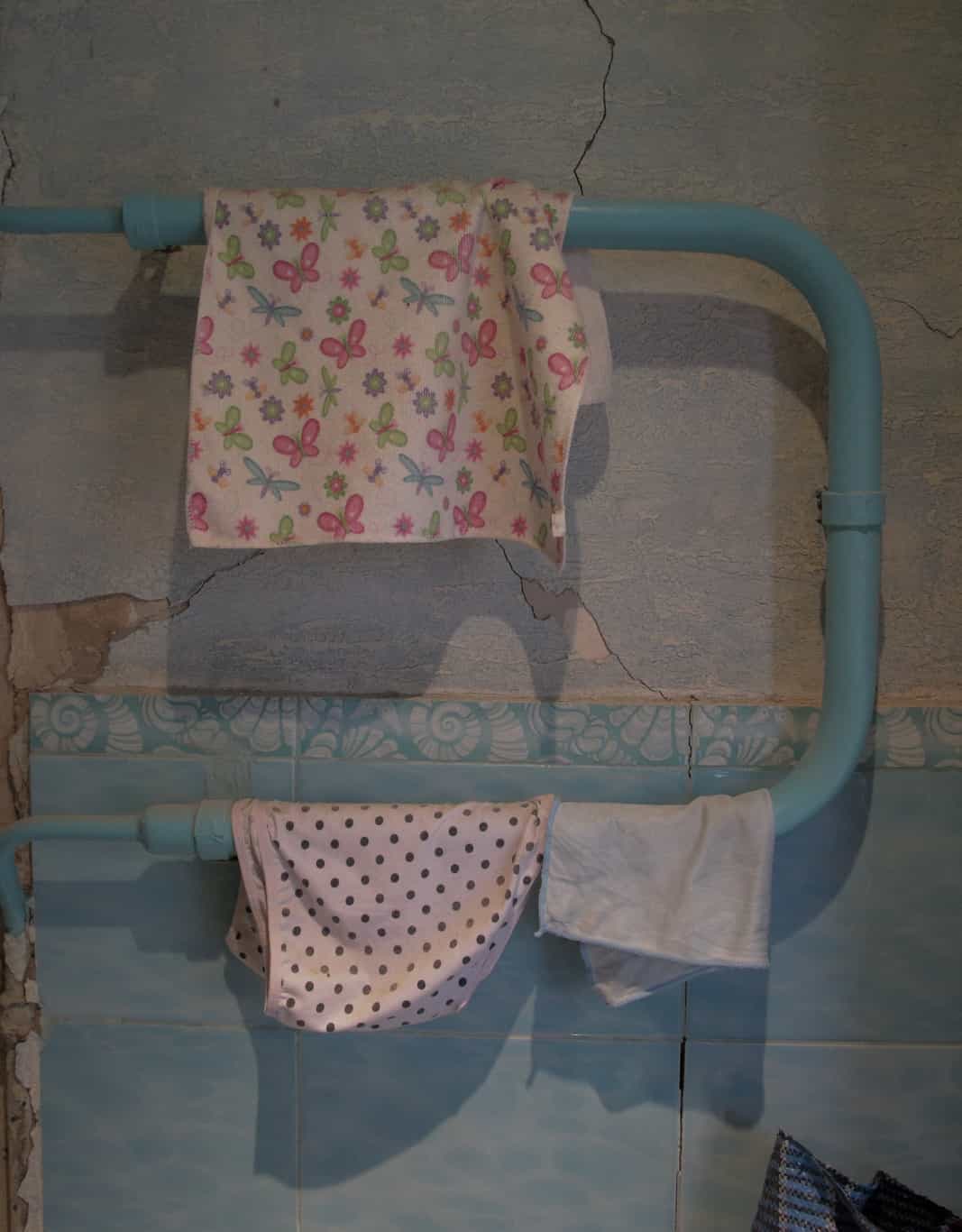
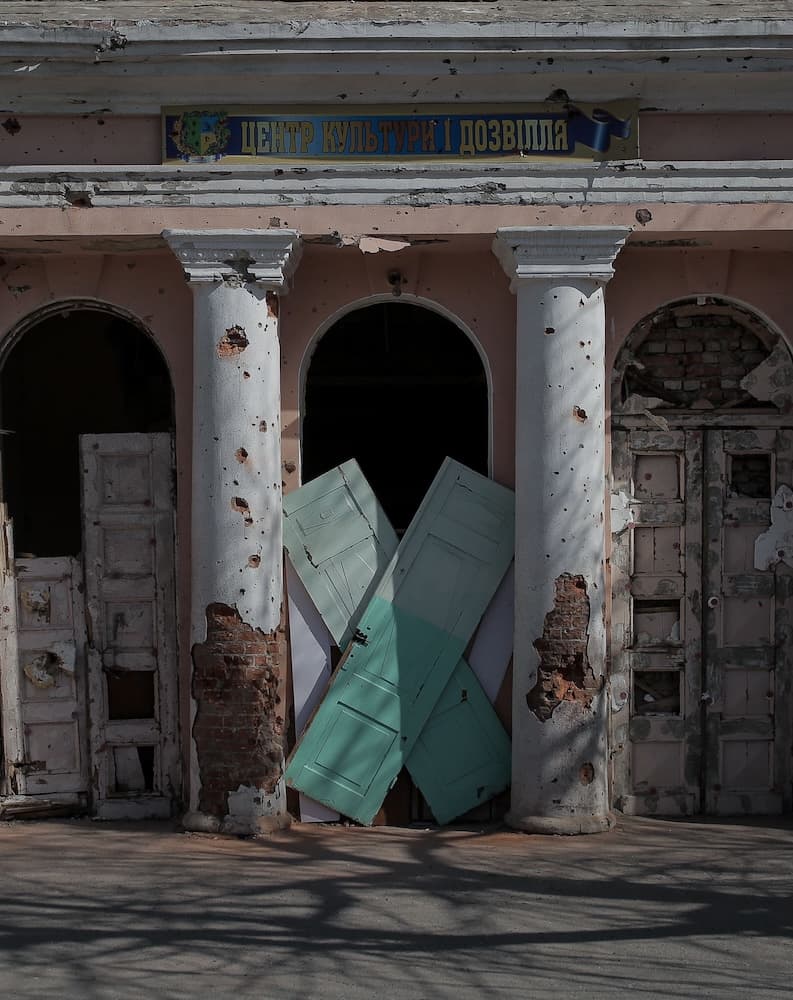
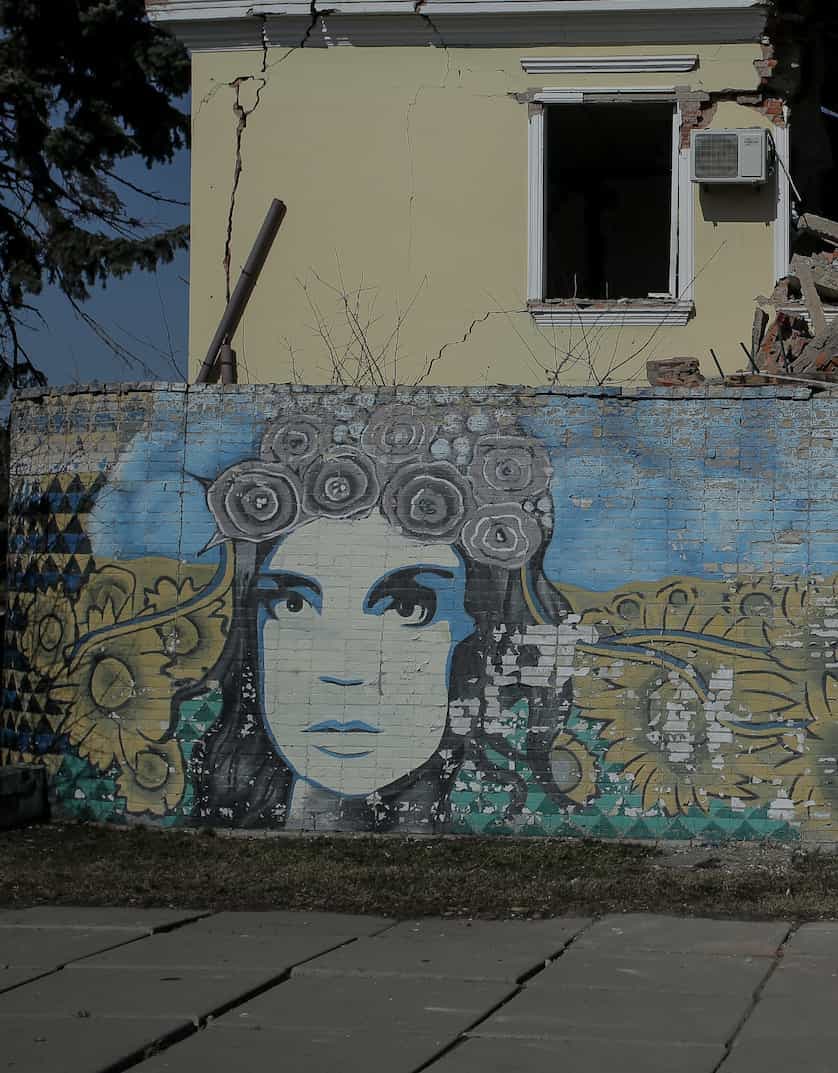
Other Testimonies from the Archive
- Recording
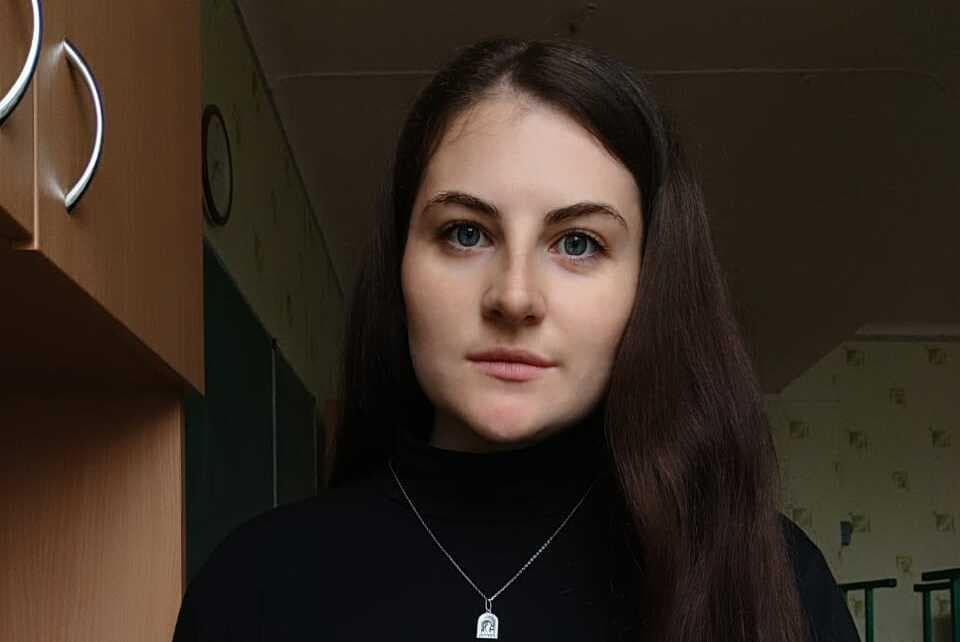
They forced us to kiss their flag and the St. George’s ribbon
A school teacher was taken into Russian captivity, returned, and learned to enjoy life again
Viktoriia Andrusha12/23/22 - Recording
The occupiers act like they’re tsars
A resident of Kherson on life in an occupied city
Panteleimon Onopchenko08/08/22 - Text
I really don’t know what they expected
Residents of Kherson on the first months of life in an occupied city
Anonymous03/22/22 - Text
Our city wasn’t especially patriotic, but now people understand
A woman on what life is like in occupied Melitopol
Anonymous03/27/22 - Text
A Niva pulled up, they loaded on all our belongings and drove off
A resident of Trostianetson on looting by Russian soldiers
Anonymous04/05/22 - Text
She was dying for about 40 minutes. When it quietened down, I broke down sobbing — I’d never heard a person die
Another testimony from Bucha
Kseniia04/08/22