Instagram Post Text
Attention! Translation was done using AI, mistakes are possible
In early February, they started mentally preparing us for war in the “DPR.” Local Telegram channels and Russian media were reporting that sabotage and reconnaissance groups and partisans were mining everything. Then in Donetsk, they blew up an old UAZ vehicle and passed it off as a local official’s car; in Rostov Oblast, they supposedly blew up a border guard shack. All of this was blown up into claims that a genocide was taking place. Even though for the past six years we’d been living fairly quietly — only the first two years were truly loud.
On February 15, a statement from a Russian Duma deputy said that Russians were ready to give up their 13th salary for the well-being of the Donbas. I started panicking and bought plane tickets to Yerevan for March. Then on February 18, they announced evacuation and mobilization.
From the start of the mobilization, I stayed home for two months. I chatted with guys in a Telegram group I’d created myself — we discussed how to leave. I watched Volodymyr Zolkin’s channel, where he records interviews with prisoners of war, to understand what kind of people had been captured and to spot anyone I knew.
The prisoners always told the same story: “I was caught when I went out for cigarettes, for food.” The commandant’s office likes to drive around neighborhoods slowly, cruising under buildings, looking for men. Fortunately, I didn’t need to go outside to buy groceries, because I lived with my parents.
Through word of mouth, I learned that the commandant’s office gets paid for every conscripted man. In Donetsk, information about all the inner workings — who to bribe to be left alone — travels that way.
In mid-April, my family and I found a way to get out. We stayed in Rostov Oblast for two or three days, reached the Georgian border, and then made it to Armenia.
When I arrived in Yerevan, I realized I was someone people in Donetsk would listen to. I’m from Donetsk, I’m not biased. The whole time, I hadn’t been living under so-called “Ukrainian propaganda” — I’d seen everything with my own eyes. If I recorded a video about how men in our city are simply being snatched up, about how this is simply the extermination of the city’s population, it could change someone’s mind.
That’s how I started my TikTok. In a day, I could film three or four videos. Mostly I recorded how the mobilization was happening and how to avoid it. I managed to help a few people.
I had a video about salaries and food prices in Donetsk versus Kyiv. I found comparative tables on Google for peacetime and after 2014. I’d take those statistics, narrate a text over them, edit it all together, and insert a screenshot with the data for clarity. I wanted people to draw their own conclusions.
My friend and I made a video about the shelling of the Kyiv district executive committee building in Donetsk, which happened back in February. We concluded that it couldn’t have come from the Ukrainian-controlled side. A Ukrainian media outlet took it without my permission and re-uploaded it to their YouTube Shorts. It gained traction among the older generation, where there are a lot of pro-Russian types.
People who know my family started calling my relatives, saying what garbage I’d recorded and “this heresy needs to stop.” A fairly high-ranking person among the separatists called to warn that the MGB agents (employees of the “DPR Ministry of State Security” — S.P.) were threatening me.
When the threats started, my parents and I had an honest conversation. I told them that for their sake, I’d stop my activities, but temporarily. They didn’t take it well, but they were relieved that I’d cleaned everything up (Daniil deleted most of the TikTok videos, but the video that provoked the threats is still on YouTube — S.P.). My parents believe that one person can’t change anything — it’s all decided by the big politicians.
In 2014, my parents and I rarely discussed the political side of things. We were afraid that our apartment would get hit, that someone would be hurt. Who was right and who was wrong — that wasn’t really interesting to us.
In Donetsk, there were both pro-Ukrainian and pro-Russian rallies. I was in sixth grade at the time and I was annoyed that they blocked my way home.
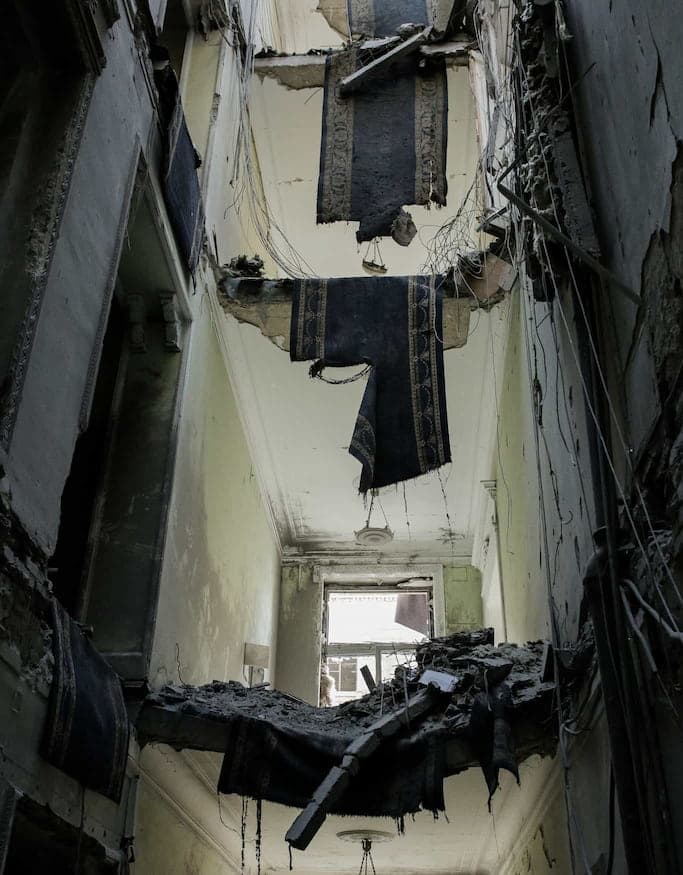
The scariest moment for me was in August 2014, when some of our property was destroyed by a shell. The second moment was in February 2017, when an explosion happened near our apartment.
After school, I wanted to study in the Czech Republic or Armenia. But my parents wouldn’t let me go to Europe — they said I’d be too far away and they wouldn’t be able to help me. So I enrolled in a university in Donetsk.
I don’t consider it all that terrible. I was lucky with my classmates and professors. For example, my professors helped me find remote work in Europe.
My school had fairly progressive views. They issued us Russian history textbooks, and the teacher would say: “Throw out this garbage — we’re going to study properly.” When we discussed the Battle of Kursk, he’d say that this turning point was an achievement of the entire Soviet army, not just the Russian one, as the Russian textbook claimed.
Until 2016, I watched Anatoliy Shariy’s YouTube videos obsessively (a pro-Russian propagandist — S.P.). Under the influence of propaganda, I held completely pro-Russian views. Then I stumbled upon a Ukrainian blogger with a different perspective, Oleksiy “itpedia” Shevtsov. Thanks to him, I started noticing the problems around me.
My city, after 2014, instead of developing at the same pace as Kyiv or Kharkiv, was dying — and is still dying. At first it wasn’t so noticeable, but after 2017, the corpse started to rot. That’s when Ukrainian goods stopped being delivered and cooperation with Ukrainian enterprises ceased. It was deeply painful to watch.
My parents ended up in Ukraine in the 1990s because of the war in Armenia. They fled one war and ended up in another. In 2015, we could have emigrated to Germany, but my parents felt differently about it. After February 24, we had an absolute consensus: we needed to leave.
In Armenia, both Russian and Ukrainian Armenians equally feel like outsiders. We’ve absorbed a culture that’s too Europeanized, while people here are quite conservative. So it’s a bit difficult here, but it’s better than being in the occupation with the risk of being sent to the front and killed.
I wouldn’t call Armenia fiercely pro-Russian. People here have different views. It’s not the “DPR,” where the central square has banners reading “Russian Donbas” and “Our choice is Russia.”
I’m an Armenian who was born in Ukraine — a Ukrainian Armenian. After February 24, I became much more Ukrainian in my identity. One of my homelands is being destroyed. After the war, I plan to live and work there, so that my taxes go toward its rebuilding.