Instagram Post Text
Attention! Translation was done using AI, mistakes are possible
My mom is 84. I really wanted my parents to move in with me — I’d been asking since before 2014 — but they flatly refused. They have a three-story house. My father would say: “I’m staying here, all my people are buried here, this is our land. What have I forgotten in Tbilisi?”
Dad died last September, and Mom was left alone. I wanted to come to my father’s funeral, but the Ukrainian side didn’t grant me an electronic pass (permission to enter occupied territory — SP). I asked my grandson who lives there to look after Mom — she already has trouble walking and is frail. I sent them money.
Usually I’d call my grandson. He’d say: “Everything’s fine, I fed Grandma.” Sometimes he’d send photos. Then the war started, and it was always: “No connection.” The last time I spoke to Mom on the phone was October or November of last year. Several times I asked relatives, old classmates to check on her. When they came, he (the grandson — SP) said everything was fine, Mom was sleeping or lying down.
For six months I gathered my courage and saved money to get her out. After yet another round of news about shelling, I realized it was now or never. I have patients in Moscow — I treat people in both Russia and Georgia — so I decided to go to Moscow and then to Horlivka through Russian checkpoints.
From Moscow, I got to Rostov-on-Don on BlaBlaCar. There everyone says: “Are you crazy? Nothing goes to Horlivka, they’ve been shelling for two days.” They gave me contacts of volunteers who supposedly help evacuate relatives. A volunteer girl charged 10,000 rubles for transport [from the Russian border] to Makiivka (a satellite city of Donetsk — SP). She took me and three other people — so she earned 40,000.
One person’s war is another person’s goldmine. One bus driver told me he gets tips on where they’re shooting. How? Does Zelensky call? Or Putin? People make money on the fact that others can’t save their loved ones.
They brought me to Makiivka. There used to be a bus from there to Horlivka. Now nothing runs: fighting, mines, crossfire. Only pensioners and looters are left.
From Makiivka to Yenakiieve [40 km], another car took me for 7,000 rubles. I didn’t argue anymore. In Yenakiieve, another driver demanded 20,000 for the trip to Horlivka (another 18 km — SP) and said he needed to pick up more people to cover costs. The ride took 2.5 hours — the road is torn up by tanks and APCs. You could hear shooting in the distance.
Two hours in, they started shooting somewhere nearby, and the driver says: “Get out of the car.” We’re standing in a field of sunflowers. I had to switch on my Donbas mode — I grabbed him by the shoulder and said: “I’ll kill you, you bastard, right here. I got in, I paid, I’m going.” He drove on, dropped me off in Horlivka, and tore off at insane speed. In truth, I was scared. For a second I thought: maybe I should actually go back?
In Horlivka, I went to the local police station. Checkpoints everywhere, everything barricaded with sandbags. I walk in: so and so, I’m here for my mom. The guy in uniform answers: “There’s shelling here — what mom? Do you have kids? Are you nuts? How old is your mom? She’s lived her life.”
I go at him: “Listen here, you jerk!” — I’m in such a state that I don’t care what I say. I talked them into driving me to the house — I wouldn’t have made it alone. Everything’s torn up. At some point we got stuck, the guys barely pushed the car through, I hit my head on the roof, blood’s running.
Already near the house, a police guy asks: “What if she’s already dead?” And then these guys remembered that just yesterday they’d been called to our address because Mom was screaming. When they arrived, they couldn’t hear anything anymore, didn’t break down the door — figured she’d died.
When we pulled up to the house, the Ukrainian side started an offensive. The guy says: “We need to run.” I say: “I’m not leaving without my mom — I traveled all this way.” We broke the gate lock, walk into the yard — our dog’s corpse is lying there, died of starvation.
We approach the house, and I hear: “Daughter! People, help, I’m hungry, I’m dying!” We broke down the door. I walk in, and my heart just stops. How she survived, I don’t know.
She’d been locked in a semi-basement room with a tiny window near the ceiling. The stench was unbearable. Mom barely alive. No toilet, no water. She had a loaf of bread there, which she’d been somehow picking at without teeth. She drank water by raising her hands to the window and cupping it in her palms.
I went up to Mom, wanted to lift her myself. They told me: “What are you doing, she’ll fall apart.” We carefully lifted her together and carried her out. One of the guys said: “If her grandson were here right now, I’d send him straight to the front — I’d empty an entire magazine into him, that scum.”
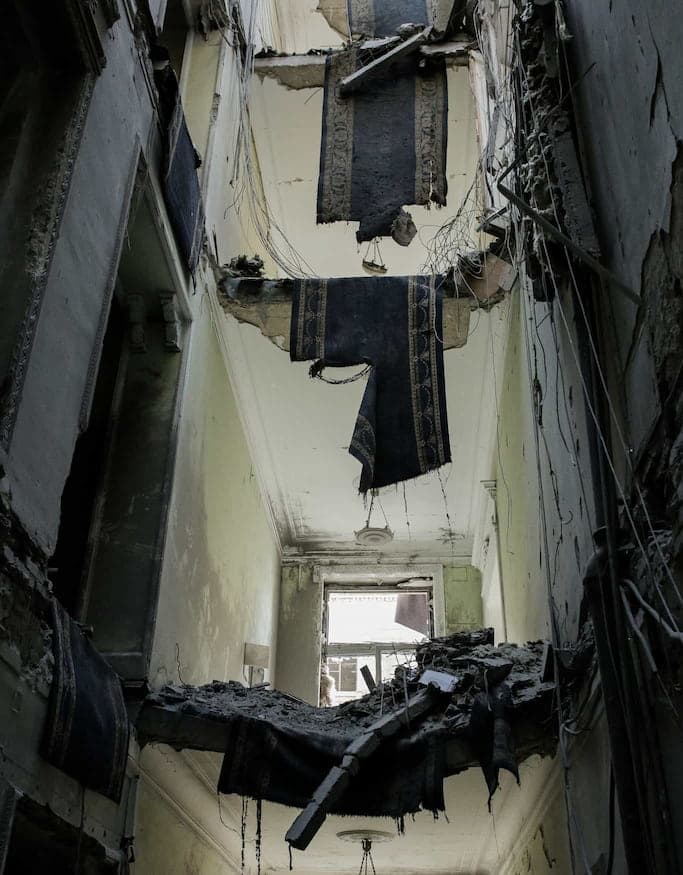
There was nothing left in the house — they’d taken everything: furniture, appliances, the gas stove, even the wrought-iron railings from the porch. And they locked Mom in — who would find out? War’s going on, another old woman died somewhere.
Right as we were leaving with Mom in our arms, shelling started. If the guy hadn’t pushed my head down, I would’ve been hit. But I didn’t understand, didn’t feel anything — at that point I just didn’t care.
We brought Mom to some acquaintances. I wanted to wash her, but there was no water — they’d blown up the water system. We barely scraped some together. Fed her. In the morning, I thought, I’d file charges against him (the grandson — SP). Let the bastard rot in prison. But after sleeping on it, after seeing Mom alive — washed, fed a little — I couldn’t file the charges. I just couldn’t.
God knows what will happen to him. He’s my blood. Apparently he’s living just fine there in Horlivka — bought a house, planning to get married.
The next morning, we headed back with Mom. She has a Ukrainian passport, but only an internal one. I called the Ukrainian embassy in Georgia. They told me: “Go through Verkhny Lars, they’ll let you through” (a checkpoint on the Russia–Georgia border — SP). I told everyone Mom was a refugee.
Complete strangers helped us — let us skip the line, helped push the wheelchair. Nobody asked if she was Russian, Ukrainian, Georgian, Jewish. Nobody searched bags, nobody checked phones. Only those racketeers in cars gouged us for money — they didn’t care that there was a war and people were suffering.
I spent all my money — getting Mom out cost me $2,500. Friends helped me buy a wheelchair, a walker, medicine. I can’t arrange her pension — she doesn’t have a foreign passport. They’ll help me get one faster, because I treated the entire previous consular staff (of the Ukrainian consulate in Georgia — SP). But what about people who don’t have connections like that?
Mom is like a child now — sometimes she doesn’t recognize me, talks nonsense. We make her walk, make her live, I push her around. At night she lies there and every 15 minutes: “People, God, help, I’m dying of hunger, I’m dying, help.” Silence. One, two, three, four, five: “Help, good people, I’m dying of hunger. Lord Jesus Christ, save me.”