Recording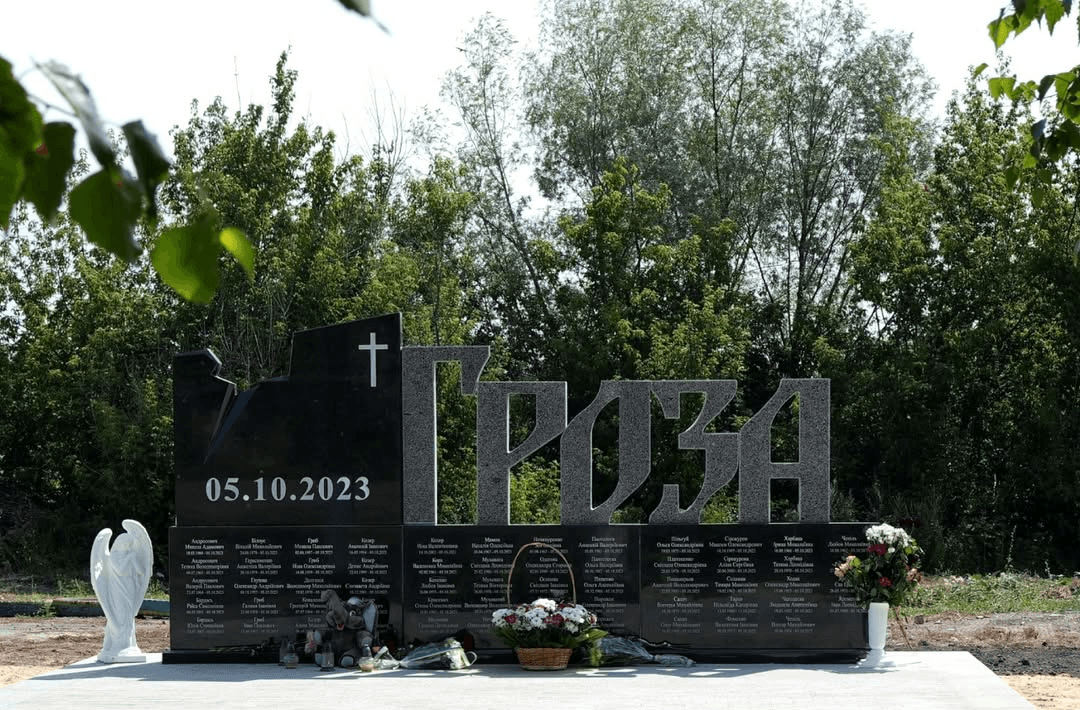
We won’t be here, but it will remind people that a Russian missile hit and killed half the village
A resident of the village of Hroza about the strike that killed 59 people
Volodymyr Bespalyi09/04/24
A resident of the village of Hroza about the Russian strike that killed 59 people
Rescuer Volodymyr Bespalyi had moved with his wife and children to stay with relatives in the village of Hroza. After in the fall of 2023 the Russian military struck a village café, Volodymyr was trying to pull his loved ones from the rubble. The blast was so powerful that one person had their skin completely stripped from them. At the time of the strike, a memorial gathering was being held at the café for a fallen soldier, attended by fellow villagers.
Attention! Translation was done using AI, mistakes are possible
ВБ: Will we be speaking in Russian or in Ukrainian?
АП: In Russian, if possible.
ВБ: Good.
АП: Thank you. Please introduce yourself. Tell me what you do, where you live, how old you are.
ВБ: I am Bespaliy Vladimir Mikhailovich, I serve in the State Emergency Service. I'm 43 years old. I am the son-in-law of the deceased Panteleev Valeriy and Panteleeva Irina; and relative by marriage - brother Anatoliy Panteleev and Panteleeva Olya, who also died there.
АП: I understood you. Tell me, please, can we speak in Russian?
ВБ: Yes-yes-yes.
АП: Thank you.
ВБ: Completely?..
АП: Yes, if possible.
ВБ: I understand.
АП: Am I correct in understanding that you live in Hroza village?
ВБ: Yes, I temporarily live in Hroza village.
АП: And before you lived somewhere else?
ВБ: Before we lived - a military town in Pervomayskoye village. Seven kilometers from here.
АП: How long have you been living in Hroza?
ВБ: Since the beginning of the invasion... Since the beginning of the war.
АП: And why did you move?
ВБ: Well, we fled from there. We fled because of military actions, it was dangerous.
АП: You moved to Hroza because...
ВБ: And Russian military were living there.
АП: And your relatives lived in Hroza, am I understanding correctly?
ВБ: Yes, our relatives lived in Hroza. We lived with mother, Panteleeva Irina Viktorovna, may she rest in peace, well, [mother] of my wife. And when the war began, we fled from there here, to Hroza, because it was unsafe there, there were military there, there were checkpoints. It was very dangerous.
АП: Did you move just you and your wife? Or was someone else with you?
ВБ: With children - with a son and daughter - we moved here.
АП: I understand you. Let's move on to what happened. Please tell me, how did you find out about what happened? What was it? Then I'll ask you clarifying questions.
ВБ: Well look. On the fifth... Well, basically, the whole village probably knew, all of Hroza knew, that there would be a reburial. And supposedly they were gathering about a hundred people to organize a wake for the deceased Andrey. His remains were brought here from Dnipro, if I'm not mistaken.
АП: Yes.
ВБ: For reburial. Well and all the close ones were supposed to gather, all civilians. There were no military there. Of the military, and even then former, Andrey was no longer serving... rather, his son Denis... Oh! Denis, right?
АП: Yes, Denis.
ВБ: Yes, yes. And there was one more - Yaremenko Ivan, he also served, but he was also discharged. That is, there were only civilians there, everyone was civilian, there were no military at all.
And at the appointed time... I don't know what time was appointed there. Well and they were gathering to see him off on his final journey. That is, it was a reburial. They buried him at the cemetery, and everyone headed here, to the cafe. It was set for everyone there. But since everyone didn't fit, such a number of people didn't fit there, it was decided to do it in two shifts. That is, first one part went in, conducted, commemorated. And the second part of people was on the street, near the cafe.
How this information was presented there, in Russia - it's unclear. There are many versions going around, that they were burying an Aidar fighter, and a hundred Aidar fighters were supposedly present, and not civilians actually. Well, nobody knows anything. At that moment, on the fifth I was at work and was already driving home.
АП: And you work somewhere else, somewhere, yes?
ВБ: Well, in Shevchenkovo. Three kilometers from here. Three kilometers - Hroza is located from Shevchenkovo.
I hadn't even left Shevchenkovo yet, I heard a loud explosion. At first I thought it hit Shevchenkovo. And then, looking around, I see black smoke in the direction of Hroza. Then my daughter calls me, crying, says: "Papa, our windows here almost blew out." That is, I understood that it hit somewhere in Hroza.
Naturally, at full speed I flew here, calmed my daughter. I look - black smoke is rising in the direction of the cafe. I - there. I ran there... well and started helping to carry out, whoever was still alive, to drag everyone out of there.
First... Well yes, it turns out, how to prioritize? We were taught to prioritize. Whoever speaks, whoever moves, gives some signs of life - those first of all to pull out.
What were you saying next? What questions do you have there?
АП: Am I correct in understanding that you ran there, to the scene, and there was nobody else there yet, that is, there were no other rescue workers?
ВБ: There was one ambulance there. The first woman - the one who worked in the store - we loaded into a minibus. Some person was driving by there or something. We loaded the first woman into that bus, he drove off, took her to the hospital. I immediately ran up to her, asked: "Do you hear me? Do you hear me?" She says: "Yes, I hear." Then: "Where does it hurt? What hurts?" She: "Arm, leg..." We examined. A tourniquet wasn't needed. Immediately quickly we loaded her into a blanket, into the car, into this minibus - and sent her for emergency medical care.
Then I ran further to another victim - the same thing, asked the question: "Do you hear me? Do you hear me?" He says: "Yes, I hear." - "What hurts? Where does it hurt?" He: "I can't feel my legs, my arm hurts." Well, it became known later that his spine was damaged and his lungs were punctured.
АП: Did he survive?
ВБ: Yes, he survived, he survived. They performed surgery on his lungs, but the question remains: whether he will walk further or not.
Then I saw my mother-in-law, Panteleeva Irina Viktorovna. She was lying on a stretcher near the ambulance. I ran up to her. She didn't hear me, she was mumbling something. She had shrapnel in her right arm. The doctors bandaged her, gave her a painkiller injection and told me, like: "Go further. Everything's normal, she'll live. Go further."
Then I ran to the next woman, she was lying, aunt Galya Taran. I asked her the same question: "Aunt Galya, do you hear me? Do you hear me?" She didn't hear me. Well, I see - she was alive, she was mumbling something. Well, the right side [of the body was damaged]... I see that there was blood on her leg and arm. I called over a free doctor. Well, there were no free ones there. There was just panic among everyone. Nobody understood what to do and where to run.
Then I ran further - there, inside the cafe itself. Part was burning, part wasn't burning, everything was in dust. Then someone brought a bucket of water. We ran there with this bucket of water, deeper, further, where exactly the kitchen was located in the cafe. Naturally everything was covered in bodies, everything was just in bodies. And we heard a voice - well, someone calling for help.
Right then our firefighters arrived, the State Emergency Service. We already started, it turns out, to dismantle everything, to clear it. We started pouring water on that section where there was a fire. And we started advancing there - where the voice was coming from: "Help... Help..." We got closer there. A block was lying there - well, weighing probably about a ton. We rolled it over with special... such fire crowbars, with their help we rolled over this big block. One. Then - a second one, a bit smaller. We saw this Galya. We applied a tourniquet to her arm, because she had a lacerated wound on her right arm. In front of her we pulled out the corpse of Osipova Svetlana...
АП: Can you tell me who that is?
ВБ: Osipova Svetlana? They asked her, she was cooking food there, at this wake. She's not a worker at the bar, nowhere, nothing, they just asked her to cook food.
Well, first we pulled her out. We were pulling her out together with her husband, Sergey Osipov. Well, it was already clear that she was no longer alive, because the body was severely mutilated. We carried out Svetlana Osipova. Then we got this Galya, alive, pulled her out on a stretcher.
Under Galya was Olya Panteleeva. She was still talking to me before this, she was still alive. Well, while we were getting to them, she, unfortunately, bled out. We carried her out. I called, again, immediately doctors from emergency medical aid. They ran up, conducted an examination of the person and pronounced death. She bled out, she's not alive.
АП: So she was also your relative?
ВБ: Yes-yes-yes. She, it turns out, is the wife of my wife's blood brother. Right. Then...
АП: Did she recognize you?
ВБ: Yes, she recognized me. When she was still under the rubble, she recognized me. She was screaming, yes: "Help... Help..."
Then we already started clearing the rubble. We got out whole bodies first. Then - fragments, large fragments. Then - small fragments. Well, very many remains. Very many remains.
Then I saw a child, he was lying near the fence, we carried him out. He was then covered with a jacket. Near the child lay my father-in-law, Panteleev Valeriy Aleksandrovich. He didn't have the upper part of his head, only the lower jaw was there. I recognized him... identified him by his false teeth, he had false teeth. And in his pocket were his favorite candies - lollipops. Car keys were still there. Well, I understand the police confiscated them. All the nearby cars that were there - people had driven cars [to the wake] - were crushed by the blast wave. Crushed from above and from the sides, like crackers. Horror...
АП: How much time did you spend there, clearing?
ВБ: Until the end. Until the last victim.
АП: Am I understanding correctly that at first you were the only person, except for the doctors? That is, there were ambulance doctors and there was you?
ВБ: There was me, some people who lived there, in Hroza, emergency medical services. And some military personnel were there, they also helped.
АП: And the military personnel from where? They came from somewhere?
ВБ: They came from somewhere, yes. Well, there are many here...
АП: What happened next - after you cleared everything?
ВБ: Well, we cleared for a long time. We collected body remains for a long time, very long. There were very many of them: fingers, hands, legs, ears. We even pulled out - well, you understand approximately - an ordinary bucket, ten-liter - half a bucket of human skin. Such was the force of the impact that it completely tore the skin off someone.
АП: And it was thrown into the bucket?
ВБ: No, not into the bucket. It was lying under the rubble. I already put it in the bucket. Well, we carried out remains with a bucket.
АП: Sounds simply monstrous.
ВБ: Monstrous, yes. Everything there was monstrous. Well, they say they found who guided the missile.
АП: Do you know these people?
ВБ: Yes, they were here. Well, these Mamons, two brothers, they're normal. They wouldn't do such a thing, of course. But the third Mamon, Vladimir - he, of course, could do such a thing.
АП: Can you tell me a bit more about them?
ВБ: More? Well, their father is Mamon Sergey. He worked all his life in the collective farm here, worked on a fuel truck, worked on a tractor, drove the collective farm chairman here. He worked the land, he had a farm, kept pigs.
Sons... The eldest studied to be a police officer. In police, in short. He graduated from police academy, I think, in Kharkiv. He worked in the internal affairs department in Kupiansk. The younger one finished technical college and after technical college went to police school. Well, they liked to play cards for money. Everything that young people like, that's what they did - rode cars, motorcycles.
Then, when Russia came, they went to work for Russia - they were at checkpoints, in police. They thought that Ukraine wouldn't return and, like, Russia would be forever. And they immediately found work for themselves.
АП: All three?
ВБ: No, two. Father Sergey, he didn't work for Russia.
АП: You just said that you think it's the youngest. You mean - the youngest of the brothers, yes?
ВБ: No, this is the oldest. This is from his first marriage, Sergey's - Vladimir, this son.
АП: And he's also in police?
ВБ: Yes, he also worked in police. Where exactly - I don't know. But I know that he definitely worked in police. And then, when Russia was with us, he also worked here in our police, in Shevchenkovo, under Russia.
АП: Why do you think it's him?
ВБ: Well, because he behaved improperly here under Russia, when he commanded here, drove around. You understand? There were many complaints about him.
АП: He himself doesn't live in the village?
ВБ: No, and he never lived here.
АП: So his father is just from this village?
ВБ: Yes-yes, his father and brothers are from this village.
АП: I would like to return to the deceased. You told about several people you recognized. Am I understanding correctly that you communicated quite closely and knew quite many people in Hroza?
ВБ: Well yes. Well I didn't recognize many, I'll tell you, because everyone was shriveled, bodies withered. You know, such a feeling, like a sharp flash - and a person squints sharply. Well, in that sense - all bodies were lying shriveled, sharply squinted.
АП: You mean that everyone had squinted eyes, tense faces?
ВБ: Yes-yes-yes. Well, such constrained. Like, you know, to suddenly frighten a person - boom! - and the self-preservation instinct, let's say, kicks in.
АП: You started telling about Galya, whom you pulled out, who was alive. And who is she? Can you tell a bit more about her?
ВБ: Well, she lived near the cafe... lives, rather. And the same thing - they asked her. There were three women who cooked food for this wake: Galya, Sveta and Olya. The three of them cooked food. And from these three cooks, it turns out, only one survived - thanks to these two, because one was on top, and the other below, and she was - Galya - in the center, between them. Maybe that's what saved her life.
АП: And what did she generally do? Did she work somewhere?
ВБ: No, she didn't work anywhere. She's a housewife. She was at home.
АП: You said that the husband of one of the women came and helped pull her out.
ВБ: He ran up, yes. When he heard the explosion, he also ran up, just like me approximately, at the same time. And we cleared rubble there together.
АП: And what's his name?
ВБ: Sergey Osipov.
АП: His wife died?
ВБ: Yes.
АП: And why wasn't he at the funeral himself?
ВБ: He was.
АП: He was, but he survived, it turns out? Or how?
ВБ: Ah, why specifically he wasn't at the funeral?
АП: Yes.
ВБ: I don't know, I'll honestly tell you. I don't have this information. I don't know why he wasn't there. Fate spared many there. And you know - how?
АП: Tell me.
ВБ: One, so... Korkh is the surname. His wife survived, she's now lying in the hospital. There, as I told you, they divided into two groups. One group went in, eating, and the other group waited on the street while the first group ate. And he was in the second group. He just got tired of waiting for them to call the second group, and he went home. He survived.
Then - the second one, Igor Krivobород. He came there, he was there. They called him from the collective farm - like he needs to go, bring grain for sowing. He left from there and went to get a car and haul grain for sowing, to the field.
Then, further - aunt Natasha Kozyr with uncle Vitya. This is the blood sister of my mother-in-law, Panteleeva Irina Viktorovna, who died. They also were supposed to go there, but they didn't make it. They were milking cows. Farm work, in short, feeding. They were hurrying, wanted to do all this quickly and go there, to the cafe. And already when they were walking there, to the cafe, on the way they heard and saw this explosion. It also saved them that they fed the farm for a long time.
Then, further... Who else told stories there? Got mixed up in my head. Well, many more told how they didn't get there due to certain circumstances. There would have been at least twenty more people. Ah, also Kozyr Valeriy and Lyuba - these are the parents of Olya Panteleeva, who has children, four remain. They also were getting ready, but they didn't let him off work, uncle Valera. And aunt Lyuba, in short, had a leg, something with her leg, she didn't go. Although both were getting ready to go there too.
АП: And were you planning to go?
ВБ: No. I didn't know this Andrey Kozyr very well.
АП: And your wife also didn't go?
ВБ: My wife knew [him] well, but it so happened that she didn't go.
АП: But she was planning to?
ВБ: Well - 50/50. Both yes and no.
АП: What was it like for you to encounter all this? It's clear that for work, probably, such cases happen quite often for you, but here almost everyone was acquainted.
ВБ: What was it like? To be honest, like a dream, a terrible dream. And you can't wake up, believe all this. At this moment now it's like that. There are no other explanations for all this at all. There I pulled everyone out on adrenaline, worked. There was no time to think at all, everything went by minutes. First of all I wanted, of course, to help everyone. That's all. Help everyone...
АП: You knew very many. Can you tell me a bit more about the deceased who were close to you?
ВБ: Well, mother-in-law - Panteleeva Irina Viktorovna, may she rest in peace - she was a housewife all her life, worked the farm. She at one time, when she was young, was head of a farm. She knew everything about cows - from A to Z. And even she herself kept them, at home she had a farm, cows.
Panteleev Valeriy Aleksandrovich, may he rest in peace, father-in-law - he was a driver all his life, all his life behind the wheel in the collective farm. Then he retired. Then, after retirement, he worked in Kharkiv, "Roganskaya" company, they hauled water around the city to people.
Anatoliy Panteleev - this is their son, my wife's brother, the deceased, may he rest in peace. He worked here, in Hroza, for his uncle. He slaughtered pigs. They bought pigs, slaughtered pigs and delivered meat to stores, to outlets. Well and delivered goods to stores. Again, to this same store, to this cafe he delivered goods.
Olya Panteleeva, may she rest in peace, his wife, Tolik's, she was a housewife. Well, a good housewife - always baking, cooking, cooked very deliciously. Always smiling. When needed - she helped the girls in the cafe cook too. The girls constantly had bachelorette parties here, in Hroza. You can look on the internet. They had bachelorette parties - 15-20 girls gathered constantly themselves, without men. They partied one hundred percent.
АП: They had such parties in the cafe, yes?
ВБ: Yes, in the cafe, near the cafe, on the street.
Many are missing there, of course, many are gone. And there are still many unidentified. They're now identifying by DNA analysis. And they'll be doing it for a long time still...
АП: I know that a child died. Who was it?
ВБ: Yes. I understand this is Kozyr Igor's son. Well, I saw him as he was lying. On him... the child was whole. I understand he was on the street, standing at that moment, the blast wave threw him.
АП: Am I understanding correctly that these Kozyrs - they're not relatives of Denis and Andrey?
ВБ: No, just people with the same surname. There are many people with the same surname here.
АП: Please tell me what happened next after people were identified? As I understand, the funerals were several days in a row?
ВБ: Until now. Both today and yesterday there were funerals, and the day before yesterday. The first funerals were the next day. That is - the sixth, seventh, eighth, ninth... What's today?
АП: The eleventh.
ВБ: The eleventh? Today there were funerals. Practically every day they bury. Yesterday we buried at the cemetery... Now. Six, seven, eight, nine, ten... Ten people.
АП: And the funerals still haven't ended?
ВБ: No, there are still many unidentified bodies even. Well, if 52 people died... I don't even know. I don't know how many have already been buried.
АП: Do you go to each one?
ВБ: 40 graves were dug in our presence. This is besides ours. We dug separately.
АП: What do you mean - "besides ours"?
ВБ: Well, 40 graves were dug separately. That is, a section at the cemetery was cleared, there were 40 graves. Plus these ten people, we buried yesterday.
АП: I don't quite understand. These ten separately? That is, someone else dug graves?
ВБ: Well yes. For us - separately. A funeral bureau dug for us, we hired separately. And there they dug 40 graves with a tractor.
АП: And these ten - these are your relatives, you mean?
ВБ: Neighbors, relatives, yes. It turns out, these four graves are ours: father-in-law with mother-in-law, and next to them their neighbors - Pirozhok Aleksandr and Pirozhok Tatyana. They lived together nearby, and they buried them together. It turned out like that - nearby.
АП: I understand that it's probably difficult to answer, but how do the funerals go? How do people generally hold up in the village?
ВБ: It's better not to see such a thing. Now my daughter is sitting nearby, I can't tell you anything in front of her.
АП: Maybe I'll call you back later then, to talk?
ВБ: Well let's do it later then, yes.
АП: What time should I call you?
ВБ: Well let's do it in the evening. We'll do homework now.
АП: Yes, of course. Write then when it's more convenient, I'll call you. Thank you.
ВБ: Good.
АП: Goodbye.
ВБ: Let's do that. Goodbye.
A resident of Dnipro remembers his wife, killed in Dnipro in a strike on an apartment building
An resident of Izium on life under occupation, her husband’s death, and evacuation
A Ukrainian man lost seven family members in one day. He couldn’t bury them for over a year
A pregnant woman and her husband survived under the rubble of their home in Zaporizhzhia
A teacher lost his wife and two children in the shelling of their home in Dnipro

A coach pulled his former student from a building destroyed by a missile in Dnipro