Everyone was lucky except for the girl whose baby was suffocated. He was two days old. She was in the postpartum ward, farther away from me.
Before that, we’d been full to capacity, but as it happened, everyone had been discharged. We try not to keep patients in the wards too long now.
When the first rocket hit, I was in my on-call room, in the maternity ward on the second floor. I walked over to the window to see where the strike had landed. Couldn’t see anything. Sat down on the cot, picked up my phone to call my brother and ask if everyone at home was safe.
That’s when the explosion hit the maternity hospital directly. It was incredibly loud, with a bright flash that singed me. Everything was immediately buried under debris.
When I was trapped, I couldn’t tell if they’d find me or not. Somewhere far away, I could hear the screams of that girl with the baby. I could hear her clearly, she was yelling: “Ryatuite moyu dytynu!” Save my child. That’s in Ukrainian.
I realized they’d gotten her out, because she stopped screaming. Then all voices went quiet for a while. Then from somewhere came a voice: “Is anyone here?”
I yelled as loud as I could so they’d hear me. I’m afraid of enclosed spaces, and here I was lying as if in a grave. There was that Hollywood movie where a guy was buried alive. At least he could move his hands — I couldn’t move anything. Only my right hand moved slightly; I could clench it into a fist.
The rescuers heard me and started digging me out, but it took a very long time. I don’t know how much time passed.
What were my first thoughts under the rubble? I’m alive — that’s good. I can feel my arms and legs — so my spine is intact. And the most important thing: I desperately wanted to live.
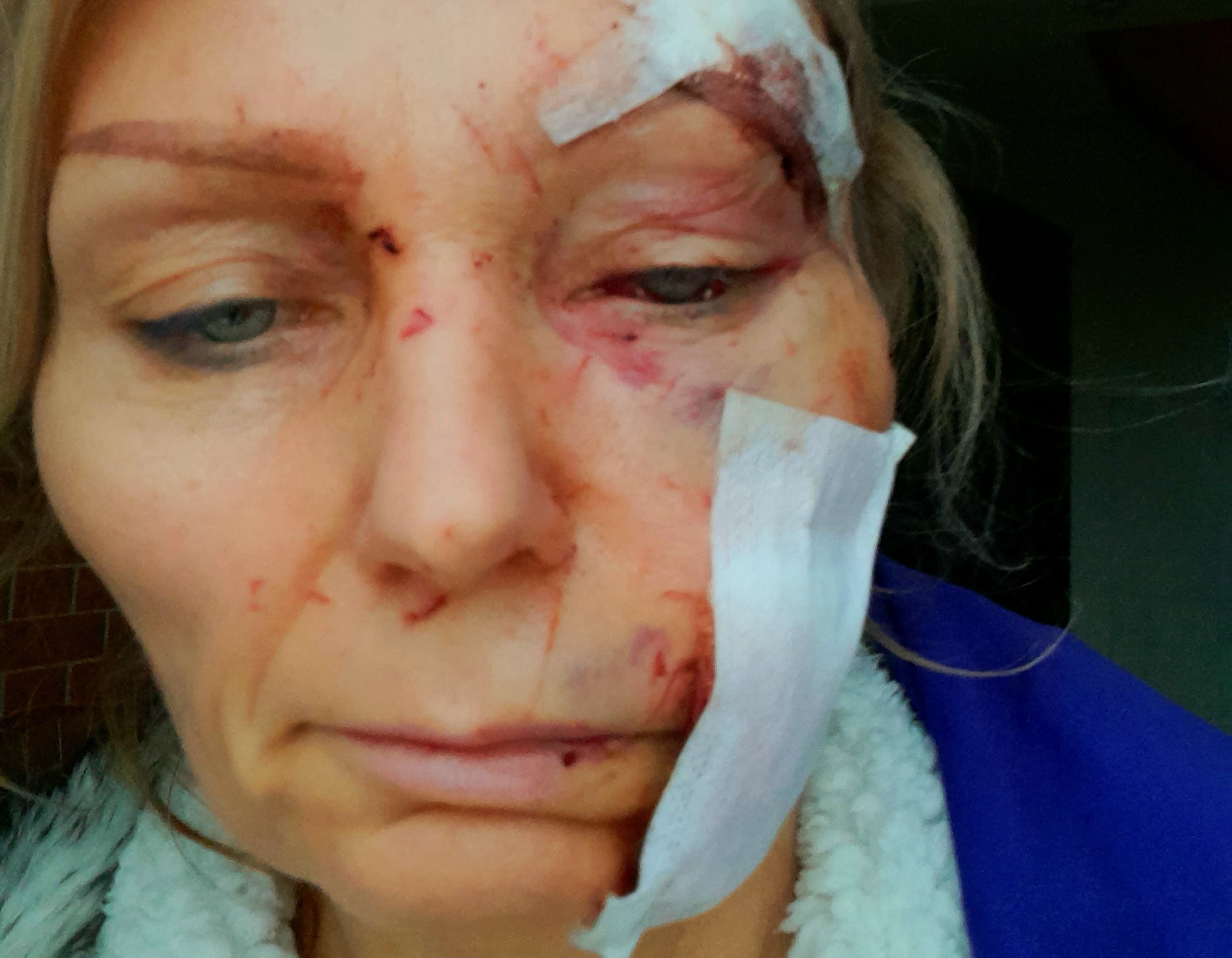
I never lost consciousness. I could feel the burns — my entire body and face were burning unbearably. Tiny scorching stones were searing into me. And on top of being terrified that they won’t find you and you’ll die, these stupid little pebbles are heating you from every side.
I was overjoyed when I heard the voice of my friend Roma, who works for the State Emergency Service. I hear Roma saying: “Guys, dig faster — that’s my friend.”
They carried me on a stretcher to the emergency room of our hospital. They cut off my clothes, examined the injuries, washed off what they could. They called a resuscitation team and took me to Zaporizhzhia, to the burn center.
Right after the explosion, absolutely all my colleagues came. Our head of department, Maryna Hryhorivna, was probably the first to point out where I might be.
In that wing, there were me, a midwife, a nurse’s aide, and the mother with her baby. The midwife and nurse’s aide were in the delivery rooms — where births actually happen. That’s what saved them.
The sappers who were at the explosion site said that people don’t survive after a rocket like that. Before that, the same kind of rocket had hit a residential building in our city. Ten people died — nothing was left of the building.
I don’t go to church, but I believe something was protecting me — I had a small cardboard icon of the Holy Mother, the one I was baptized with. I’d been carrying it with me since the start of the war. They didn’t find it; it stayed somewhere in there.
My Ukrainian flag survived. As soon as the war started, I’d hung a large flag in my on-call room. It was covered in dirt and soot, of course, but it survived. They carried me into the emergency room, and one of the rescuers says: “Here, the flag survived too.”
I’m going to take that flag to Crimea when it’s liberated. I’ll attach some flagpole to my car and drive with it all the way to Crimea.
I really want to see my dog. I miss her.
I have a French bulldog. My dad mostly takes care of her — walks her, feeds her. My phone was lost under the rubble. I had a ton of videos of her on it.
Right now, I need to recover first, because I can barely stand up. I have burns over 37% of my body, and they’re going to operate on my arm — there’s a large open wound there.
My colleagues told me the maternity hospital is being moved to the pediatric ward’s building. There are no walls left — nothing. It was like a second home for me, and now it’s gone.
This is a hospital into which the chief physician had put an enormous amount of work. Next to me was the hysteroscopy room (a method of examining the uterine cavity — S.P.) — it had literally been operating for two or three months. We’d specially traveled to Kyiv for courses and gotten our certifications. Expensive equipment had been purchased for performing surgeries.
And now they took all of that and destroyed it. I hope victory comes soon, and the scum who are doing this will answer for everything.
The smell of rocket fuel — or whatever propellant they used for that monstrous rocket — I will remember for the rest of my life.
The most revolting smell you can ever encounter. It’s like some chemical substance. A nauseating, sweet smell. I’d never encountered anything like it in my life, and I never want to again.
I never thought something could happen to me. I always knew I’d live a long life and everything would be fine. This situation changed something. Now I’m constantly afraid that another strike will come.