Text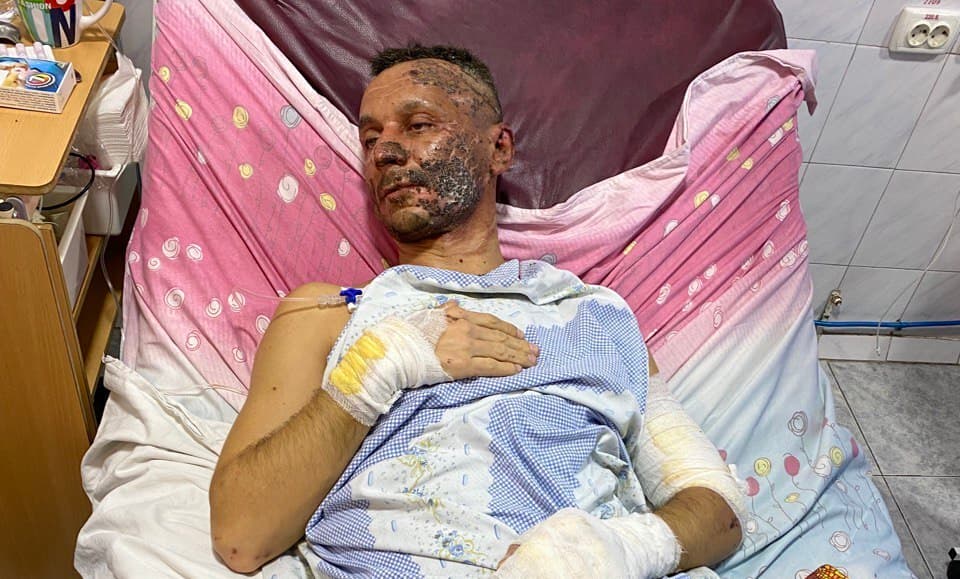
37% burns, a large laceration
A doctor survived a missile strike on a maternity hospital
Andrii Kozyn11/29/22
An obstetrician-gynecologist survived under rubble during the shelling of a maternity hospital in Vilniansk. His story continues two years later
On June 29, 2022, Russia shelled the maternity hospital in Vilniansk, Zaporizhzhia Oblast. Obstetrician and gynecologist Andrii Kozyn was trapped under the rubble. He was rescued, but his left hand was seriously damaged, preventing him from working fully. He was unable to undergo further rehabilitation: his father was diagnosed with cancer, and Andrii stayed to help him. Nevertheless, the doctor managed to return to the hospital part-time and found his love.
Attention! Translation was done using AI, mistakes are possible
АК: Andrey Kozin
АП: Anna Pavlova
АП: Hello, Andrey, greetings. Can you talk now?
АК: Yes, I can.
АП: Good, please tell me, how much time do we have if they don't cut off the internet?
АК: Well I don't know, I'm not Jesus Christ.
АП: I understand, you just said that you have lunch break. That's how much, half an hour?
АК: Well, we have half an hour, I think.
АП: I understood. Then I hope that we'll be lucky today and we'll have connection with you. I'm glad to hear you. Glad that you're in good health.
АК: Mutual, yes.
АП: Thank you for agreeing to talk. We last spoke in autumn of [20]22. You were then in the hospital after being wounded, after you were pulled out from under the rubble. Please tell me, did it take you long to come to yourself, did you recover for a long time, how did all this happen?
АК: Well, I haven't fully recovered, I'll tell you right away. I can't operate, perform my functions in full volume, like it was before, because of the left hand. Got wounded and, let's say, the functionality of the hand leaves much to be desired, and very strongly. Movement in the wrist is maximally limited.
АП: And how do you work now then?
АК: Well, how? I get out of the situation, work on ultrasound mainly.
АП: Were you in the hospital for long?
АК: I was in the hospital for about a month, then I had rehabilitation for up to three months, after that MSEK [editor's note: medical-social expert commission] disability group, second one I have, because of all this. Well, then little by little returned to work.
АП: Do you work in the same place as before?
АК: Yes, we work in the same place as before.
АП: As far as I remember, then the hospital, maternity ward was badly damaged. Did they manage to restore it?
АК: Well no, how to restore it? There's no building there, half of the maternity ward remains, and it's not subject to repair, it's probably for demolition. But I don't know, I'm not a specialist in this, I won't assert how and what. But there's not much to restore there, in my opinion.
АП: So now you work in a different building, or how is this all arranged?
АК: Yes, in a different building. The women's consultation moved there. Everything functions for us, except the maternity ward.
АП: And the maternity ward itself, where do they send patients now? To another city?
АК: To Zaporizhzhia - we're close to Zaporizhzhia.
АП: So now, it turns out, there's no maternity ward in the city?
АК: No maternity ward.
АП: How was it for you to return to work?
АК: Well, it's not really pleasant for me to return there every day when you see all this.
АП: You mean when you see the remains of the building?
АК: Well, ruins and what's happening in general now. And that you worked before this, did a bunch [of things], you had a bunch of opportunities, and now you don't have these opportunities.
АП: Because of the trauma, you mean?
АК: You can't do surgery with one hand. Of course, because of the trauma.
АП: I understand that I'm asking some, maybe, obvious questions, but I wouldn't want...
АК: Burns healed in principle, not bad - there are scars on the legs, a little bit on the face, but let's say, the main problem is in the left hand, because it was probably closest [to the explosion site]. It had a big wound, they did plastic surgery on me, sutured this wound. It suffered the most, maybe from compression, I don't know, but I have all the nerves damaged there, those that go to the wrist. I regularly go for rehabilitation to the regional hospital. The doctors there do a lot, but, let's say, first of all, time passes, time works against me, and the possibilities are a little bit not the same. If, for example, to take some foreign rehabilitation centers, there's probably more functionality there.
АП: And wasn't there a possibility to go abroad for treatment?
АК: There wasn't a possibility financially to go abroad, there isn't one in principle now either. I would of course very much like to. I'm trying to find out about this question now, I have relatives abroad, they're also finding out. In principle, they're ready to receive [me] there, they know this whole situation, they're aware, only the possibility to get there should exist.
АП: So you need to find some means now to go abroad?
АК: The question isn't even about means. I don't know how they let [people] through [the border] now in the current situation with current laws. I'm registered. Nobody removed me from military registration. I just have a deferment for disability, I have disability for two years with extension, until [20]25, and I don't know at all whether it's possible now to travel on disability. Because you look at social networks - some say they travel freely, others say you don't travel freely. I'm not hiding from mobilization, I was last at the military commissariat in May, I think. There's a deferment, but how things actually stand at the border, I can't tell you, because I haven't tried. But let's say, at the moment this is my main goal, because physically this is such... I psychologically just can't feel like some kind of invalid. I want to do what I did before this. I want to go to the operating room, want to work the way I worked before this. At least so that it [the hand] starts to move a little bit like it moved before this. My fingers don't move at all, they're clenched. My wrist is completely clenched, the thumb sometimes moves away, the other four - they don't work. How can I go to the operating room if I can't even put a glove on my hand?
АП: I want to believe that you'll manage to go abroad and do something.
АК: I don't plan to go abroad for permanent residence, I want to go so they do everything for me like it was or maximally return to that state, as I'm saying. Because our doctors are great, in principle, no problems at all in the regional hospital, big thanks to them, they got maximally involved in this situation, helped as they could, did everything, but again, this needs time. While you're in rehabilitation, something recovers there a little bit.
It seems they even have muscle stimulators there with electricity, weak currents, something works there. But this needs you to go. For example, they tell me abroad - this [will take] from a month and a half. I don't have the possibility to be in the regional hospital for so long, and they probably don't have such possibilities there. Big flow of people, and I can't be there constantly. They told me, this is a month and a half [might take], maybe two months. They can't tell me how long the rehabilitation period will take.
АП: Am I correct in understanding that you now work as an ultrasound doctor practically with one hand?
АК: Well yes.
АП: Incredible.
АК: Well how else? I don't want to sit at home. I even found a second job in another place, because in the hospital they didn't give me full employment, only gave 0.75 [of a position], said that like because of your limited possibilities you can't work a full position, so I had to look for a second job. I still have a second job. I'll literally stay here at work now and will go to another place to also do ultrasound.
АП: So you work in some other hospital?
АК: I don't want to name this place, it's not a hospital, it's a medical station in certain places.
АП: But you also work there as an ultrasound specialist?
АК: Yes, I work there as an ultrasound specialist, officially, in a state institution, let's say.
АП: In your hospital or where you work, are there other doctors with some wounds received?
АК: No. Where I work, the second doctor with us, she also suffered, she herself is going through this rehabilitation, we sometimes see each other in the regional hospital [for rehabilitation].
АП: Wow, she also works?
АК: Yes, works. She's an anesthesiologist-resuscitator.
АП: So both of you with wounds are working?
АК: Yes.
АП: Incredible. How do patients relate?
АК: Patients all relate well, everyone's glad to see [us]. At least, all my patients whom I treated, operated on, are very glad that I returned.
АП: Am I correct in understanding that after rehabilitation, which is possible to receive abroad, you'll be able to fully return to work?
АК: I very much hope for this. They promise me, say that yes. This disability group, I don't even really want to talk about it, because I don't have understanding that [I'm] some kind of invalid. I want all this to be cured and not to extend anything [editor's note: referring to extending disability status], so that everything turns out normally, so that it's good, like before.
АП: How are things at home? You said something about your father?
АК: Dad, maybe against the background of all these worries, - he's an IDP [editor's note: internally displaced person], everything remained there for him, he came here with one backpack. Probably against the background of this psycho-emotional stress [he got sick]. Just recently we found out. Started losing weight, classic scheme. Tests were done - fourth stage cancer.
АП: Nightmare.
АК: We're doing chemotherapy, without any particularly good improvements. Now, let's say, the tumor stopped, [we managed to] stabilize, it's in one position, but definitely not better and definitely it's not decreasing - somewhere better, somewhere worse it became. With such a stage also you don't have to expect any miracles there.
He also now received a disability group.
АП: Did you find out about this long ago?
АК: Literally a couple of months. He felt bad yesterday. And we had to go for a control tomography.
АП: He lives with you, yes?
АК: Yes.
АП: You said he left with one backpack - did I understand correctly that he lived before in another place?
АК: Well, in Tokmak, yes, near Tokmak.
АП: I see. How do you generally manage to [survive] all this, what supports you in such a situation?
АК: Don't know... Banal faith in Ukraine's victory.
АП: I remember how you planned to drive with a flag [around the country] when victory [comes].
АК: Yes, I planned, and the flag is kept. Only, damn, when all this will happen, it's unclear.
АП: How's your dog?
АК: The dog feels excellent, better than everyone.
АП: If you go abroad, will he go with you?
АК: I don't know, this is a painful question. I'd like to, of course. Who to leave him with here? Of course, he'll go.
АП: What's happening in your city now in general? Judging by what you write, judging by the news, the situation is quite difficult.
АК: Difficult. "Shaheds" fly regularly, rockets fly regularly, sometimes they hit infrastructure objects, literally last week. You probably read the news that in Zaporizhzhia Oblast
an energy worker died. It was not far from us, around five in the morning. Well, we don't really sleep much here.
АП: I understand that there are also problems with communication?
АК: There are problems with communication, because... Well, I'm not some military specialist, I don't know. It seems to me that it's good on one hand, - there will be fewer collaborators and traitors filming something wrong. Well yes, sometimes power outages.
My girl supports me very much, big thanks to her too.
АП: Tell me a bit more in detail, if possible.
АК: I don't really want to talk about this, just big thanks to her. We have big plans for life.
АП: Did you meet already after your wound?
АК: Well, we'd known each other for a long time, because this city is small, and there aren't so many doctors. Yes, we started communicating closely, let's say, after discharge.
АП: She's also a doctor?
АК: No.
АП: You just said there aren't so many doctors, so...
АК: Well, because I also had quite a lot of patients.
АП: She's your patient?
АК: Well, let's say, not my regular patient, but in certain life situations we met.
АП: Wow, incredible. How did you start communicating? Did she come to you in the hospital when you were recovering?
АК: Oh, I didn't want anyone to come to me in the hospital at all, it's not a mausoleum. I don't know how - just like that. Thanks to social networks.
АП: Do you live together, if it's not a secret, or are you planning to marry?
АК: We're planning, but living together [because of] the situation with dad somehow doesn't really work out, in a one-room apartment.
АП: You live with dad just the two of you now?
АК: Well yes, with the dog. My brother came now, also helps. Such a situation with dad...
АП: I remember you told that they were pulling you out from under the rubble and among the rescue workers was your friend.
АК: Yes. I don't know, my friend disappeared somewhere, vanished somewhere. I haven't called him for a long time, don't know at all. Maybe he was also drafted. It's already unclear. Before we saw each other, probably a couple of months ago, he was still here, still working. I don't know the situation now either, because I communicate little with everyone.
АП: I'd like to clarify more about the city. Can one say that people have already gotten used to the war, to what's happening? What condition are the townspeople in generally? Are many leaving? Are there those who are returning?
АК: First of all, I don't keep such statistics. Second, those who left, they left at the very beginning. Some returned, some didn't. We have many people who came from occupied territories. Because the city is not far from Zaporizhzhia, in principle, convenient, with infrastructure, with everything. That there became much fewer people, I can't say. Well, some aren't here, some are. Some returned. Well, by patients, yes, maybe there became fewer.
I don't know how one can get used to this if you periodically have "Star Wars", damn, above your head not far behind the city, this is all perfectly visible. This crap in general, these "Shaheds" fly, buzz periodically almost above your head. So I don't know who got used to this. I can't get used to this. I'm scared.
АП: You said that you don't want to leave permanently if you go for rehabilitation. Did you think about the time when the war will end? Are you planning to stay at your home or did you think...
АК: I didn't plan to go anywhere at all, absolutely. And I don't even have the thought now that I can go somewhere. And what to do somewhere there, I also don't imagine. I have work here that I understand, to which I've already devoted a sufficient amount of time and energy. Let's say, if not for the war, everything would suit me completely.
АП: You said that you have big plans with your beloved. Could you tell about this in a bit more detail?
АК: No, well I'm saying, I wouldn't want to discuss these personal moments at all, but there are big plans. There are plans for life, for the future.
АП: She helps you deal with your problem?
АК: Yes, helps with everything. All kinds of massages there, bending these fingers... Helps with everything.
АП: Probably the last question I'd like to ask, concerning your dad. How possible is it generally now to get some help with oncological diseases in your region?
АК: Well, look, what kind of help? Help can be received, and, in principle, good help can be received. I have, for example, my groupmate, my former class president, oncologist, she helps very much with this question. I understood that with the beginning of the war, help to oncological patients, as I see it, it improved. Zaporizhzhia oncology dispensary, they have everything for chemotherapy, they don't refuse anyone. All the fears that were told about it, there's nothing like that there. The institution changed very much with the arrival of the head doctor, - well I see it like that, at least.
In principle, in the oncology dispensary now conditions are much better both for patients and for doctors, everything's at a good level there. And everything's available, if there was desire. Possibilities [are limited] only in transporting the patient, but otherwise, in principle, there are no problems with this. There are nuances with certain medications, but these are purely personal nuances. We, for example, are treating at the moment not in the oncology dispensary. I just trust my class president, my colleague, my groupmate very much. We're treating with her, she works in a private center. [But] the questions that we needed to solve in Zaporizhzhia oncology dispensary, [we solved], there were no problems at all. Everything was done [there], and can be done now. And I think that a moment will come when we'll turn there purely in connection with financial questions. Because treating, for example, in private centers - it's expensive. But it's not as expensive, for example, as abroad. This is all accessible.
Patients, the only thing is that there are very many. Even the doctors themselves say, colleagues from the oncology dispensary, that in connection with the war the number of patients increased maximally. This concerns not only elderly people, but also very many young people.
АП: And what's this connected with?
АК: Well, first of all, nobody fully revealed the etiology of oncological diseases [editor's note: etiology of disease - causes and conditions of disease occurrence]. I think, stresses, possibly, these missile emissions. You understand, what we breathe now, this also leaves much to be desired. Don't know.
АП: So there really is such a dependency - with the beginning of war the number of patients increased?
АК: What some doctors who work there say - yes. And what I see, what patients come there. That is, we go for chemotherapy, I see, first of all, the flow of these patients, that there are very many of them, and the age group, plus I see these patients here at my place too. You listen - in that family someone died from cancer, in that family someone died from cancer. Well, it's just total, just total.
АП: Are you afraid for your father?
АК: Of course. I'm afraid for everyone. We're all very worried. They also provided help to him there, his community where he lived, and people, acquaintances also provided feasible help. Thanks to everyone for this.
АП: How is he holding up?
АК: He's holding up for now. Holding up, wants to go home very much.
АП: Did he come to you after you were wounded? Or even before that?
АК: No, he left before that. He left even when it was possible to leave through Vasylivka, when they still let people through there. Well he also left like that, damn, - they approached, left only beyond Vasylivka and got under "Grads". Sat there somewhere in a basement beyond Vasylivka. Waited it out. Well, he left literally in a day. They probably drove for 8-10 hours.
АП: Yes, of course, one can only envy your optimism. You tell about all this in such a way.
АК: No, well what optimism? Well just, what to do, right? What options are there? Options to do nothing, not go to work, suffer. Well what options? Also not to live, for example. I don't know. You just say like that - "optimism" - but what... Now everyone has optimism, everyone who's here. Everything works. Well there appeared problems with electricity now - so they're everywhere.
АП: Andrey, thank you very much for the conversation...
АК: I just don't know what to tell you. So that the interview doesn't turn out to be some kind of such that nobody asks me anything for it later, that I said this, didn't say that...
АП: It seems that everything's fine for now, everything you're saying.
АК: I just don't want to illuminate personal life, bring it to the masses. There are quite big plans, logical plans. I have the only question, to manage to leave, because, well these aren't complaints to TCC [editor's note: Territorial recruitment and social support center - agency dealing with military registration and mobilization of population] or something else, but there's a problem in this. They constantly ask you some questions. That is, everyone here knows you, everyone knows where this trauma came from, everyone knows that it's not that you went and paid someone money and they just gave me a [disability] group, and I'm dodging [military service]. Everyone knows this perfectly, but it doesn't really touch anyone, as I see.
Now according to some new laws some certificate from TCC should be needed, but how to get it? And in general it's unclear whether they'll give you or won't give this certificate, I don't imagine at all. I might maybe, if not for dad, I would have already gone. And now I don't know.
АП: You mean [saying] that if not for dad, that you're afraid to leave him and therefore you're not leaving?
АК: Well, first of all, yes. Brother, in principle, can look after him. But at that moment it was necessary to maximally solve with chemotherapy and with diagnosis, with everything. At the moment, in principle, one can leave him here for a couple of months and go.
АП: But you're not going because it's unclear whether you can leave or not?
АК: Well yes. State border service, hotline, says that yes, all this is possible. When people encounter this at the border, then people aren't let out without some reasons. I don't know what other reasons are needed. If by law you're disabled, you can leave. In principle, there should be no questions at all. But it turns out, some questions might be. I updated all this data, I have these VIN codes in "Reserve plus" [editor's note: VIN code - this is an identification code of 19 digits that the Oberig registry automatically assigns to a person liable for military service, conscript or reservist whose data is entered in the system, "Reserve+" - application for those liable for military service]. I don't know what else is needed to do this.
But again, I haven't tried leaving [yet], and in principle, until they tell me exactly [in Europe] that yes, you can come for rehabilitation... This question is also [being resolved]. Just yesterday my sister and I were talking, she's finding out all these moments through volunteers, how it's better to do this, how it's better to come there. From me, let's say, only coming there is required. People there are ready to help - even come tomorrow, lie down in the hospital and we'll restore everything. Well, no questions to them at all.
АП: This is Germany, no?
АК: Well, not quite Germany, I also don't want to say yet. It's close. I had two options - either this or that. But since I have relatives there... She [sister] communicates with volunteers, with everyone. She's already settled there, she left at the very beginning [of full-scale war]. When she left, we took out her mother, my godmother with my own brother, and then literally in a couple of days also took out dad [editor's note: most likely means that the brother helped Andrey take out relatives, but stayed himself]. This was all decided on the phone, and we, it turns out, took everyone out. And what's happening at home... At home also not everything's very good, because everywhere where our property is, they live... [editor's note: "they" refers to Russian military]
АП: You mean "at home" - in the house where your father lived, yes?
АК: Yes, where father, in brother's apartment, in our common house.
АП: In Tokmak?
АК: In our house where I grew up, in the apartment, there was also a hit there. This is, probably, how much? A month ago. In telegrams, everywhere this was all covered. Well not in our apartment, we only have windows there, I understand, that were damaged, and everything.
АП: "They live" - you mean that...
АК: Well, occupiers, orcs. Let's say, for now [for us] to return there... Dad has there, I understand, according to information from a neighbor, everything's being taken out from dad. From my aunt who left, they even cut out the radiators.
АП: Lord, radiators. Why do they need radiators?
АК: Well don't know. They cut dad's fence, he had such a solid fence. Maybe they weld something for their tanks there, - what do they like to weld from them? Some protection from drones, I don't know. But, in short, they cut the fences there.
АП: Nightmare, nightmare. Do you have any connection with neighbors left?
АК: Well this is brother who communicates, he communicates, dad calls neighbors, they tell about all this "wonderful" life.
АП: Nightmare.
АК: People there also got used to it. Everyone can be understood. They [dad and brother] left, they have essentially nothing here, but everything remained there. Everything that was earned over long years.
АП: Nightmare. I wanted to clarify the last detail. When I asked you about oncological clinics, you said that the situation since the beginning of war improved greatly. Did I understand correctly that it improved precisely compared to the beginning of war?
АК: No. This is only my subjective view. When we studied at university, this was 2008-9-10, what I saw then when we had practice, and what I saw now, this is heaven and earth. It pulled up to good private clinics. I know that they changed management there, but this, in my opinion was before the war, still during covid times. That is, the dispensary shows itself at a good level now in general. And they really have everything in medications, that is if a person got sick, there's no such thing like before that you should go buy everything for your own [money]. All their chemotherapy, this is really free, you can go get treated. In this regard the oncology dispensary, like the regional hospital too... How much I've been treated there, everything's free, nobody demands anything from you, they give medications for free. In this regard everything's excellent. In principle, like everywhere, like in our hospital there's also a lot.
I don't know what war is going on there now with joining to the regional hospital. I don't know this, I don't delve into these nuances, but the oncology dispensary now, in principle, is a very good organization that really helps people. My friends work there who also live in Vilniansk. In principle, they also helped with dad, at least, solved these questions. They're maximally satisfied with the clinic and the clinic really transformed from that moment [when I came there for practice].
АП: Andrey, thank you very much for the conversation. I was glad to hear you. We were lucky that we weren't interrupted, and I very much hope that you'll manage to go abroad for treatment after all. Please keep [us] informed.
АК: Well, I have the only problem, just to go so that they cure you there and you can normally return, work normally, like it was before that. Because what exists now, this doesn't suit me at all. I can't walk around with the hand of some crab. This already bothers me, honestly. Such a situation that you walk and hide because you're ashamed to show it to someone.
[...]
I don't know how it will be. Of course I'd like it to work out to leave, so they do everything right there for you. And here I'll finish treatment in the regional hospital. Because everyone there is also glad to see me and waiting. I just don't have time for all this now. I have a second job, I need to work. I'd be glad to go to them too. I was supposed to go in May for repeat rehabilitation, - well, for the next one, not repeat, I've had enough of them already. I couldn't just because of family problems, in connection with dad's illness. So I didn't go.
АП: Wait, you mean for rehabilitation you were supposed to go abroad or?..
АК: No, to the regional hospital. I need to go there at least every two-three months. They have an apparatus there, analogs of which probably don't exist. There's an apparatus there that was invented, I don't remember by whom. They told me the story - there are only, in my opinion, two left in all of Ukraine. Special currents are developed there. Well, in short, this is an apparatus that really works, this is tested on myself. It really works, really restores innervation [editor's note: innervation - providing organs and tissues of living organisms with connection to the central nervous system through nerves]. Very cool thing.
АП: But you didn't manage to go there in the end?
АК: I couldn't go because dad got sick. It's just impossible for me to do this. For now like this.
АП: We'll stay in touch. I hope that everything will work out. I understand that this is such, maybe, a painful moment, but if you have some photographs that you're ready to share, your current ones, please send them.
АК: I don't really have such photographs. There's nothing to photograph. Everything healed, burns healed great in general. Thanks to the fifth hospital [editor's note: Fifth City Hospital of Emergency and Urgent Medical Care in Zaporizhzhia]. There, of course, also maximally knowledgeable doctors. Sekh Andrey Vasilievich, head of department, he's just great. He treated so well that... Didn't even need to do a transplant, because I have 37% burn surface, and, in principle, everything healed maximally, just maximally well healed. Those who say that there's bad medicine in Ukraine - well I don't know, who... Maybe because I work here, but I hardly see bad medicine. People do really cool things and treat very well.
АП: Just the previous photo that we published was from the hospital, and there were severe burns there. If you have some current photo, it would be great to publish it. Especially if you say that they did everything so well, it seems to me showing this once more would be good.
АК: Well I don't know, I'll look, [maybe] something decent will be found. I'm saying, doctors, everywhere I've turned, [to them] there are no questions. Encountered already as a patient, not as a doctor - everywhere everything was done maximally great.
АП: Pleasant to hear. Well, then we'll stay in touch with you. I'll send you the text. Thank you for taking the time. I was glad to hear you.
АК: Goodbye, thank you.

She was 19 when she lost her leg from a missile that struck Kramatorsk. Two years later, she’s finishing university and posing for Vogue and Playboy
A resident of the village of Hroza about the Russian strike that killed 59 people
An resident of Izium on life under occupation, her husband’s death, and evacuation
A Ukrainian man lost seven family members in one day. He couldn’t bury them for over a year
A pregnant woman and her husband survived under the rubble of their home in Zaporizhzhia
A doctor survived a missile strike on a maternity hospital