Instagram Post Text
Attention! Translation was done using AI, mistakes are possible
On the night of the 20th to the 21st, I had a dream that I was in my apartment, that bombs would be falling in front of the windows. The next day, I came to work and said: “What if the war starts in a few days?” My colleagues laughed: “Don’t catastrophize, Olena Pavlivna. That can’t happen.” And on the 24th, at 5 a.m., I woke up to a very loud explosion.
I understood I had to run. I started gathering documents, photo albums of my late parents, albums from my youth, albums of me with my little daughter. For me, those were the most valuable things at that moment.
For a second, I wanted to sit down. It felt like I was saying goodbye to my home. Then — a sudden muffled sound. It was around 6:30 in the morning. Millions of fragments rained down on me. I remember very clearly how time slowed down.
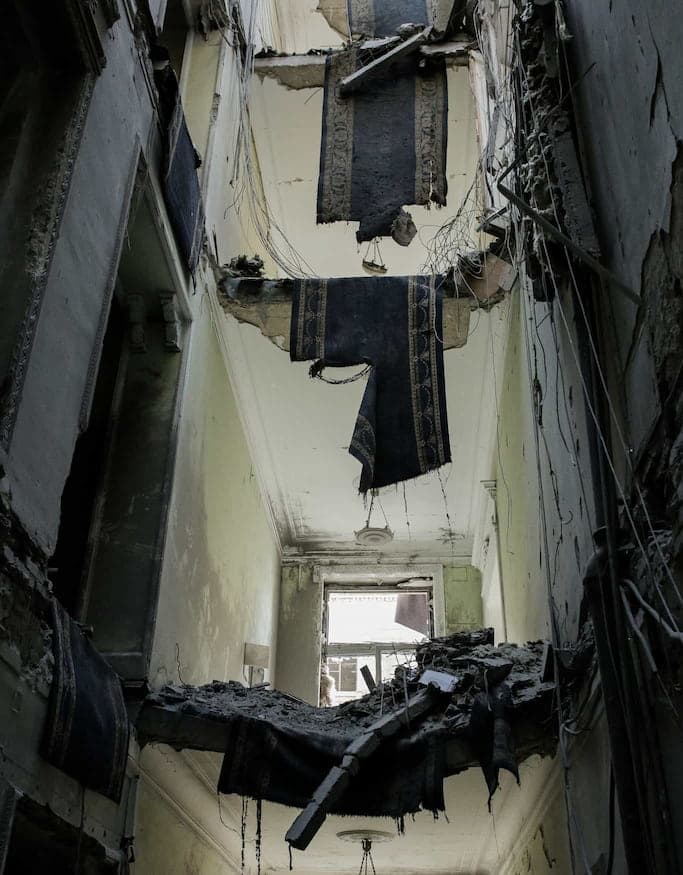
I lived in the third stairwell; the missile exploded near the first. The window blew out and bounced off the wall, pinning me under the glass. My apartment had a heavy steel door — it was blasted out of its frame. The force of the impact was so strong it ripped off the faucets in the bathroom.
My mind was working with absolute clarity. I thought: I’m not ready to die yet. I called my loved ones — told them I was wounded but alive. There was such a rush of adrenaline that until the evening, I didn’t feel any pain. I was moving on autopilot.
Blood covered my face. Bandages wouldn’t have stopped the bleeding. I grabbed whatever I could from the closet. Right before New Year’s, I’d bought a pristine white shirt — I’d wanted to wear it to my kids' school event — it was the first thing I grabbed. The clothes are beyond saving: all soaked in blood.
I can’t say I’m a deeply religious person, but in that little room I had icons and a small wooden angel. The icons had fallen but were intact.
I spent a long time trying to find one shoe. I live on the second floor — it turned out to be on the stairwell landing near the third floor, simply blown there by the blast wave.
A close acquaintance of mine was supposed to pick me up. I went outside and saw chaos. The first ambulances began arriving. It looked like the end of the world.
I walked up to an ambulance. I had a wound under my eyebrow — a shard of glass was sticking out. They pulled the glass out, treated it with peroxide, and said: “You need to go to the hospital.” I said: “I won’t go — there are people in worse shape.”
My acquaintance arrived in his car. He saw paramedics carrying people: “If you can wait, I’ll help.”
I spotted three correspondents walking. I said: “Guys, what newspaper are you from? Where from?” One says: “USA.” I realized these were foreign journalists who’d been returning from Donbas through Chuhuiv. When the full-scale war started, they happened to be among the first ones there.
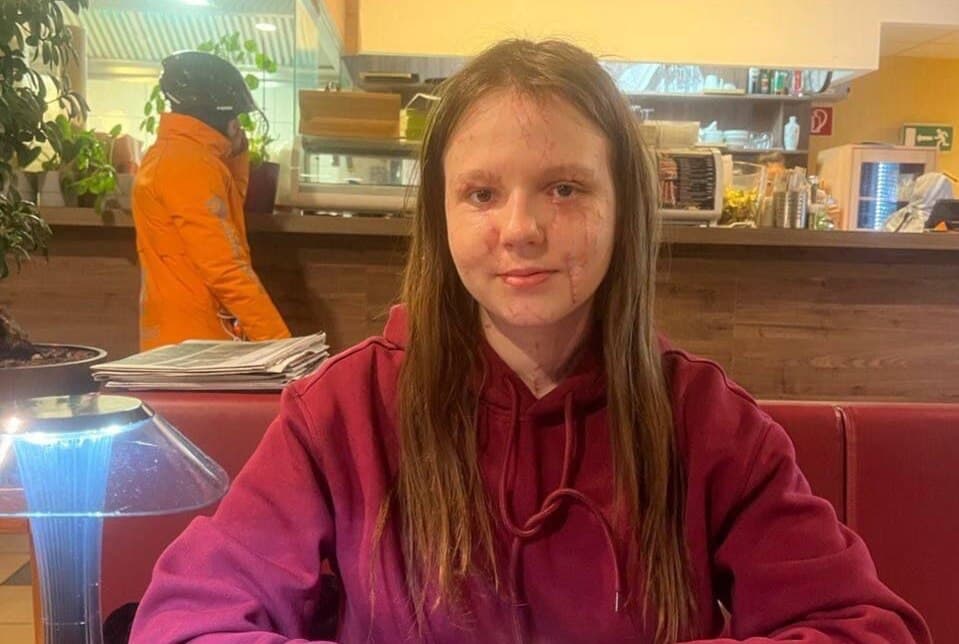
Wolfgang Schwan (photographer for Anadolu Agency — SP) took my photo, which later went around the whole world. When they took the photo, I couldn’t have cared less.
The doctor at the hospital said: “You could say you were lucky,” because they only found a concussion and a severe contusion. The nurse turned out to be the mother of one of my kindergarten students. She took me to another wing of the hospital. There were comfortable wards for World War II veterans.
I already knew something was wrong with my eye. Everything was blurry, at an angle, like some kind of kaleidoscope. It felt like I was seeing in fragments. But there was no ophthalmologist at the clinic.
They said at the hospital that I needed to stay under observation. I asked my acquaintance to take me somewhere farther away, because explosions were everywhere, and his house was outside the city, near a forest. They released me from the hospital at my own risk.
The moment we stepped out of the hospital, foreign correspondents approached. I said in the interview: “We need to be strong. I will do everything to help Ukraine. It doesn’t matter that I’m a woman and that I’m 50. I will never live under Putin.”
They made a saccharine report: that we weren’t expecting war, that we want peace. But they cut the part where I said I’d never live under Putin. I was in shock — I couldn’t understand how they could do that.
For a week, dirt and lymph kept coming out of my eye with the tears. If not for antibiotics, I wouldn’t have survived. Getting ophthalmological care was impossible, because Kharkiv was being shelled. Leaving was impossible.
On March 18, it was arranged for someone to drive me to the train station. He ran stores and twice a week would make his way to Kharkiv by back roads to buy groceries.
I ended up in Dnipro. In a few days, I went through three clinics, but they told me they couldn’t help.
They examined me on every machine and said: “The retina is torn, and this is a very serious surgery — we don’t do these.”
The British newspaper The Mail on Sunday was one of the first to publish my photo. I was in bad shape physically and emotionally, but it happened that they were the first and at that point the only ones I gave an interview to. From that day on, they started helping me.
They found a clinic in Poland and rented me housing. Volunteers drove me to the border, and the newspaper’s journalists were already waiting there. I’m very grateful to everyone who was with me in difficult moments and to those who help people fleeing the war.
I had three surgeries in Poland. They preserved the cosmetic appearance of my eye. The last surgery is in mid-January in London. There’s an opportunity to stay and live there. But I can’t. I want to go to Ukraine. If they can even partially restore my vision, I want to live a full life, work, be on my own land.
I found a volunteer center in Poland for children from Ukraine. Polish teachers were drawing with the children. I was the go-between, because I speak Ukrainian.
The American artist Zhenya Gershman painted my portrait — “The First Face of the War.” When it sold at auction for 100,000 dollars, she called and said: “I’ll wire you the money — you have no housing, you need to start everything from zero.”
I said: “No, let it all go to help Ukraine.” Zhenya reached out to the Ukrainian Red Cross, and ammunition was purchased for our guys: body armor, helmets. I understood that I’d saved at least someone’s life.
This artist and I have become very close. She painted another portrait of me and is now ready to put it up for auction.
She found me a psychologist specializing in post-traumatic syndromes. She’s from Russia — her name is Nastia. We meet online once a week. She’s one of the leading specialists in the field, and she works with me for free. I’m grateful for that.
The fact that I survived is not for nothing. A great responsibility rests on my shoulders. Since I was already known as a face of the war in Ukraine, I am the face of Ukraine in the world.
In November, a huge auction of Ukrainian artists' paintings was held in Warsaw. Besides the art exhibition, there was a photo exhibition. Wolfgang Schwan, who took my photo, was there. That photo played a big role in his life — he became world-famous. It was nice to talk to him and realize that our meeting that day changed both our lives 180 degrees.
When the war ends and he comes to Ukraine, we’ll definitely take a photo together. So that the face of war becomes the face of peace.
In September, I went to Ukraine for nearly a month, to visit my daughter. When I crossed the border, I pressed my hands to the ground and said: “Lord, I’m here!” I would definitely have stayed, but I have silicone oil in my eye. It needs to be removed, otherwise I’ll get a corneal opacity.
My mother is Russian; Russian blood flows in me.
By and large, we’re all mixed. What for? Why? To satisfy one tsar’s ambitions?
By and large, my home is all of Ukraine. I can live in any city. I’ll feel at home even if I never return to my apartment.
Outwardly, not just me — a great many people in Ukraine have aged ten years. That facial expression, the mark of war — so many people carry it. I hope that when peace comes, we’ll roll back those ten years, and the smiles will return and the wrinkles will smooth out.