Back
When we evacuated from Kharkiv, we walked on foot along the metro tracks
A Crimean Tatar on his volunteer work at the Poland-Ukraine border
Ruslan Abliakimov, a Crimean Tatar, talks about his volunteer work on the Polish-Ukrainian border. He helped refugees at the Tesco humanitarian center in Przemyśl: he coordinated transport, distributed food and supplies, and supported women, children, and the elderly. He shares stories of evacuation, the atmosphere in the camp, helping animals, and the attitude of Poles toward Ukrainians.
Interview
Transcript
Transcript
Attention! Translation was done using AI, mistakes are possible
КА: Katya Alexander
РА: Ruslan Ablyakimov
КА: Let's start with how you actually decided to become a volunteer, how did this whole story begin for you?
РА: Can you imagine, you wake up on February 24th, they write to you that a war has started, you just sit there for a couple hours, not understanding what's happening. Very, to put it mildly, surprised by the current state of affairs and thinking what to do. Right away I went to that organization that helped me come to Poland, and we started making lists of people who needed to be relocated urgently.
КА: Relocated from where?
РА: From Russia, or from countries where these people... There was a feeling that now they'll start a global cleanup, the sword, so to speak, of Russian justice was hanging over everyone from above. We needed to come up with some plan for how to help people who oppose the war in Russia. There wasn't just a feeling, but a complete realization of how many people would now pour from Ukraine into Europe. On the 25th [of February], I think, I was going to the office, and while I was riding the bus, I heard one woman talking in surzhik [editor's note: mixed Ukrainian-Russian dialect] with some of her relatives in Ukraine, she herself was Ukrainian. I remembered her words: "If it gets scary, hide in the basement." Well, and I understood that it's fucked up, to put it mildly. That same day there was an opportunity to go to the border. We first decided as three people that we'd go just pick up refugee acquaintances, specifically Russians who lived in Ukraine, in Kyiv. While we were driving there, they found some other transport, we thought, now we'll arrive and pick up someone else, because there are tons of people there. We arrived, and in the end we stayed there for about two days. First we went to the railway station, looked at what was happening there – there were already quite a lot of people there, beds were set up in the waiting halls, there was already an organized field kitchen process, they were handing out SIM cards. In general, they'd already somehow started taking care of people who were leaving Ukraine. Then we found out that another camp was being prepared at the Tesco shopping center in Przemyśl. It was empty at that time. There's a big building there, a regular shopping center, empty pavilions, and only a pharmacy was working. In the parking lot of this shopping center, first Ukrainian organizations appeared, volunteers, Poles, the Red Cross. They started organizing a field kitchen for people, there was an opportunity to bring things and distribute these things among refugees who needed them – warm clothes, something else. Then tents started appearing there, this camp started growing, a portable medical station appeared. After some time this camp moved directly into the Tesco shopping center itself, because it was empty, and they decided to organize a reception point there. They set up beds everywhere, cots, mattresses, organized an information point for coordinating the flow of people, because very many people were arriving, and something had to be done with them, some had to be sent away, others had to be received. I immediately understood that this was such a, quite extraordinary story. First of all, this is quite a historical moment, which I'll tell my descendants about later. Probably, one can be proud of the fact that you didn't just sit on your ass when all this was happening. Well, and plus, of course, the realization that you're helping people – that's quite a powerful thing.
КА: Since you were dealing with the relocation of Russians, who, obviously, are in easier conditions for moving, can we tell how the evacuation of conditional political [refugees] from Russia is organized?
РА: There's a Google form, people who want to relocate fill out this Google form, they tell about their cases. All this gets reviewed, then they contact the person, if possible they advise him to leave somewhere temporarily, to Istanbul, to Georgia or somewhere else. There they offer the person to apply for a humanitarian visa through a simplified scheme. For this visa, only the person's passport is needed, fill out a form and provide a photo. No income certificates or anything else is needed, the Polish Ministry of Foreign Affairs is quite loyal to Russian political [refugees] and provides visas, for which, of course, huge thanks to them.
КА: Can you now try to describe this volunteer headquarters, how everything is organized inside? I didn't quite understand, were you at the border or in the shopping center, or is the shopping center at the border. In general, clarify this point and tell how the process inside is organized.
РА: Look, Przemyśl is a city located on the border with Ukraine, literally 10 kilometers from the border. There are several border crossing points located not far from Przemyśl, and one of the busiest ones, from where very many people arrive, is the Medyka border crossing point. People, as a rule, simply cross the border on foot at this Medyka, and on the Polish side they were already picked up by Przemyśl fire service buses and taken to Tesco. Arriving at Tesco, they could quickly get SIM cards for themselves, get food, receive psychological and medical help, take clothes they were lacking. Then they went to the information desk, where Russian-speaking volunteers, as a rule, were sitting. We asked each one where they were planning to go, to find them suitable transport. If they needed to wait a long time, we distributed them to sleeping places. There was a big hangar there, where, apparently, there was a warehouse, and such small pavilions. We have, for example, some number of people who want to go to Wrocław – that's a Polish city. We sorted them into a pavilion where other people sat, waiting for transport to Wrocław, so we could quickly run there, say that there's a bus for 45 people, gather up, you're going now. We had transport that was, as a rule, volunteer transport, that is, people just came from the very first day in their own cars and picked up refugees. These are simply caring Poles, Germans, French, Czechs, Ukrainians who live in Europe. Many volunteers had the opportunity to provide people with temporary housing, work, opportunities to somehow legalize themselves. In general, this was held together on a voluntary basis, both from our side and from the side of people who took refugees somewhere further. People were constantly leaving, constantly new buses were arriving from the border to replace them, this was such a flow of refugees. We were engaged in making sure they had everything necessary there, so we could find transport for them, so they could get some help: eat, rest, contact relatives. I myself let people call from my phone many times when they needed to.
КА: How many volunteers, in your impressions, were at that point in Poland where you worked? Who are these people – are they Poles, are they Russian emigrants? In general, who was volunteering there?
РА: At first there were mostly Ukrainians, us – two Russians and a citizen of Tajikistan, there were Belarusians. In general, there weren't that many people.
КА: Not that many – how many is that?
РА: Maybe 20-30 people. There were Ukrainians who were themselves refugees, came and became volunteers. Some are still volunteering, I know several such girls. At some point the administration of Przemyśl decided to take all this under their control, they brought Polish pioneers, scouts there. They were right in their scout clothes engaged in coordinating some of the refugees, some who spoke English, or could even say some elementary phrases in Russian. At some point there became more Poles, but there was a constant pool of volunteers who spoke Ukrainian or Russian. We, those who speak Russian or Ukrainian, worked with people directly. There were functional positions in the warehouse for unloading, for distributing things, there were functional positions in the cafeteria, there were volunteers who worked with children, in general, there were volunteers from Caritas, who mostly also were engaged in working with people. There were Russian-speaking guys from Germany who also helped and proved themselves quite well. The number [of volunteers] constantly varied, probably there were no fewer than a hundred volunteers there.
КА: And how long did you volunteer in total? Two weeks, it turns out?
РА: The first time I came there for two days, a day later we returned to the camp again, I was there for about six days, probably. Then I came back to Warsaw and then left for the border again for about a week. Somewhere around plus-minus two weeks.
КА: You mentioned that Ukrainians also volunteer there. Are these those who now left Ukraine? That is, they are refugees, they are fleeing [from full-scale war in Ukraine] and then work at volunteer points, right?
РА: There were different ones. There were those who lived in Poland and dropped everything, decided to help their compatriots as a volunteer. We had Ukrainian students there who could choose free time and come there to volunteer too. And there were Ukrainians who came as refugees and ended up staying themselves and helping people.
КА: Wow. Listen, I'm getting a little confused. You volunteered at two different points, yes? Both at the border and at this shopping center?
РА: I volunteered one day at the railway station. Trains from Kyiv, from Lviv, from Odesa arrived at the railway station. There were also many people there, but there wasn't the opportunity to accept such a large number as at Tesco, at this point. Then we just went out to the border, directly to the border crossing, but no help was needed there, because everything was simple there. People come, get on the bus and come to us. I globally worked at two points, but mainly I was at the refugee camp, which was in the shopping center.
КА: And can you tell, or more precisely not even tell, but describe your personal feelings? What's the atmosphere at the volunteer point? How does all this feel through yourself?
РА: Quite hard. There are very many different stories there, of course, I had to hear a lot about how people's houses were destroyed there, they constantly told about rockets, told about how planes flew overhead, this whistle. The scariest thing, as people told us, people themselves said, is when planes fly over you, aerial bombs are the most deadly. Mariupol, for example, was bombed mainly with aerial bombs. But we didn't have people from Mariupol at that time, because then people weren't really being let out of Mariupol, it was blocked. Actually we even felt this, we heard a lot from the news, from mass media, that Russian occupiers didn't give people the opportunity to leave cities. They started having famine, people couldn't get water. In some other cities approximately the same situation was happening, but probably on a smaller scale. At some point more people from Lviv came to us, for example, at some point many people from Kharkiv, from Zaporizhzhia, from Donetsk Oblast came to us. We saw that it really was all true. People from Mariupol didn't come to us, why? Because they weren't being let out to here. What's the atmosphere there? In general, women, old people, children, teenagers came to us. I often had to see tears, often had to calm people down, often saw people who didn't know where to go at all – they crossed the border, and then they had frightening uncertainty.
КА: Surely you, as a person who worked with refugees from Ukraine for two weeks, have some stories that particularly strongly stuck in your heart, in your memory. It would be great if you told some of them.
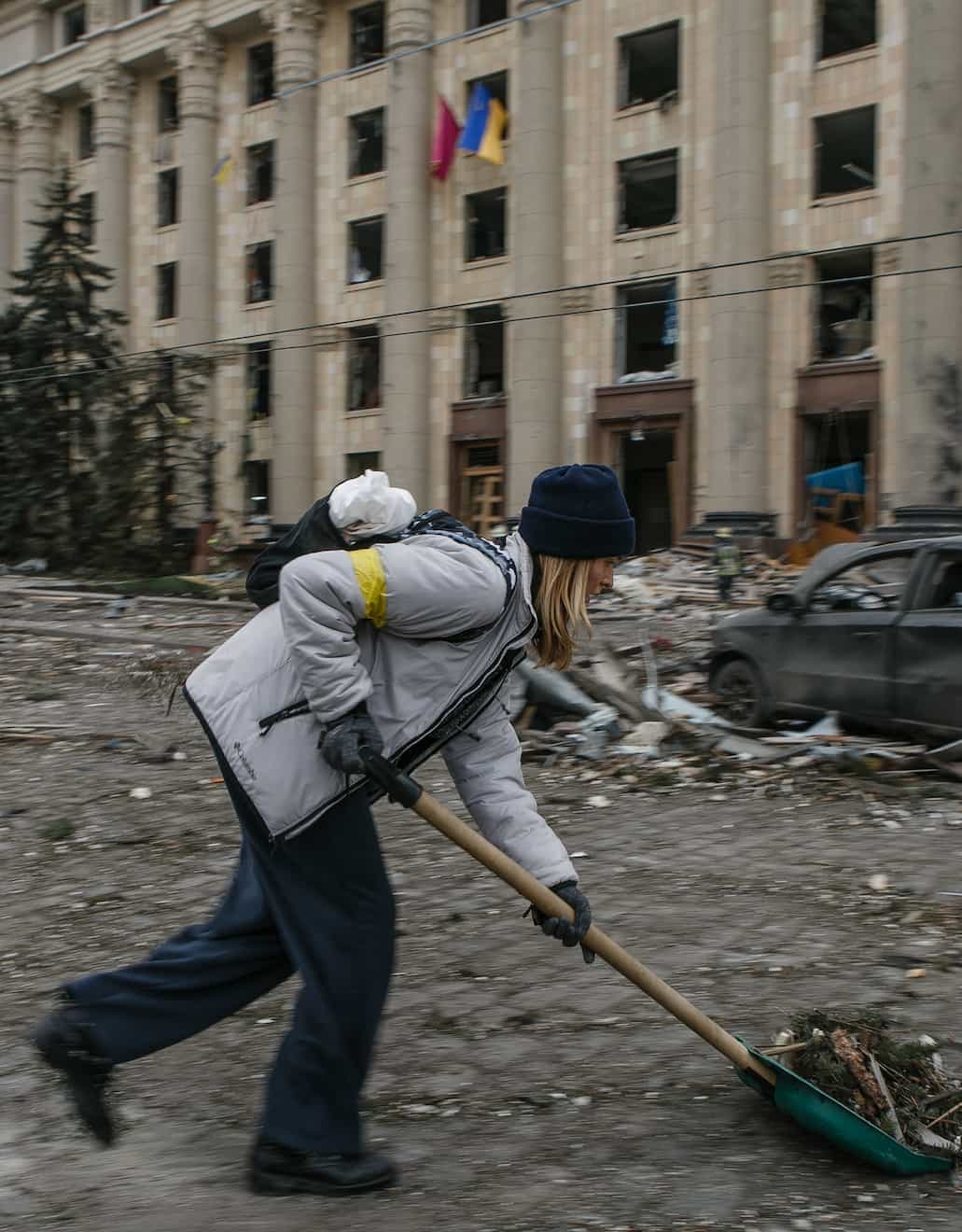
РА: Which stuck in my heart... The first days were the hardest, I heard stories about how people had to leave animals there, I heard about so-called meowing boxes at the station. This is when they weren't allowed on trains with animals, and people had to literally leave animals right there at the station. It was hard to hear how someone's men are fighting on the frontline. It was hard to hear how someone's houses were being destroyed. The most chilling stories were from Kharkiv. People told how they sat in basements. From Kharkiv one woman told how, when they were evacuating from Kharkiv, they walked along the rails in the metro for a long time – seven stations, 12 kilometers. When they told me about how they walked along these paths in the Kharkiv metro, I even envied a little, because I always had a desire to walk along these paths myself. Well, of course, not under such conditions. There was a lot there, I can't even single out something right now off the top of my head, I need to think about it. You're just constantly doing something there, constantly people, constantly something happening. Ah! Here, look, probably the most memorable story. We had a woman with six children, she came to us, crying, a woman from Kyiv Oblast. She had a torn hand, a wound on her palm. How this happened: during bombing she had a glass in her hands, and this glass cracked and cut her hand open. She somehow gave herself first aid in her village, and came to us – she had infection, a sea of children, and she was just crying because she didn't understand what was happening, what to do next, and how to live further. We placed her, and then found her an opportunity to go to France. One volunteer organization took her to the suburbs of Paris, they promised to help her with work, with everything necessary. I hope that now this woman is doing well, with the children everything is also good. They promised to find school, kindergartens for the children and provide everything.
КА: Listen, can you repeat the story that we discussed before the interview? About the Russian language, you told me that you were on the megaphone, that you were making announcements, when you lost your voice. In general, this whole story about how you were normally accepted, except for one exception.
РА: You have to understand that the people who came to us were mainly from eastern Ukraine, and they are Russian-speaking. They themselves speak Russian, they ask you questions in Russian, no problems arose. Many understood from my accent that I'm not Ukrainian, and then it was easy for me to find contact with people, saying that I'm a Crimean Tatar, because Ukrainians relate well to Crimean Tatars, and understand that Crimean Tatars are the same victims of the war that began in 2014, as the people themselves who are now leaving Ukraine. When I said that I grew up in Russia, also no problems arose, because they understand that there are normal Russians, and there are, conditionally, crazy Russians, either who support the war, or who are under the influence of Stockholm syndrome. They don't want to think, imagine that their country is doing what it's doing – that is, killing people, bombing peaceful cities and so on. The only moment was when I was announcing the movement of buses that were leaving in the near future. I worked that day 23 hours, I think. This was my last day of the second visit. Really, I slept in the car for 3-4 hours. I was very on edge, when you're just doing work and that's all. You're emotionally already a little shaken. One girl came up and said in Ukrainian, well, is it possible to make announcements not in Russian, but in Ukrainian? I say, what's the difference, they understand what I'm saying anyway. She characterized Russian as the occupier's language [editor's note: "mova okkupanta" - "occupier's language"]. In general I understand her, of course, because, objectively speaking, Ukraine will now change very strongly toward some kind of its own national identity. More people will start speaking Ukrainian, I see this myself from some of my personal feelings and contacts. I repeated to her again that there's no difference at all. And, in general, we ended this conversation at that.
КА: So this was the only case in which anyone reacted to the language you spoke?
РА: The only one.
КА: Do you know how many Ukrainians stay in Poland, and how many go further? Is there such information?
РА: I don't know, this needs to... It seems to me, even Polish border services probably don't know this data. But the main mass still stays in Poland, very many go to Warsaw, to Krakow, to Katowice. Many say they don't want to go further, because they still want to return home to themselves, to Ukraine. If we take the figure of 3 million, more than 3 million, probably about 2 million stay in Poland, the main mass. For example, there's a large Ukrainian diaspora in Italy, and people go to their relatives in Italy. Someone has relatives somewhere in Germany, Belgium, they went there. Many people went to Spain, because they have relatives there.
КА: And what concessions are there from Poland's point of view for refugees, how do they try to improve their lives or ease them at least a little?
РА: First of all, Poland opened a humanitarian corridor, green corridor, for everyone coming from Ukraine. Practically no documents were needed to cross the border. I saw situations when people crossed the border not just with internal passports or IDs, one woman crossed the border with a driver's license. I then helped her buy a train ticket, although she didn't have the right to buy, well, not buy, in short, now I'll tell about the driver's license. Another woman, in my memory, crossed the border with a photocopy of her passport. This is first. Second, at least in Warsaw, refugees with Ukrainian passports can ride public transport for free. They distribute humanitarian aid, naturally, and plus also for Ukrainians now in Poland, and, I think, somewhere else in Europe, free railway transport. There are also separate programs for those who were forced to abandon their universities in Ukraine, now many will continue studying in Poland. Well, and they provide temporary housing for refugees. Understandably, this is quite a spartan thing, but, one way or another, they constantly collect money for them. The state also pays a one-time payment, I think, 300 zloty to each refugee. But there you need to get, it's called pesel, this is such a tax document. What else? The Poles themselves also actively help. One should probably make a curtsy toward the fact that Poles, actually, before all this didn't really like Ukrainians. Because there are many Ukrainians in Poland. They, in the opinion of Poles, not in my opinion, take jobs away from Poles, they somehow behave inappropriately. Although I never had such a feeling about Ukrainians. All Ukrainians I know, see, I can characterize as very nice, good people. You know, as one refugee here in Greece told us today: by feeling, Poland is the most European country. Because it was able to quickly form its position on this war, and wasn't afraid to call black black, and white white. Some somehow try to dodge, that is, neither ours nor yours, neither here nor there, but Poland immediately started helping, immediately started sending humanitarian aid, some equipment, ammunition for the army, some defense means and so on. Poles massively, this is really a mass phenomenon, accept refugees in their homes, settle them for free. In general, all Ukrainians I talked with are satisfied with how Poland received them, how Polish citizens received them.
КА: Am I understanding correctly that not only the state goes to meet Ukrainians who found themselves in a war situation, but people also very kindly started meeting and perceiving them?
РА: Yes, now Ukrainians are perceived in Poland as such real brothers-brothers. Seriously, it's impossible to go into some small neighborhood store and not see at least a sticker with the Ukrainian flag there. Very many Ukrainian flags on the street. They really relate to this with great empathy, and the position of caring Poles occupies a big place in all this. That is, Poles are really great guys in this regard. I'm very proud of them.
КА: Listen, I also wanted to ask: since Poland became a place not only where a huge number of Ukrainians went, who had to flee from war, but also part of Russians who hypothetically or not hypothetically were subjected or could be subjected to political persecution, how do they get involved in helping Ukrainians and do they get involved?
РА: Directly in the camp itself there weren't that many Russians, well, maybe there were up to 10 people in all the time, not that many. But those Russians who can provide housing for refugees willingly provide it. Russians go to anti-war actions here, picket embassies, Russians collect humanitarian aid, those who have the opportunity send money. Specifically in Poland, Russians are not pro-Putin. I, for example, don't know a single pro-Putin Russian here. Because, probably, Poland has such a specificity that it's a country that suffered a lot from Russia in its time and it's hard to find any sympathy for any actions by Russia, especially such ones. In general, Russians come here who, one way or another, either understand this immediately, or they start to understand it in the process of life in Poland.
КА: And can you tell a little more about how anti-war actions take place in Poland?
РА: Listen, honestly, I haven't been to a single anti-war action here. But I heard that there was repeated picketing of the Russian embassy, someone even threw red paint, symbolizing blood, at the sign with the Russian embassy nameplate in Warsaw. In principle, probably like everywhere in Europe.
КА: And you didn't go because you were volunteering, yes?
РА: Volunteering, yes, I tried to spend myself on something where I could bring more benefit.
КА: Absolutely reasonable, I understand you very well. Tell me, there where you volunteered, there are surely some locations where people who came from Ukraine are temporarily placed? I don't want to call these camps, because that has a terrible connotation, but some such camps for refugees. Are there such?
РА: Of course, I told you, the largest camp is exactly this Tesco.
КА: I apparently didn't understand that this was a camp, can you tell in more detail how it's organized inside?
РА: Officially it's called a Humanitarian Aid Center. At first there were regular tents standing there, and there were sleeping tents, but there was very little space there, so they only accepted women with children there. Then all this gradually moved under the roof of the shopping center, there are many empty pavilions there, and in these empty pavilions they put cots, threw mattresses, and these people, many for several days, lived in such conditions. That is, it's a camp. This center, where people could spend the night, eat, rest, get some help. By the way, they could also take some necessary things for animals, because many came with animals. There really are very many beds there, just a sea of cots. That is, you walk, and there are cots standing everywhere, cots, cots. Cots in the corridor, cots in pavilions, cots in hangars. Such a solid sea of cots.
КА: You said that many come with animals. This happens, do they somehow help with this? Are there any concessions from the state's point of view for transporting an animal from Ukraine?
РА: As far as I know, no documents on animals need to be provided when crossing the border, which wasn't the case until recently. The main concession, the most substantial, which is adequate and necessary, is this. And so, when arriving at the camp, one could get animal food, they gave some leashes for free, some veterinary, pharmacy things. Understandably, they were very strongly traumatized by all this journey. Again, the psyche of an animal is more delicate than a human's. When I walked through this camp, I couldn't pass by some dogs and cats, I always wanted to pet them. I talked with the owners in parallel, many transported dogs under tranquilizers, for example. They sat indifferently, looked somewhere into the distance. Cats sat in carriers. Dogs also mostly sat in carriers. The substantial, most necessary thing is that they allowed transporting animals across the border without providing documents.
КА: I probably asked you everything I wanted to ask. I want to ask you the last question. Is there anything about your work with volunteers that I didn't ask you about, but you would like to tell yourself?
РА: Listen, I don't even know... War is shit, please, don't start wars.
Testimony Photos
Other Testimonies from the Archive
- Recording
Children have been born, weddings have been held, but there has not been such joy since
A resident of Kherson stayed in the city under occupation and helped hang the first Ukrainian flag after liberation
Borys Aliiev11/22/22 - Recording
All we have left of Vova are rubber slippers
An resident of Izium on life under occupation, her husband’s death, and evacuation
Liliia Maichenko09/09/22 - Recording
They put a bag over my head. A pink, new one
A kindergarten teacher from Kherson became a TikTok star, was taken captive — and survived
Olena Naumova12/05/22 - Text
At first they buried people for a bottle, then for 100 grams. And when there wasn’t any alcohol left, bodies just lay there. It’s terrifying
A native of Odesa ended up in occupied Mariupol and escaped through dozens of checkpoints and arrest
Vadym Lahunovych04/20/22 - Text
They cut into people’s dogs alive before their eyes. Skinned them
A dog handler from Lviv describes evacuating people with their pets and the Russian soldiers' treatment of animals
Olena Ostashchenko04/07/22 - Text
I’m the only adult who has to protect everyone
How a mother of quintuplets evacuated her family from Odesa
Oksana Kobyletska11/09/22