Back
During World War II, Jews hid in this house in an Italian village
A couple turned their home in Italy into a shelter for refugees
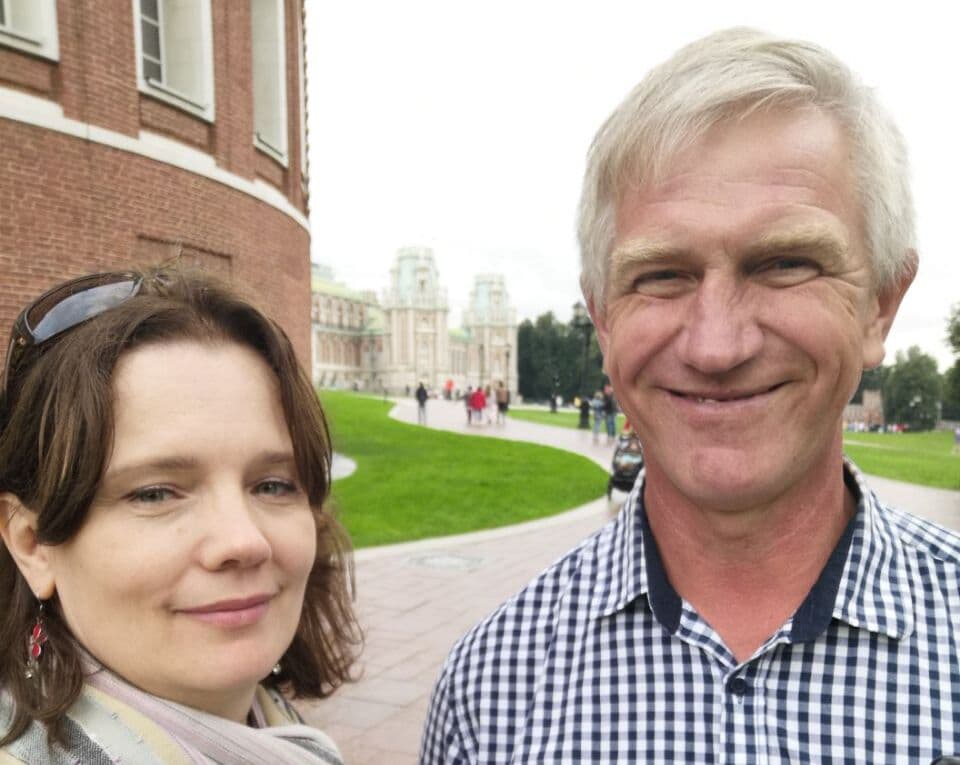
Artist Sergey Balovin and his wife Claudia settled in an Italian village. They restored an old house and opened an art residency in it. It turned out that during World War II, Jews had been sheltered in the same house. After February 24, 2022, Sergey and Claudia began hosting Ukrainians. Some stayed for several days, others for several months. The couple holds exhibitions by antiwar artists and tells Italians the truth about the war and Russian politics.
Interview
Transcript
Transcript
Attention! Translation was done using AI, mistakes are possible
АП: Thank you for agreeing to talk. Listen, Danya told me very briefly about the history of your house and about your residency. It seemed very interesting to me. I already told you about our publication – we try to tell about the war from very different sides, and it seemed interesting to me to tell about a place that has been, it turns out, for many years, such a refuge...
СБ: Such an ark.
АП: ...for people who suffered from war. But I would like to find out in more detail who you had there, to learn about the history of the building, in order to propose this story to the editorial office, and, if they approve it, to call you for a more serious, more in-depth interview.
Do I understand correctly that your residency is located in an old house where during the Second World War Jews were hidden from the fascists?
СБ: Yes. Well, in general in this village a total of 22 Jews were hidden during the Second World War, all survived (according to data from the municipality website 21, Sergey made a mistake – editor's note). The village is small, 250 people live there today. Well, and already during the Second World War there weren't much more there. During the period of industrialization everyone fled to the city. At one time about a thousand lived there. Well, that is, you can imagine that about 10 percent of the population were Jewish illegals at that moment. In our house lived the family of Roberto Terracini, an artist from Turin, and all survived.
АП: That is, he was hiding some of his acquaintances?
СБ: He himself was hiding under false documents with his wife and child. They were renting part of the house from a local family. That is, it's not that the locals accepted them there completely selflessly, which in principle is also normal. There just live village people, they rent out for some, probably, small money, their rooms.
However, the very fact that they were renting these rooms to Jews already put them in a very risky position: they all could have been shot. Germans came, fascists, checked who lived there. Somehow they still managed to avoid it, they all hid there, found ways to somehow not get exposed.
And this has its own prehistory too, because this village, it was founded by Waldensians. This is such a very small branch in the Catholic church, they are also called pre-Protestants, because they appeared before the Protestant movement. But having formulated their protest essence, they acted as antagonists of the official Catholic line, already in the XIII century propagating quite liberal values, even by today's standards.
For many centuries these Waldensians were persecuted for their beliefs. This place where we live, this village – is a kind of ghetto. They were driven into the mountains, to a height of no less than 800 meters, they were obliged to live there. Such a kind of ghetto, where these religious Protestants settled. Against this background they had empathy for the persecuted Jews, pursued everywhere, and they accepted them with greater ease, including partisans were hidden there. There was a strong partisan movement in these parts.
АП: And now this house belongs to you or are you renting it?
СБ: Yes, yes, it belongs to us now. We started the history of this project with such an exchange. We started completely with zero budget, without money. It was a different house, which is located right next door, of another family, which agreed to provide us the house in exchange for us, in turn, taking care of its condition. We in some sense restored it to residential status. It was completely abandoned, we put it in order, started living there.
They initially wanted to sell it, but, seeing what it turned into with our participation, evaluated their property differently and decided that they didn't want to part with it. Therefore when we, in turn, were already ready to buy it, they said that they no longer sell it, but allowed us to still stay there for several years.
We bought the neighboring house in the end, but that house was also at our disposal. Well, and now we exist only in our own house, which we also continue to restore, and it is precisely in this house that the Terracini family lived. This is all written on our website, you can browse through it.
АП: Yes, I will definitely do that. Tell me, please, about the war with Ukraine. Do I understand correctly that some guys lived with you there, refugees? Or not refugees? Or does someone live there now too?
СБ: Yes. As soon as the full-scale invasion started, we made the decision that we would accept refugees, and this would be our contribution our contribution against Putin's regime, so to speak... Not even so much against, as much as help for people who need help. We organized a number of events. The whole year was devoted mainly to Ukrainian themes of some kind.
We immediately held a meeting with local village residents, where we tried to explain what was happening, because many Italians are quite superficially familiar with the situation. We tried from our, of course, maybe subjective point of view, but to clarify the essence of the conflict and announced that we were ready to accept refugees from Ukraine and Russian dissidents. And already from the first days of March families came to us, completely random people who are not connected with art. We accepted them because we could do it.
АП: Were there many of them?
Sergey Balovin: For 2022 we in total accepted 14 Ukrainians. Someone lived literally for several days, some lived for several months. Some part of these Ukrainians remained and lives in Italy near us, became neighbors. We helped them find housing, get them settled. Some part became our second family. They returned to Ukraine, but from time to time return to us, when they have such an opportunity, for a month – for two.
АП: That is, these are not some artists, not art figures – these are just ordinary people?
СБ: Yes, just people, not connected with art in any way. For them this was such a not very usual situation. Besides the fact that there's war and they are refugees, they also found themselves in an art residency, – not the most usual place, where there are lots of different strange people, artists. But they got used to it, accepted this with time.
It wasn't immediately easy for them. They themselves admitted that it took quite a long time to get used to a completely different life, to a different routine. Everything is different: different people, different conversations. Some managed to adapt, get used to this environment. These were already elderly people, pensioners.
АП: Did they stay in Italy, or are these the ones who left for Ukraine?
СБ: No, a young family with a child stayed in Italy, our peers. And the pensioners came with their grandchildren, and they in the end together with the grandchildren returned to Ukraine, stayed there. The parents of these children remained in Ukraine, they could not leave the country. And they [pensioners] made the decision to return [to Ukraine]. They came [to Italy] in March, and returned in September. Since then the pensioners returned [to Italy] again, they sort of became grandmother and grandfather for our daughter.
АП: Wow.
Sergey Balovin: She perceives them as real grandmother and grandfather, as relatives.
АП: And now does someone from the Ukrainians live with you?
Sergey Balovin: At the moment nobody lives at all, we have a temporary lull. We in general planned to leave Italy these days. One Chilean lives with us now, a musician, practically homeless. That's all for now.
And so besides these Ukrainians we also accepted artists, who applied to this Artists at Risk project. Ukrainians often refused, learning that we had Russians there. Well, it's understandable. Mainly [in the project] there were either Russian artists, or Ukrainians who grew up in Russia.
Say, we had Katya Kabalina, who received a Ukrainian passport while already being in Italy. She is ethnic Ukrainian, but grew up in Russia. She lived with us under the Artists at Risk program, having fled from Moscow.
Then Lev Nikitin lived there, but he lived not only under the Artists at Risk program, he in principle stayed here, received political asylum. We helped him get stuck in Italy. Shamil Shaev also lived with us under Artists at Risk, participant of this exhibition (unclear) of war... (talking about the exhibition "LE MUSÉE DES HISTOIRES (NON) IMAGINÉES" ("Museum of Non-Imaginary Stories") – a project of Russian artists who condemned the war and left Russia. Took place in Lyon in October 2023 – editor's note)
АП: Yes, yes, yes, we are acquainted.
СБ: Daria Yurishcheva lived there, who is now in Marseille. She is an animator artist, she made the project "Animators Against War," which united different Russian-speaking animators who made small short films as a statement against war. She also lived with us for three months.
Zoya Pilipenko from Kharkiv lived with us, already such an elderly Ukrainian artist, who taught painting all her life there at an art school. Well, here, in general, approximately such a set of different characters we had.
АП: You said about elderly Ukrainians who became grandmother and grandfather for your daughter. Tell me, please, can you share their contact?
СБ: Well, I should first ask them...
АП: Yes, of course. Because for us elderly Ukrainians who found themselves in emigration, even forced, yes, such, even those who returned back, – this is still priority heroes for us. It would be interesting for us to talk with them.
СБ: Aha. I somewhere even had livestreams recorded with them. If I find them, I can send them.
АП: Yes, listen, materials would be useful. I think that you, for example, have some photographs, videos.
СБ: Materials will be found, yes, yes.
АП: Do I understand correctly that this your, I don't know, can this be called a program, but your this initiative for accepting Ukrainians – it's not closed, and if people need help, they can come to you now? Or have you stopped for now?
СБ: Yes, it's not closed. Now there's just much less demand for this whole thing. We are still ready to cooperate with Artists at Risk, they disappeared somewhere a little... Yes, we thought about announcing this. Plus now it also started, also here Israel and Palestine... We would be ready to accept from there too.
We don't have any external financing for this. As much as possible, we accept, of course, but our possibilities are not limitless.
АП: Well, understandable, yes.
СБ: In any case, all this can be considered, negotiated about something, so that from the Ukrainians' side...
АП: And how do Ukrainians find out...?
СБ: Huh?
АП: Yes, yes, go on.
СБ: It's important for them to have the will to integrate into the Italian context, because here, on the spot, various programs exist to support Ukrainian families, but it's important that children go to school, for example.
АП: And how did Ukrainians find out about you?
СБ: We had an interview with Anton Gross, this is such a popular Russian-speaking blogger from Ukraine, who has a Russian-speaking channel devoted to life and emigration to Italy. Learning about our project, he wanted to record an interview with us, which we planned for spring, but war started and he came earlier. There is this interview on his channel, where we told about our house, our project. Right after this interview Ukrainians contacted us, who watched this interview, and came literally in a matter of days, got to us. Well, they find out like this somehow, word of mouth...
АП: Well, that is, it's mainly "word of mouth."
СБ: Aha, yes.
АП: These elderly Ukrainians who somehow stuck in my memory, – where are they from? What kind of people are these?
СБ: This couple I was talking about, who became grandmother and grandfather, they are from Zaporizhzhia. And they returned now to Zaporizhzhia. Actually they really liked living with us and they would have been ready to stay longer, but this grandfather, despite his age, he's retired, but continues to work. And he doesn't want to abandon work. I understand it's not even so much connected with money, as much as with the fact that he feels his востребованность [editor's note: demand/need for his services] and wants to be useful.
АП: And what does he do?
СБ: He works at "Motor Sich" – an enterprise that makes all kinds of aviation engines. He's an engineer with good experience. There's a paradoxical story, of course: the planes (unclear) that bombed Ukraine in the first days, they fly on these engines, which are made at this plant.
АП: Wow.
СБ: I won't go into details, because I might be wrong, but a scandal was revealed there, exposing corruption at this plant. Already after the start of the war in 2014 they supposedly officially broke off all kinds of connections with Russia, stopped supplying these engines to Russia, but by some roundabout ways engines were still being supplied. That is, war was already going on in Donbas, and Ukraine continued to supply engines to Russia. Well, not Ukraine as a state, but some corrupt officials.
АП: That is, essentially, he designs engines for planes that bomb them?
СБ: Yes. But now he wants to believe that no, that this doesn't happen...
АП: Well yes. But he designed them, okay.
Sergey Balovin: ...there they supposedly found these functionaries. Well and he's also convinced that the plant has potential to produce some... well, some there, including bombs, or something. And he's surprised why they don't use there... But again, I don't want to go into details here, because maybe it's better...
АП: Yes, yes. I just want to understand something about this couple in general terms. Certainly, they interest me, but before talking with them, I need to know at least something about them.
СБ: Aha.
АП: I had such an amazing, I call her "cosmic Larisa," a 70-year-old Ukrainian from Kyiv, who went to France, being an English teacher. She worked with the Ukrainian space project. She traveled to NASA and participated in shuttle launches with Ukrainian cosmonauts. She ended up in France after the start of the war, absolutely incredible.
[...]
Listen, I didn't clarify: tell me, please, when did the last Ukrainians leave you?
СБ: They didn't leave. Depends how you look at this. This couple that was there, they already just returned. They were last time in June, probably, May – June. Who else of the artists... Yes, something, yes, it's been a long time since there were Ukrainians. By summer it ended.
АП: You said that some of them stayed in Italy and integrated into local life.
СБ: Some stayed, yes.
АП: And is it possible to talk with them too?
СБ: Yes, I'll also ask them, of course.
АП: Yes, that would be great. To learn the story of people who are trying to integrate is also interesting. Especially Italy seems not the most obvious country – mainly everyone is in Germany, in France.
СБ: If you're interested – a very interesting story of Lev Nikitin from Russia. He's an artist and an open, active LGBT activist, spoke out a lot on this topic, and on this basis received political asylum in Italy. Now he's trying to study Italian, integrate into the environment. We do exhibitions with him, right now we opened his exhibition, which tells about his experience of receiving political asylum, experience of moving into a completely new environment and into a new life.
Testimony Photos
Other Testimonies from the Archive
- Recording
We couldn’t stay on the sidelines — we understood that many people would suffer
A volunteer from Belgorod helped hundreds of Ukrainians return home; a criminal case was brought against him
Natalya Vishenkova11/11/23 - Text
When I’m feeling down, I remember: I’m not in the army. And I feel so much better!
A Russian conscript fled to Latvia to avoid being sent to war
Anonymous02/10/23 - Text
At first they buried people for a bottle, then for 100 grams. And when there wasn’t any alcohol left, bodies just lay there. It’s terrifying
A native of Odesa ended up in occupied Mariupol and escaped through dozens of checkpoints and arrest
Vadym Lahunovych04/20/22 - Text
I’m the only adult who has to protect everyone
How a mother of quintuplets evacuated her family from Odesa
Oksana Kobyletska11/09/22 - Text
These people were bombed by my own country, and now they have permanent injuries
A Russian citizen who volunteered at a Ukrainian hospital
Nikolay Avramenko08/01/22 - Text
I was furious, thinking: 'Let everyone just give in to Putin, as long as this war ends'
A Russian woman in Germany used to scold Ukrainians, and now raises money for the Armed Forces of Ukraine
Ekaterina12/01/23