Back
They told me that when I give birth, they’ll take the baby away
A female medic from the Armed Forces of Ukraine went through captivity while pregnant
Mariana Mamonova, a female medic of the 36th Marine Brigade of the Armed Forces, learned she was pregnant during the defense of Mariupol. She hid it from everyone and decided to stay with the battalion. She and her fellow soldiers were taken prisoner. Russian soldiers, upon learning she was pregnant, threatened that she would give birth in captivity and they would take her baby. She constantly talked to her unborn child, 'persuading' it to hold on until her release. She was exchanged just days before giving birth — Anna-Maria was born on Ukrainian-controlled territory.
Interview
Transcript
Transcript
Attention! Translation was done using AI, mistakes are possible
ММ: Maryana Mamonova
КА: Katya Alexander
ММ: Hello.
КА: Hello. Maryana, hello.
ММ: Hello.
КА: Maryana, before I start asking questions, I want to ask: do you have any questions for me?
ММ: No.
КА: Okay, good. Let me then tell you a little about our conversation.
ММ: Go ahead.
КА: I will be asking you about the last year of your life, about how you found out that you were pregnant, how it was to stay in Mariupol, about captivity, as much as it's possible to tell, about how you got into the exchange, returned home and how you're raising your child now. Our conversation will come out in the format of your monologue, the principle of documentary is very important to us, we don't want to add anything from ourselves – neither my questions, nor anything else. This will be a first-person monologue in text format.
ММ: Good.
КА: Then can I start asking questions?
ММ: Yes, ask away.
КА: As I understand it, you found out about the pregnancy somewhere around January, right?
ММ: It was already March. I found out that I was pregnant when we were already in Mariupol, at the Azovmash factory. I constantly wanted to sleep, I felt very bad. Thinking that I was pregnant – that was the last, let's say, thought. I had a pregnancy test, which I took just in case. And it showed me a positive result. That's how I found out that I was pregnant.
I'll admit to you that I was scared, because I didn't expect that I would be pregnant. And the situation in the city was already bad, it was impossible to leave, and to run somewhere, to do something – that was already meaningless, so to speak.
КА: The exits from Mariupol were already closed, right? It was already hard to leave?
ММ: Yes, they were closed. And the corridors that existed, they were unreliable. As you know, filtration points were already set up, where Russian military caught Ukrainian military who were leaving Mariupol, and took them away in an unknown direction. I was even more afraid of that. Therefore, I decided that I would stay with my guys, with whom I served. So I stayed. I didn't tell anyone that I was pregnant, because, you know, no one would have helped me with anything, first of all, and secondly, you know, everyone would have [run around] me: "You're pregnant, don't do this, don't do this." I didn't want this care, didn't want such attention, so I didn't tell anyone.
КА: And you, it turns out, were at the Illich Steel and Iron Works, right?
ММ: Yes.
КА: So you found out that you were pregnant. This is very scary, because around you a full-scale war had already begun, Mariupol is being bombed from all sides, probably the drama theater had already happened.
ММ: Yes.
КА: And you still don't tell anyone that you're pregnant. How was this experienced? Did you have any doubts about how to raise the child further, what would happen in the country in general?
ММ: You know, I didn't think about what would happen further in the country, because the situation was such: if you lived another day – that's good. Of course, we had to hope that we would get out, that help would come to us, because the means that we had, they were melting away faster and faster. And with what we had, you can't hold out. Everyone hoped that there would be help. And every day they told us: "Any moment now someone will come to us, any moment now such-and-such brigade is coming to us. Don't worry, everything will be fine, everything will be fine." People were always calmed by this, hoped, as they say, so it will be. But then we realized that no one would come to us, and if by some miracle we manage to survive – that would be good.
КА: Did your condition somehow influence how all this was experienced by you? This feeling that if you survive, it would already be good.
ММ: You know, at that moment I started to be afraid, very strongly afraid, because I was afraid not for myself anymore, but for the child. Some things I didn't do, and my people did them, medical personnel, because I understood that something very-very bad could happen. I was afraid of losing the child, because there were no appropriate doctors in the city, there was only a military hospital, which, let's say, didn't specialize in pregnant women.
I was afraid that if I lost the child, then the probability that I could have children in the future, if I survived, was very low.
КА: Because of the absence of medical help, specialized, right?
ММ: Yes. That's what I was very strongly afraid of, just very strongly afraid! You know, I still believed that we would manage to get out of here, that everything would be fine, we would hold out, they would come to help us. Every day I calmed myself with this.
КА: You said that you stopped doing some things to preserve the child, so as not to harm yourself. For example, what was that?
ММ: I was the chief of the battalion service, that is, not of the hospital. We went out on evacuations to places of clashes between our army and the Russian army, where our guys were defending the city. With each day it became more and more dangerous to go out there. My paramedic, Alexey Nikolaevich, started doing some things more, because I say: "Alexey, we need to do this and that," "Alexey, we need to do this and that." I won't say that I didn't do anything at all. No, I did, I just shifted some things to Alexey.
КА: But he didn't know [about your pregnancy]?
ММ: He didn't know that I was pregnant. He said: "Maryana Vladimirovna, why should I do this?" But I couldn't tell him that I was pregnant. I said: "Alexey, that's how it needs to be."
КА: Did you tell anyone that you were pregnant?
Maryana: No, no one. I didn't tell anyone at all that I was pregnant, because the probability that we would get out of the city alive was very...
КА: Small?
ММ: Yes, small. Therefore I didn't tell anyone. To my husband in the last days of March, before we were taken captive, I sent messages and at the end I put these emojis, you know, "mom, dad and girl," "mom, dad and boy." I couldn't restrain myself. But to directly tell my husband that I was pregnant – no, I didn't say, because I knew that he would worry even more. He has no possibility to help and take me out of the city, so I decided not to tell anyone, so that if something happened to me, then let it happen to me for them, but not as a pregnant wife or daughter.
КА: And where was your husband at that moment?
ММ: My husband is from Mariupol, but works in Lviv. At that time he had already left the city.
КА: But he was in Ukraine, right?
ММ: He was in Ukraine. My husband was formerly military, but due to health reasons he quit. Therefore he worked at another job.
КА: And did he... those emojis... Did he guess or not?
ММ: He guessed that I was pregnant, but, as he told me [after captivity], he was afraid to ask directly, because he understood that he wouldn't be able to help me with anything. He guessed, because I told him that I felt bad, that my head hurt, that I was tired.
КА: But you probably found this out when you were released?
ММ: Yes, I found out that he guessed when I came to Ukraine, when I was exchanged. We talked with him, and he told me: "Honey, I guessed that you were pregnant." When I was taken captive, I was allowed to call my husband and tell the news that I was pregnant.
КА: Well, we'll get to that.
ММ: Good.
КА: Those month and a half, from mid-March to April, before you were taken captive, what was happening both in Mariupol itself and at the Illich factory? How would you describe what was happening there?
ММ: This can be compared to the rape of a woman. It was a very beautiful woman – I'm talking about the city. It was a very beautiful city. And when...
КА: Maryana, sorry please, the connection dropped for literally twenty seconds. The last thing I heard was: "It was a beautiful city." And then the connection dropped.
ММ: We, before entering the city, were standing in another place. It was the village of Shyrokyne. This is Donetsk Oblast, near Mariupol. When we were retreating, we entered the city. I was entering the city, it was night, two or three in the morning. Imagine, you're entering a city, and everything there is not as you saw it. Broken roads, equipment that's burning, cars that are overturned and broken, windows in houses are broken. The store you always drove to is broken, some things are lying around, military are driving by with weapons. Everything is, you know, like apocalypse – disheveled, horrible. And all this causes some feeling in you, of offense, fear, hatred. Everything was so beautiful – and in one moment it all just collapses, just collapses. Actually it was horrible, very scary. The city emptied, just emptied. It became deserted, because people started leaving, abandoning homes, everything. Someone managed, someone didn't manage. Street lights broken. It was very scary to look at all this. We were driving through the city, and it was just empty, empty and broken. And this was still at night, and it added even more horror, because there's no light, everything in darkness. Well, it's horrible. Honestly, it was very horrible.
КА: I can't even imagine. And did many wounded pass through you, through your brigade, through the hospital at the Illich factory?
ММ: Look. I had more than a hundred wounded, all with different degrees of damage, with wounds. 42 people were killed. My battalion wasn't very big, no more than three hundred people, well, three hundred and something, because then mobilized ones came too. And the guys who died were those who had served for a very long time, because I had been working in the battalion since 2018 and knew everyone. And it was very hard, because you know these guys, you know everything about them. And you understand that you can't help them with anything. This feeling of helplessness constantly killed you, you could say.
КА: Of course. I remember correctly that you have a marine battalion, right?
ММ: Yes.
КА: That is, you're the medical unit attached to the marine battalion, right?
ММ: Yes. It was the 501st Marine Battalion of the 36th Brigade.
КА: These are your guys, with whom you worked side by side for many years, whom you knew. What was it like to experience this right there, when you still need to save the wounded, as much as possible?
ММ: The very first killed that we had was a man, he was 33 years old. It was March 2nd. Probably then we realized that this wasn't the first and wouldn't be the last person we would lose, because with each day the number of killed grew. In one day there could be up to ten people.
The most terrible thing, when we had killed, but we couldn't take them, because very active fighting was going on. Other guys who knew the killed went to take them, risking their lives, because it was very and very dangerous. In a day two, three, four, five. And you fight to take the body, because sooner or later relatives will ask: "Where is my son?" In the last days of March, we had guys who died, and we couldn't take them, because the Russians took that territory very quickly. When I got out of captivity, many mothers wrote to me, asking: "Where is my son? Where is my son?" Because from the military unit to which we transmitted information that someone died, for some reason the information didn't reach the relatives. What the reason was – unknown. All the mothers started writing to me: "Where is my son? Where is my son?" I knew where part of the guys were. But the other part, which we unfortunately couldn't take – I didn't know where they were, what happened to their bodies. When all this started, we had a place where we collected the wounded... not wounded, but killed. And we hoped that it would still be possible to take them out, because, you understand yourself, a mother will believe that her son died after she sees the body.
КА: Of course.
ММ: We didn't expect that these guys would have to be buried here, somewhere in Mariupol. We didn't think about this at all. We thought that we could take them out, relatives could bury them, everything would be, well you know, humanely, as they say.
But when we realized that there was no way out of the city, then difficulties started, because these bodies need to be buried somewhere. But where, if shelling is constantly going on? Everything is not so simple. Well, we stacked them. And then they brought a tractor like that, you know, that digs earth, and in Mariupol at the stadium, near the park they buried the guys. Because it became warm already... You understand yourself that the body won't lie for long.
КА: Well yes.
ММ: Something had to be done with this. There was a part of guys whom we buried. There was a part that remained at the factory. There was a part of guys who remained at positions, who weren't taken. And what their further fate is – I don't know. Very difficult. I'll tell you that it's very difficult to understand that you didn't save, you didn't help... This helplessness kills you. Because you think: "But maybe, if I had arrived faster, it could have been done this way, it could have been done that way." A lot could have been done when you sit and think. But there are situations when fighting is going on, when time is not in your favor, when they tell you: "No, you can't go." And you understand that this is time that plays against you. Because the wounds that the guys faced... If you take an aerial bomb, then after it, if it falls, it's very difficult to survive. And very many guys died precisely from aerial bombs. And you understand that you couldn't have saved him, but still, you know, these thoughts: "But maybe this way? But maybe that way?" This helplessness kills. You know all these guys, you worked with them, were friends sort of, communicated...
КА: It's almost a second family, of course.
ММ: Yes, it's almost a second family. You noticed well: it's a second family. They bring a body, you take some personal things. And you look – he's so young, he's so handsome! But he won't be anyone's husband, or friend, or son anymore. This is very hard.
КА: Of course. And you continued going out to evacuate the wounded, the killed until the end, while already being pregnant, right?
ММ: Yes, I went out, my Alexey went out – for which very big thanks to him. There were guys who themselves brought [wounded] from positions to the hospital, because it was very hot. And the commander didn't allow the medical vehicle to go out, so we went out in a civilian car. It happened that we went out to meet them, took [wounded]. It happened that guys from positions just threw them in a car and brought them to the hospital, because there was no time to wait. We got out of the situation as we could.
I went out until a certain moment. [The last time] when I went out for wounded, there were very many of them. I went out, my driver and one more fighter. And we came under shelling, had to hide in a school. And this driver who was with me, Uncle Vasya, he said to me: "Maryana Vladimirovna, I know that you're pregnant. With respect to you, I understand that you're the chief, but you won't ride with me anymore, because I worry more about you than about myself. Therefore – excuse me, but you won't ride with me anymore." [After that] I didn't go anymore.
КА: And how did he find out?
ММ: How did he find out? He hid me in a technical room in the school, in a room where they hide all sorts of mops, buckets and such. He hid me there. And then I had such fear and panic, and I say: "Uncle Vasya, I can't die, I can't die!" And he says: "Maryana Vladimirovna, I know that you can't die, because a woman who carries new life just can't die. And I won't let you die." He didn't tell anyone, I asked.
And I look at him like: "Uncle Vasya!" And he says: "Maryana Vladimirovna, do you think I don't see that you're pregnant? You're just a walking pregnant woman." I say: "How do you know?" He says: "I see. Because I have two daughters at home, three grandsons. Do you think I won't see what a pregnant woman looks like? I'm not eighteen years old, I see everything." He sat down next to me like that, calmed me down and says: "Maryana Vladimirovna, I'll do everything that depends on me so that you get out of this city alive and give birth to a healthy child. But, excuse me, you won't go out on evacuations with me anymore, because I worry very and very much about you."
КА: My God! And that shelling you just told about, when you had panic, do you remember it? When you said that you can't die, what were you thinking about? About the child inside you? What were your flash thoughts, emotions?
ММ: We were riding in a sanitary car "Bogdan," it's military. I was sitting in back, in the cabin sat the driver and one more boy who rode with weapons. I also had weapons in back, because we understood where we were going. We were riding very fast. And we came under shelling from a tank. When we were riding, the car skidded very strongly, it even jumped. Well, and I with it. We were running away from this tank. At that moment I became really scared for the child, very scared. I started being afraid not for myself, I started being afraid for the child, because I didn't know how all these events could affect him...
КА: ...affect.
ММ: Yes, affect. I was very afraid of this, very strongly afraid!
КА: But this is such a hopeless situation, as I understand, because you can't leave Mariupol, plus you're military. If it's a checkpoint, then they take you, most likely. And at the same time to stay – this is also very dangerous. The Illich, as far as I remember, they managed to hide for quite a long time, the Russians didn't know that there was a military hospital there. But still this was for the time being. How was this experienced, when you can't leave and it's very difficult to stay, and inside you is new life?
ММ: It's difficult. They started shelling us every other day at this factory. Bombs, artillery – everything started working. You understand that you have no way out, you won't leave here. You understand that you can die. But you stay with people whom you know, who give you some feeling of security. And if you leave the city, then you leave alone and this is until the first Russian checkpoint, filtration. You understand that no one will help you there. This scared me even more, because I understood that in any case they would find out that I'm military, in any case I would stay there. This feeling, this fear that I could stay there alone, and everyone would leave – this was even scarier than staying in Mariupol. Therefore I'm with guys whom I knew, whom I loved, who knew me. They constantly with me: "Maryana Vladimirovna, come here. Maryana Vladimirovna, you need to do it like this and like that." However it was, I'm a woman, and women – they're more stress-resistant, but they're panickers, if you can say so. They sort of calmed me: "Don't worry, everything will be fine, everything will be fine." They calmed me and said: "Don't worry, everything will be fine, everything will be fine, everything will be fine." And I believed them. Although I understood what the situation was, but I believed them.
In these situations you will believe just in everything, because you have no other choice. And you believe. Believe and hope that everything will be fine, that you'll survive, that you'll get out, that they won't shoot you, that you won't die. Everything that remained for us in this city was to believe. Believe that you'll survive. Believe that you won't be the person who dies here, somewhere unknown, and your parents and close ones will search for you, search, it will be unknown where you died. This is horrible, actually this is very horrible. I feel very sorry for relatives who don't know where their close person died. In Mariupol there are very many guys who went from Mariupol through fields, gardens. Who could, got out however they could. Therefore very many guys fell in those fields. And no one knows who and where. Much more time will pass before we find everyone.
КА: Everyone, yes. Unfortunately, this is so. And besides your driver, no one figured it out, right? I understand correctly?
ММ: No. Maybe someone guessed, but they didn't tell me about it. Because I would have started denying that I was pregnant.
КА: So that no one would take care of you and not...
ММ: Yes. I didn't want them [to treat me] like a pregnant woman: "You can't do this, you can't do that. Take this." I didn't want this. I considered that I was on equal terms with everyone, so that I wouldn't have any privileges, because there were already problems with water, with food. I didn't want this, so that: "I'll give the last, this is for you, and this is for me."
КА: The situation is heating up from day to day, not even from week to week. Did you think that you might be taken captive?
ММ: You know, at the beginning of the war, when all this started, I told my guys: "If you see that I'm being taken captive, you shoot me, just shoot me, because I'm very afraid of this." If you have the opportunity to talk with my guys, they'll tell you that I told them every day about this captivity: "I'm afraid of it. I'm very scared," because actually it's very scary. And if war begins, you shouldn't exclude the option that you can be taken captive.
At that time Russian military very much abused, let's say, Ukrainian women, Mariupol women. They told us about this, horrible things that they do, so I was very strongly afraid of this! It seems to me, the scariest thing that can happen to a woman is abuse, physical violence. This is very horrible! I was afraid of this. And I constantly told my guys: "If I'm taken captive..." They then started laughing at me: "Maryana Vladimirovna, if you're taken captive, what do we need to do?" I say: "Shoot me." And I talked about this, but they already turned everything into a joke: "Don't worry, everything will be fine, you won't be taken captive. Why do you constantly think about this?" I say: "Because for me this is very and very scary! Actually very scary!" And therefore I told them every day: "I'm afraid of being taken captive. I'm afraid of being taken captive."
КА: And how did this overlay with the fact that you were already pregnant at that moment and knew about it? Did your thoughts change about the fact that such a probability exists, it can't be excluded during war, unfortunately? What did you think about what would happen if you were taken captive while being pregnant?
ММ: You know, I remained on the same thing – to have me shot. Because I understood that if women are raped while their children are watching, then a pregnant woman is no different from what they do in front of children, in front of husband. There's no difference. For me it was very scary, scary.
КА: And where was there already information about what happens in captivity? Or is this what was known for eight years before the beginning of full-scale war?
ММ: This was known throughout eight years. And what they do with Mariupol women, our guys told us, political officers, they reported information that there are incidents, what Russian military do with women.
КА: And how did you understand or how did you find out that there was an order to surrender to captivity? How did all this happen in general? And when? Can you try to remember step by step?
ММ: Look. I remember all this well, because on this day I returned many times to understand how this happened. There was no order that we surrender to captivity. No one told us that we're going to surrender to captivity. No one. And the people who rode with me, no one knew where they were going. They woke us up at two in the morning, it was already April 4th.
КА: April 4th or March?
ММ: April, April, April, April 4th. Sorry. They woke us up at two in the morning and said that there would be a meeting in the kitchen, to have with you only body armor and helmet. Aviation strikes had already started, and they didn't stop. We slept in body armor, walked in helmets. This wasn't something, you know, strange or something new. I and my unit came to the kitchen. There were all the wounded who were in the bunker. And one of the officers told us that we're going out to reinforce a position that at that time was bearing very big losses, irreversible losses, guys were dying. There really were very few people there. They told us: "You're going there. With you only body armor and helmet. Everything else will be brought to you in the morning." This was all very and very fast. You were given a command – to leave, we sit down, load into cars, leave while there's no shelling, while everything is quiet. Everything quickly-quickly-quickly! If we're leaving then we're leaving. We sat in a car, in a vehicle. It was very dark. We sat in one car, and the car started moving. And everyone who sat there said: "Where are we going? Does someone know where we're going? Are we going to the second company?" Other guys said: "Probably we're leaving the city. Probably someone found some paths that lead out of the city." There were many versions, but no one of all who rode with me (and there were about 30 people), no one said and didn't allow the option that we're going to captivity. No one. The car drove literally seventy meters, well, up to a hundred meters. And the car gets a flat tire. And they very quickly tell us: "Come on quickly into another car!" because two cars were going. We get into another car and start asking: "Where are we going? Does someone know where we're going? No, no one knows? Probably we'll be leaving the city. Probably we're moving to Azovstal." There were versions, but that we're going to captivity – no. We rode, such shelling started. We thought that we'd all die. They started shooting with phosphorus weapons, the whole sky was like during fireworks. And the car in which we rode was a "Gazelle"
КА: Not armored?
ММ: Yes, just a civilian car, which had a tarp in back that was thrown back. Why do I say this? Because there will be a story further. We rode, maybe, fifteen-twenty minutes, no more, and the car stopped. We heard voices, Russian voices. But this wasn't strange, because very many [our] military spoke Russian. Now everyone is switching to Ukrainian, but then there were very many such. Dogs started barking. This also wasn't something new, because guys stood in the village, and very many dogs remained alone. They talked something there, talked, talked. And the tarp of this car opens, rises and they shine very bright light on us, very bright, as I remember now. Military stand with white these... Ukrainian military had yellow and blue...
КА: Armbands?
ММ: Armbands. That's it! I forgot the word. And these are white. They told us that white are Russian military. We see that these armbands are white. In this second you understand: "No, it's the light falling like this, it's the light falling like this. This can't be, this can't be." And they shine, these dogs are yelling, constantly barking, barking. They stand with weapons pointed at you, all in these balaclavas. And at this moment you understand: no, this can't be. This isn't what you think. And one of the Russians says: "Guys..." No, "comrades." "Comrades, from this minute you are prisoners of war of the Russian Federation and the Donetsk People's Republic. Upon attempt to run away and move in the wrong direction you will be shot on the spot. If you follow the given instructions, this may save your life." And you understand: no, this can't be. This isn't what you thought. This isn't captivity. Just this isn't captivity. You look – and this white armband... You know, at that moment such a feeling that there wasn't an armband there, but a whole... I don't know, everyone stood all in white, you understand: no, no, no, this isn't captivity. There were very many of us in the car, there was no [room] to turn around. The guys who sat next to me, these were my guys. I ask: "Alexey, Alexey, tell me that this isn't what I think. Please, please, tell me! Please, Alexey!" And he just looks at me, looks and doesn't blink, understand, because he has fear in his eyes. I say: "Please, Alexey!" I had such, you know, like hysteria started. I say: "No! No! No!" I couldn't believe this. I say: "Please, Alexey! Please! Well please, tell me that we weren't taken captive. This isn't that. This isn't what I think. Please!" And he looks at me and says: "No, Maryana Vladimirovna, this is what you thought. We were taken captive." And I say: "Just not this. Just not this. Please, let's run, let's run away." He takes my hands like this and says: "And there's nowhere to run. Nowhere. Maryana Vladimirovna, there's nowhere to run. They'll kill us." I say: "Let them kill, let them kill. Let's run! Please, let's! Let's do something!" I say: "No, just not captivity... Please, just not captivity..." And these military said: "Hands up, so we can see your hands. No sudden movements. One by one get out of the car and do what you'll be told." At that moment we started getting out, jumping out of the car.
They started taking body armor, helmets, pushing, searching, whether you have something there or not. These were sort of unpleasant sensations. This was very scary, because you understand that what you were so afraid of, what you ran from, what you feared so much, it caught up with you, overtook you. And that's it, well just everything. You understand that there's no way out. This was very-very, believe me, this was very scary. If people knew where they were going, that they were going to surrender to captivity, none of these people would have gone, just no one, because this is very scary, this is very scary. Because captivity, whoever says there, captivity doesn't give you the possibility, as everyone says, to come out alive. This isn't so. Because very many guys they kill, very many guys... they abuse, bringing them to death. This is horrible. If people knew where they were going, they wouldn't have gone, just they wouldn't have gone.
КА: It turns out that you were going to a position, but the car was taken in captivity? That is, this wasn't arranged beforehand with anyone? Right?
ММ: Right. Because they told us: "You're going to a position." That's it. The information was – "to a position." We're going to a position. We knew where we were going: we're going to a position. The guys discussed the fact that maybe not to a position, maybe we're going to Azovstal, because it was safer there. Maybe we're leaving the city, and we don't need things, because we'd have to carry things with us. If everyone started taking some things, this is plus additional space. They first put us in two cars so people could sit. And such a discussion started, they started saying: "Maybe we're leaving the city? Maybe there are some paths where we'll need to walk without things?" That people were going to captivity, they didn't know. That's the whole problem, that people didn't know. They found out about this only when they tell you: "Guys, you were taken captive." They didn't tell us: "You surrendered to captivity." They told us: "You were taken captive."
КА: You have this just insane panic, growing inside, because of what happened what you were so afraid of. Did it subside, do you remember the moment when you realized what happened? What thoughts were in your head when the information finally reached you inside yourself that this is captivity?
ММ: Probably when they took our things, searched us, lined us up in one line and say: "You were taken captive. You are prisoners of war of the Russian Federation and the Donetsk People's Republic." At that moment fighting was going on. Behind were little houses, and they were collapsing because shells were falling. At that moment I realized that I was taken captive. I have nowhere to run. At that moment I very much wanted, precisely at that moment I very much wanted these shells that are falling on the house... For it to just fall on the place where I'm standing, so I could die in one moment. It's very difficult to convey in words what you feel when you understand that what you were so afraid of, what you spoke about every day, it happened to you. This pulsating ringing in your head: "Captivity. Captivity. Captivity. You were taken captive." Everything most horrible that could happen to you is just ahead, just ahead. No one will help you. Of all these guys who are here, no one will help you, because we understood that girls would sit separately from boys, that the option is possible when someone in front of someone will be... let's say, someone will be abused to beat out some information. I understood this. And this made me even more scared.
КА: So you were taken captive. You have these pulsating, mounting thoughts. You understand, start to realize what's happening. And what happened next? Where did they load you? Where did they take you? ММ: They took our personal belongings when we were leaving. Many of the guys didn't have any documents or anything like that. I, by the way, didn't have them either. They took our phones, body armor and helmets. They told us where to go, but with body armor and helmet in our hands. We walked to a certain place. They took our body armor and helmet from us, and put us on a bus, a school bus, on which we rode. I don't know how long we rode on it. We arrived at warehouses, where we stayed for two or three days, I don't remember anymore. Just a warehouse where some farmers once kept some grain. Windows with bars, without glass. We stayed there for two or three days. The guys, when we arrived, they already started taking them for interrogations. They didn't touch the girls. When we arrived, there was nothing there, there was nowhere to sit, just empty. Later they brought some boards so you could sit, cardboard. Then a Kadyrovite came to us, who communicated with us. He came and said: "Here you are in captivity. Do what you're told. You think you're the last ones here? No, your whole brigade will be here. You're now in captivity. In the future, you have a chance to get out of captivity alive, and not die somewhere in Mariupol." And that's it. On the third day or on the second... on the second evening, I think, they already took us to Olenivka.
КА: How were you physically the first days? You were pregnant...
ММ: My driver told the commander [about my pregnancy], and the commander already told these Russian guys. They tell me: "Don't worry. You'll go through filtration. We'll see that you're really a doctor, didn't kill anyone. Well, and you'll go for exchange, no one will keep you here, because nobody needs a pregnant woman. Don't worry, everything will be fine."
КА: So these were Russians saying this, right?
ММ: Yes, these were Russians saying: "You'll be exchanged, you'll go home." My guys told me: "Maryana Vladimirovna, don't worry, you're pregnant." It became known to everyone that there was a pregnant woman. "Don't worry."
КА: This was all your driver told the brigade commander, right?
ММ: Yes, he told the battalion commander: "Our chief medic is pregnant." And the commander already told the Russian guys so they wouldn't hurt me. And my guys said: "Don't worry, you won't be here long. They'll probably release the girls soon." Well "soon" [turned out to be] almost six months. That's "soon."
КА: Maryana, I've talked a lot with different prisoners - both those who went through Olenivka and those who went through other colonies. And everyone agrees that the harshest thing that happens, despite everything else, is the intake. Given your condition, how did your intake at Olenivka go? This is the first arrival, first interrogation and the corridor that prisoners walk through, there are no cameras there.
ММ: It seems to me there are no cameras in Olenivka at all. When we arrived, one Russian says: "There should be a pregnant woman in this vehicle." In our vehicle there was also another girl who came forward and says: "Behind me is a pregnant girl." - "Good." They brought us out, lined us up, our guys started getting out, not getting out, but running out of the vehicle, because they were saying: "Quickly! Quickly! Quickly!" - and they started beating them, beating them with these sticks. With these dogs. One man stood near us with a girl and a dog. This dog constantly screams, screams, screams, screams... And the guys ran out, Russian military received them, they immediately beat them. These dogs... it's just horrible. Night, lights shining, dogs screaming, they're beating them. This Russian took us, the girls, aside and said for us to watch all this: "Look how we receive your guys." They lined them up near the cage and started beating them. It was very horrible! And they told us: "Look how we teach, educate your guys. You're lucky you're pregnant. You could have been with them."
КА: My God... What a nightmare!
ММ: Yes. The most difficult thing is the reception and when they call you for interrogations.
КА: But they didn't touch you physically?
ММ: Why? They pushed me a little by the shoulder, by the arm, and so on. The attitude in the beginning was very terrible, believe me, very terrible. They humiliated us, it was strict. And you can't do anything about it. You're standing there, a Russian is standing, and he starts stroking your arm and says: "So you're pregnant. But it seems to me you're not pregnant. We'll interrogate you and see if you're pregnant or not pregnant." It was horrible. No, they didn't beat me. Well, and the girls who [were] in Olenivka. They could push. That they beat them there during interrogations - no, I don't know any like that.
КА: When the Russian military, as far as I understand, told you: "We'll call you for interrogation and see if you're pregnant or not," what state were you in when you heard this? How do you even survive this? What fears did you have, maybe additional ones appeared?
ММ: It was very scary. Your hands shake, your legs shake. Well, what could this mean? You no longer exclude options of mockery, humiliation and physical violence. I started to fear that they might call me for interrogation and they would mock me. And I'm very afraid of this! You know, it's very difficult to convey in words... you understand that they'll take you to a cell, and no one will help you. Whether you scream or don't scream - they'll close your mouth. And no one will help you, simply no one will help if you're alone, and two or three people are sitting at the interrogation. And you're alone.
КА: Do you remember how your first interrogation went?
ММ: This was already mid-April. They called me for interrogation, started asking who I am, what I am, what I did, making inquiries. They asked: "Doctor? And you prove it." Well, in that sense. But they didn't beat me during interrogations.
КА: And what did they threaten you with, maybe? Did they somehow ask about the pregnancy?
ММ: They scared me there that they could take my child away: "You won't go for exchange as quickly as you think." At one of the interrogations they told me that they would take me to a colony where women sit for very serious crimes. I would walk there with them to work, which they go to there. And then, when I give birth, they'll take the child from me, give it to a Russian orphanage, where the Russian government will raise it better than the mother - "Ukrainian military killer." And they'll transport the child from time to time so I couldn't find it. And then I'll go for exchange alone, because according to all information I appear as alone, not pregnant, no one even knows that I'm pregnant. I'll go alone, and my child will stay here. When I want to look for it, as a Ukrainian military person entry is forbidden to me [to Russia]. And I'll never know or see my child.
КА: God! And when they told you all this horror, what were you thinking about, maybe, or what were you feeling? How was such horror experienced?
ММ: You know, I calmed myself with the fact that they would exchange me. I believed that I'm pregnant, they'll exchange me, they'll exchange me. And the fact that they'll take my child away - this was a new fear that lived with me all this time, I was very afraid to give birth there. It's very scary when they take a child away from a mother. I was in a cell where very many women left their children, someone had their child taken away. It's very horrible. It's very horrible for a woman whose child was taken away - she goes in one direction, and the child - in a completely different direction. Then they sit in the cell and think all the time: "Where is my child? Where is my child? Where should I look for it? Who should I call? Who should I ask?" Nobody knows anything. I was afraid they would take my child away. It's very scary. When they told me this, I said to myself: "No, they won't do this. They can't. They can't take my child from me. This is my child. This is my child. Wherever he is, I'll be with him. I can't abandon my child." I spent a lot of time talking to my belly and saying: "We can't be born here. We need to go home. We have a dad, we have family. We're not alone. Please, stay there until the last moment, until the last moment! We can't be separated."
КА: You believed, at least tried to believe, that the exchange would happen before labor began?
ММ: And I had nothing left but to believe. To believe that they would exchange me, that my country needs me, that my parents need me, my husband, that there are people who love me, wait for me. I believed that I would get home, I should give birth to a child in Ukraine. There it's also Ukraine, but temporarily...
КА: ...temporarily occupied.
ММ: I wanted to go home, I wanted to go home. I wanted to give birth at home. I constantly told the child: "We should be born at home. You have a dad. We should be born at home, not here."
КА: Your daughter clearly heard you.
ММ: Yes. Because they kind of exchanged me on September twenty-first. They exchanged me in September, September 21st, and on the 25th I already gave birth.
КА: Yes, I read about this. Now we'll talk a little more about Olenivka and just move to this. As far as I talked with people who went through captivity in Olenivka, as far as I read from open sources - very difficult detention conditions. How did you get through all this physically? Given that when you were captured, it turns out you were in your third or fourth month of pregnancy. Can you tell in detail what conditions you, as a pregnant woman, were in there? What was happening to you?
ММ: You know, the world isn't without kind people, there were girls who were entitled to packages.
КА: To Olenivka?
ММ: Yes. They received packages, they shared with me, gave me a cookie, an apple. Well, half an apple, two or three candies. Girls who were brought food, and they had a slightly bigger portion, they gave me a little more meat, took it from their plate and shared. Girls who went to work, they were given better food - cookies, more meat. They brought it to me.
КА: These were civilians, probably, right? I mean - not military.
ММ: No, there were military and non-military. There were shifts of guards who guarded us. By mid-May it was very difficult, and then it became a little easier, because we got used to it. There were good and bad guards, if you can say so. They came to work. They knew there was a pregnant woman, and shared some bread with butter.
КА: Ah, the guards?
ММ: Yes, the guards shared.
КА: Ah, all, all, I understand.
ММ: There were good ones and there were bad ones. Normal ones, like: "Where's your pregnant girl? Give her this and this." "Pregnant girl, let's go, take a little walk." And there were those like: "You should have thought. You got pregnant on purpose to be captured. You thought there would be better treatment for you? It won't be as you thought. You should have thought with your head. It's unclear what you were doing while you were in the bunker. Were you killing Mariupol children and decided to hide behind your child? It won't be like that." There were different ones. There was a time when it was very, very, very hard, very difficult. But a person gets used to everything. There were people who felt sorry for me. They took lunch with them, came. I won't say they brought me a "feast for the whole world." No, a little - one pie, one something... And there were girls who were entitled to packages. One woman, she was a prosecutor in the city of Mariupol, a package came for her, and she shared her package: "Give it to the pregnant girl, give it to the girl." Then they took her to Donetsk pre-trial detention center. At first we thought they were releasing her. A package came for her, and she gave me the whole package, because: "(connection dropped) they'll take, - she says. - And it will be useful for you." And there was a woman from Mariupol, Anya, I forgot her surname. She was exchanged. She also received packages - books, food. And she also shared. Guys who received packages, they said: "Give it to the pregnant girl." It's not that it's very much. Once a week a girl will give an apple, someone will give a cookie, someone - a candy. And at Easter, when they called me for interrogation, the guys who interrogate, they brought a small cake, a small Easter cake, like congratulating on the holiday. I came to the cell. We had 26 girls then, I think. And I divided this small Easter cake among everyone, didn't eat it myself. Everyone understands it's small, but all the girls were very pleased, because everyone thought that at Easter they would exchange us, we would come home. And it was very touching.
КА: But at the same time they still called you for interrogation, they still interrogated you?
ММ: They interrogated, because I was head of medical service, and they thought I possessed some super-secret information. For interrogations, yes, they called me. There were guys who also shared food with me. One boy who made fingerprints, as soon as he saw me, he constantly shared a bar with me, said: "Girl, take it." You know, I can't say everyone was bad. No, that would be untrue.
There were people who sympathized. Regardless of circumstances, you must always remain human. I was probably lucky with such people, because each of them, you could say, was raising my child, because I couldn't do anything there. I could tell my child: "Don't worry, everything will be fine. We'll go home. Everything you need, you take from mama. Everything you need, you take from mama." But you can't give what you need to give to your children when you're pregnant. I didn't have that. So I told my child: "Everything, everything you need, you take from mama."
КА: You said that the Russian military who were in Olenivka were sure that you possessed some super knowledge. What did they ask you? What were they trying to extract from you?
ММ: They asked me about the dead, where we buried the dead, who provided for us, what we kind of received from America. I say: "America didn't provide for us, Ukraine provided for us. Those first aid kits that you took from us..." And they constantly took from us. Everyone who was captured said that first aid kits were taken. I say: "If you look at this first aid kit, this is not an American first aid kit, this is a Ukrainian first aid kit. Medical backpacks that were taken from me - these are Ukrainian backpacks, not American. The Ukrainian medical service provided for us well. We had everything, we had enough of everything. We didn't steal anything from anyone." They asked why we use nalbuphine, which supposedly has very strong narcotic effects. I say: "No, it doesn't have such capabilities as you say, that people injected one nalbuphine and just ran forward without weapons. We don't have drug addicts, which you constantly attribute to us." I say: "This is a painkiller that was used for serious injuries, where it was very painful for a person." They constantly asked why we have so many drug addicts, why we give everyone drugs. I say: "Nalbuphine is not a drug. In the guys' first aid kit you won't find anything except pill-pack and nalbuphine." They asked about provision, about vehicles. I say: "I don't know where my vehicle is, because I was captured, and the fate of my medical vehicles is unknown to me." Specifically about provision, about management: "Who is your commander? Who is his right and left hand? Who did what in the unit? How did everyone behave in the unit?" Some such questions: "What do you know about this or that person? What do you know about the Azov Brigade? What do you know about the shelling of the maternity hospital in Mariupol? What do you know about the theater?" Such questions: "What do you know about people from other countries who served in the Ukrainian army? Your attitude?" And various such stories: "Did you hear, did you see, who did what there?"
КА: You also said it was very difficult the first month, until mid-May. I understand it's difficult to describe in words, but I would still like to ask you to describe this difficult first month. What was the hardest? What was the most difficult?
ММ: The hardest and most difficult was to realize that you ended up in prison, in a real prison, where you'll have to live by the rules of a person who is convicted. And it's unknown when you'll get out of here. The uncertainty was difficult, not understanding why, why you should sit in prison if you're a person who defended, who saved, who did certain things to make things better. And they put you in prison for this. This was difficult. It was difficult to realize that they took everything from you. I'm not talking about personal things, they took them [immediately] when we arrived, they took everything - jewelry, money. Everything, they took it, no one will return it. It was difficult to understand - the realization that you're in a real prison, you're in a cell where there are very many people. You don't have your own space. You have to go to the toilet in front of people, whether you want it or not. You have to eat from a dirty plate from which a hundred people have already eaten. You have to lie on a floor that's cold. You don't have water to wash. You have to go to the toilet when everyone goes, whether you want it or not, because there isn't as much water as you want. This is difficult. You end up in conditions that you couldn't even imagine in your worst nightmare. This uncertainty, these conditions in which you have to live are actually very scary. Imagine a cell where there are about forty women. Each has children, each cries, each proves something. Someone screams, someone is silent, someone just huddled in a corner, hugged themselves and just cries. Someone cries quietly, and someone cries loudly. And this is every day. You fall asleep and wake up with light that constantly shines. The cell constantly opens, they take you out and count, bring you back in. They don't let you go outside, don't allow you to walk. You only have the clothes you came to this cell in. You have nothing to change into. And now you haven't washed not just for a day or two, but you haven't washed for a week already. Understand? They took your freedom, they took your human rights, they took everything. The first time we were there, we were guarded by Russian riot police, so we wouldn't escape, with dogs and weapons. Everyone came, because there were more and more women, and they came to the cell, looked at us through the bars, like at a zoo: "Look how many women. Look how many of them. Look how many killers. Look. They probably also killed women and children. Aren't you ashamed that you killed civilians? What were you thinking before you went to the army? You had nothing else to do? And here's the pregnant one. And what were you doing in this bunker?" This was very difficult, because this was all day, every day, just every day. And you don't know if your relatives know where you are, don't know, what's happening with all this. This was difficult. It became easier when they brought women from Azovstal. Then it became easier.
КА: Why?
ММ: I don't know what this is connected with, but it became a little easier.
КА: From the guards' side?
ММ: Yes, from the guards' side.
КА: They probably switched to the Azov fighters.
ММ: When we arrived, we were so frightened. And they arrived more, you know, defiant. And maybe with this (connection dropped), they, as you say, switched to them.
КА: You mentioned now in this big list of those torments, including physical ones, that you had to go through, that you slept on the floor. How was it for you, pregnant, to sleep on the floor? Your back probably hurt, your lower back hurt. How did you cope with this?
ММ: Everything hurt, because there was no place to sleep. And it turns out we slept... if you go into a room, in the corner stood this little bed, if you can call it that. As we said - "shkonjara" [prison slang for bed]. We slept in this corner, and our legs were under this little bed. It turns out, when you got up... well, not got up, but just crouched, and you could see your head like this, because you bent over like this. It was difficult to sleep, because we had three pillows, three or four small pillows, and there was a little blanket.
КА: For how many people?
ММ: For two people. We slept on these pillows with a girl. We turned over synchronously, because there was very little space. At our feet another woman slept. That is, we had very, very little space. Well, and cold, cold. We had jackets, we put jackets under our heads. At first it was very damp there. And when it got warm, all kinds of bugs constantly crawled on the walls, I remember it like now, all kinds of bugs constantly crawled on the walls, including centipedes, of which there were simply millions! It seems to me they reproduced there at the speed of light. There were so many of them, these centipedes! Then it got even warmer, and all kinds of scolopendras started. This is generally fear! They crawl on you, crawl on the walls... It's horrible. You know, at first you're afraid of them, you beat them, and then you become so indifferent. Well, she's running - let her run.
КА: These conditions, when minimal vitamins, an apple maybe once every two weeks, and then because someone shared with you - did you in this situation think that such terrible conditions you ended up in could affect you, could something happen to you and the child?
ММ: Yes, yes. You know, I constantly had these thoughts, because I worried, because I had to see and experience so much in Mariupol, so many situations that I took to heart. I understood that conditions are not for a pregnant woman - neither nutrition, nothing. And I understood, as a doctor, that these three to four months are very important for the child, when all health systems are being laid down. I was very afraid that something might be wrong, something might be wrong, because there wasn't this, this, this. I had no tests, no examination, nothing. I was very afraid that something might be wrong with the child. I wasn't scared for myself. I was afraid for the child, that everything would be fine, that arms and legs, that everything would be there - both physically and mentally, that everything would be fine. And when I was already at seven months pregnant, a doctor examined me in the cell, and they took me for ultrasound to Donetsk, did an ultrasound and said: "Everything is fine, don't worry."
КА: This was the first time you were examined at all?
ММ: Yes, yes.
КА: Why did a doctor come to you? Just like that or did something happen?
ММ: No. A doctor came because I started having very severe swelling. And then for the first time came a person who dealt with exchanges, from that side, he told the colony head: "The girl needs to be examined, a doctor should look at her. This is an unhealthy situation. Let a doctor look at her." A doctor came and examined me in the cell. He said: "Take her for ultrasound." And they took me by ambulance to Donetsk, did an ultrasound. The doctor said: "Don't worry, everything is fine, the baby has all arms and legs. Everything is fine, don't worry." And then I calmed down a little - well, everything is fine.
КА: Was it scary to go to the doctor? Well, I mean - not that the doctor would do something wrong, but that you would learn something, that because of everything you had to and have to go through, something is wrong?
ММ: Very scary! Very scary, because I understood that this little person who lives in me is the only joy I have, the only meaning of life. This is a little person who gives me strength. A little person who holds me. A little person who makes me understand that he's with me, that I'm not alone, we're together. And, you know, when I was going, I thought: "What if they say something is bad there? If they say he shouldn't be born, because there's something there?" This is what I was very afraid of - that I might be left alone. Understand? I was afraid of this. And when they brought me to this ultrasound, I wasn't alone, there was a guard with me who was with me when they examined me, did various procedures. I was very worried. You know, my heart was bursting out of my chest. And the doctor says: "Don't worry. The fact that you worry won't change anything, but the indicators might be different. So, please, mommy, pull yourself together, and let's see what you have there."
КА: But the doctor was civilian, as far as I understand, he treated you normally?
ММ: Normally. They didn't hurt me. Well, how can I tell you? Well, how didn't they hurt? They tell you: "Here, little Ukrainian, why did you go to war?"
КА: This was the doctor telling you?
ММ: Yes.
КА: My God! So he first said "don't worry, mommy," and then started calling you little Ukrainian?
ММ: And then he started looking at the child and telling me: "Little Ukrainian, why did you go to war? You're supposedly pregnant. Why did you even need this? You should have sat at home and not worried about your child, not sat in prison."
КА: And did you answer anything to all these accusations or tried to just ignore?
ММ: No, I didn't answer, because I understood that there's no point in arguing. I'm not in a position to waste my strength on proving something to someone who's not interested in it.
КА: Well yes, this is a very understandable position. So before this case, no medics came to you at all? No medications, no tests, nothing?
ММ: No, there was nothing. Only our [prisoner] doctors from the hospital came to me, asked: "Maryana, is everything fine with you?" - "Well yes, everything is fine with me." - "Well, you understand that you can't take any pills." - "I understand."
КА: I know that in Olenivka there was Yurik Mkrtchyan, who was also at Illich, he largely had to deal with treating prisoners. Did they at least let him come to you?
ММ: A surgeon-reanimatologist came to me, who came to Olenivka to treat our wounded guys. Yes, they came to me. I even shared with them, I had a cookie and candy there, because I knew they wanted to eat.
КА: But these are also prisoners?
ММ: These are also prisoners. These are our Ukrainian prisoner doctors.
КА: I talked with Yurik and, as far as I understand, they had practically no medications.
ММ: They had nothing, yes. You know, some pills came to them. I was captured, I had pills, they took them. You are captured, they take pills from you. That's how they treated our Ukrainian prisoners.
КА: And in general, did you have any basic hygiene items that are necessary for a pregnant woman? I understand there was little in general, but did anything like that reach you?
ММ: No, we had some little shampoo and something else. This was brought by girls who went to work. They went to work, for cleaning potatoes, distributing food, the guards who were there gave them shampoo. For example, I didn't have this. A girl was captured, she had shampoo, soap, and they took it from her. But if you go to work, they ask you: "What do you want?" - "Please give shampoo." And they gave a bottle of shampoo for 28 girls.
КА: So they took it themselves...
ММ: Yes. But at first there was no shampoo. They brought us Sarma dishwashing detergent, and we washed our hair with it. By the way, very good hair after Sarma. Seriously. Maybe at that moment you have nothing but Sarma, so [it seemed] Sarma washed hair well. Girls tried to wash hair with soap. You know, there's such brown soap, 72%?
КА: Which is household soap?
ММ: Household soap, yellow. It's better not to wash hair with it, because it's horrible. Better not to wash at all. You washed your hair, in that water you washed yourself and poured [this water] back into the bottle, so you could flush the toilet.
КА: In all this emotional hell, full of physical limitations, what saved you personally? What gave you strength to hold on in all this? And hold on not alone, there were two of you.
ММ: The child gave me strength. You know, everything is always known in comparison. I was pregnant, I had a child. There were women whose children were taken away. There was a woman who gave birth in February, and in April was captured. Her sick mother went in one direction with a little baby who was breastfeeding, and she went in another, they brought her to Olenivka. And she was very... well, how can I tell you? You know, against the background of others you understand that there are worse situations. Although they told me that it was most difficult for me, because I was pregnant. But I understood that it's difficult, but I'm also a happy person, because my child is with me, in my belly. This is a little person who gives you strength, who gives you confidence, gives you the desire to wake up in the morning. You're not alone, you have someone to talk to. The child gave me the strength to live, fight, believe, hope.
КА: Did you talk to your daughter?
ММ: Constantly. For some reason I thought I would have a boy, because when I went for ultrasound, the doctor told me like this: "Girl... No, boy." And then: "Girl, you will have a child. I don't know who you will have." That's how it sounded. I had all the signs as for a boy - small belly. Women who had children, [with me in captivity] there were very many, they knew everything, how a woman looks with a girl and with a boy. These women told me in affirmative form: "Maryasha, you will one hundred percent have a boy. Just one hundred percent!" And only a few girls said: "No, you will have a girl." I said I would have a little son-kolobok, I constantly stroked my belly and said: "I will have a little son-kolobok." That there's a girl there, I found out when I gave birth.
КА: And what did you try to talk about with your child?
ММ: I told my child that he has a dad, that there's family that loves us, that waits for us, that they're doing something for us. I told my belly what we would do, where we would walk, what we would eat, when he's born.
КА: And this "what we'll do when he's born." What dreams did you have that you told your child?
ММ: I wanted to travel and walk, walk a lot, because I didn't have the opportunity to walk. And I know that pregnant women walk a lot, they need to be in fresh air. I wanted this, I wanted to walk not just around the cage, like a tied animal. I just wanted to walk the streets, see some beautiful things, enjoy freedom. I wanted to travel, because I regretted not traveling.
КА: And where did you want to go most?
ММ: To Italy. I wanted to go to Italy, this was my dream. And it came true! I wanted to go to a specific place - Portofino. And one organization fulfilled my dream, I went to Portofino with my little child. She was four months old, no, three and a half. At three and a half months she started traveling. We went to Italy. We were already in Turkey, in Istanbul. By the way, we left from there, and the next day there was such a big tragedy there, the earthquake.
КА: And you also said they let you call your husband, and you told him you were pregnant. How did this happen?
ММ: I was at one of the interrogations, and they asked me: "Does your husband know where you are?" I say: "No, he doesn't know." - "And does he know you're pregnant?" I say: "No, he doesn't know." They say: "Would you like to tell him about this?" I say: "Yes, I would." And they asked if I knew my husband's phone number. I say: "Yes, I know." I thought they were playing [with me], but they dialed it. My husband picks up the phone and says: "Yes? Are you alive? Honey, hi! Honey, is it you?" I say: "Yes, it's me." He says: "How good, how good that you called! I didn't know what to think anymore." Because there's one video that was filmed in Sartana (you saw it), where Kadyrov asks: "Is everything fine?" - I was in that video. And he says: "I saw this video where you are. I understood that you were captured, but your further fate is unknown to me." I told him I was captured. Where I was, I couldn't tell him, because it wasn't allowed, they didn't permit it. I say: "Honey, I want to tell you that I'm pregnant." And he says: "I know." I say: "How do you know?" - "Because I suspected." I say: "I congratulate you! You'll be a dad." He says: "I'm very glad. But I'm even more very glad that you're alive, that everything is fine, that everything is fine with the child. Of course, I would have liked you to tell me this not under such circumstances."
КА: You heard your husband for the first time during captivity then, right?
ММ: Repeat, please.
КА: I'm saying: you heard your husband for the first time during captivity then, right?
ММ: Yes.
КА: How was this? How was this experienced?
ММ: They gave me five minutes to talk with him, two and a half of which I just cried, because I was very glad to hear him. I said that everything was fine with me, that I'm pregnant. He said he would do everything to get me out of there, that I shouldn't worry: "Don't worry, honey, everything will be fine." He asked if they hurt me or not, what I eat and how things are in general.
КА: After this, probably, publications began about you being pregnant in captivity. I found notes and news at that time, while you were still in captivity, about you being pregnant ММ: To be honest, I don't know when it all started, because at first my parents and husband didn't reveal all this, because they thought I would be exchanged very quickly, since I'm pregnant. My mom found out very late that I was in captivity and pregnant, because everyone was afraid to tell her, she doesn't have very good health. Time passed, and I wasn't being exchanged. Then they told mom, mom started crying. My husband says: "Don't worry, they'll release her soon, soon." Probably when I was already in my seventh month (it was probably July, I think), that's when people started spreading information that a pregnant girl was in captivity, going to demonstrations. I think so, because I didn't watch when it all started, it was simply forbidden there.
КА: So it turns out that for the entire time you were in captivity, that phone call to your husband was the only connection with the outside world, right?
ММ: They let me... they let me call my husband two or three times.
КА: When was this first time approximately?
ММ: End of April. The second was at the end of June, probably. June, end of June. And in August. Three times.
КА: And what did you talk about those other two times?
ММ: No, it was the end of July, because this tragedy happened in Olenivka. My husband didn't know if I was alive or not, because it happened in the place where we were. He was very worried, reading information about whether there was a list of the dead. It happened on July 28, and I called him on the thirtieth or first.
КА: Did you ask to call yourself?
ММ: The person I came to for interrogation, I asked: "Can I call?" To which they told me: "Yes, you can call." I say: "My husband is worried, I'm a pregnant woman. Please." And they let me call.
КА: And when the terrorist attack in Olenivka happened, did you hear something, did you see something? How did you all experience this?
ММ: Then there were two big explosions: one first, then a second. The guards locked us all up and ran away. They just locked us up and ran away. After some time they came and said: "Your Ukrainian army is shelling us, already killing you in this Olenivka, because you're not profitable to them. They dropped one of the artillery installations, where there were very many of your military who were supposed to go on transport tomorrow. They killed them all." They started telling how it all looked: "Someone's head was cut off, nothing was left of someone, bodies were wound up on beds, burned. You see how your army loves you? Soon you'll be in that place too." The wounded who were there, they brought to us in solitary confinement. They called our [prisoners] doctors, who bandaged them. Everything they could, they did there. They locked them in this solitary confinement. I don't remember how many cells there were – three or four. And the others, as they told us, were taken to a hospital in Donetsk. Some of the boys died on the way, and some they still managed to deliver. Then we found out that it wasn't the Ukrainian army, but they did it, it was all staged, because, first of all, not a single guard died, and this is impossible, because guards watch you 24/7. Then they themselves said: "We fried them." That's how they talked.
КА: Right to you?
ММ: Well, not personally to me, they told the girls: "We did this."
КА: What scum!
ММ: It was all in such a mocking form. "How good! Look how many fewer of you there are. Less to feed, less to care for."
КА: Ugh! What a nightmare! It's still unclear what was happening, right? Just explosions, screams, something happening. How was all this experienced?
ММ: It was very scary. How did they do it? They brought artillery installations to Olenivka, fired and left. Accordingly, where the launch is – that's where the hit is. We understood that it was on purpose. We understood that a Ukrainian shell could fly where we are too, because where the launch is, that's where the hit is. Very scary to understand that if they lock us here, then it will be completely impossible to get out, because there are two pairs of doors and you're locked with five locks. Walls this big, concrete walls. And, you know, if it falls on you, then you'll have nowhere to run.
КА: But you continued to believe that sooner or later an exchange would happen?
ММ: Yes.
КА: Your faith that an exchange would happen was also based on the fact that people know you're pregnant, so they'll try to return you as quickly as possible?
ММ: I believed in this at first, I believed that they should exchange me, they should exchange me. But then, when exchanges started, no one was taking me. Everyone was going, but they weren't taking me. The wounded were going, and they tell me: "There will be an exchange, you'll go." Everyone goes, but I don't. The boys are going, but I'm not going. They took boys and girls, everyone goes, but I don't go. At that time I just started doubting whether I would go home at all.
КА: How was it with this thought? It's very hard.
ММ: You get the thought that you're probably really not needed. They started telling me this: "Look, you're pregnant, and they're not taking you." They started telling the girls: "You see, they're not taking the pregnant one, and you want to be taken." They also told the guys: "You see, they're not taking your women, and you want to be exchanged. Look, you're not needed by anyone here at all. We're not holding you here. Ukraine doesn't want to take you." I'll tell you, no matter what they tell you, you still believe: "No, they'll take me, they'll take me. I'll be exactly that person who will be taken. No, I'm needed, I'm needed."
КА: So you tried not to let their words, which in such circumstances it's easy to believe, penetrate completely inside you?
ММ: Yes. Because if you start doubting even more, then...
КА: You'll give up. Right? That's why you believe to the end: "No, everything will be fine, I'll go home. No matter what anyone tells me, I'll go home."
КА: And how did you understand that an exchange was about to happen? How did it become clear that they were preparing you for exchange?
ММ: On August 23 [2022] they took me from Olenivka and brought me to Donetsk hospital named after Vishnevsky, to the 5th maternity ward, where I was until the exchange. I had boy guards who watched me there so I wouldn't run away – at nine months pregnant, without documents, not knowing the city... it was very funny. I hoped for an exchange. And on Friday the person who dealt with exchanges from that side came to me and said: "Maryasha, there won't be an exchange, because the exchange fell through."
КА: From that side – meaning from the Russian side?
ММ: Yes, yes, yes. He said there wouldn't be an exchange, the exchange fell through. "When it will be – no one knows, because the two sides can't agree. You'll be here. And you'll probably give birth here." I started protesting: "I don't want to. Release me home, take me to the border, my husband will pick me up. Release me home. I want to go home," – in that vein, you know, I started saying. He says: "It doesn't depend on me. You're a Ukrainian prisoner of war, you're on all the documents, they'll exchange you like that." On Monday these guys' superior called them and said to talk to my attending doctor, to ask if they could transport me. The boy talks to the doctor and the head doctor, who said: "You have two or three days, you take her. If not – it will be too late." The doctor who was there, and the head doctor, they were good people who treated me very well, who contributed to my going home. And on Tuesday, on Tuesday they took me to Olenivka in the morning, said: "Pack the things you have." Because before that, volunteers who were in Donetsk brought me things for the child, because I was supposed to give birth there. They brought me things that a woman who gives birth should have, for a small child: diapers, small clothes, and some things for me. They told me: "Take everything you have. We're going to Olenivka." From there they took me somewhere. I didn't understand where we were going, because I knew that they wouldn't transfer me, pregnant, anywhere else. And I went to Olenivka, I went to Olenivka. There they were already gathering boys and girls. The things I had that were extra, that I didn't need, I left in Olenivka. I only kept the things they gave me for the child. They told me: "You definitely take these things." And when we arrived in Taganrog, they put us on a plane, and they told me: "Maryasha, you're going home, you'll give birth at home."
КА: Oh! What did you feel then? Well, you didn't understand until the last moment whether it would work out or not.
ММ: I didn't believe until the last moment that I was going home, because it was very scary. I said: "I'll be home when I see that I'm home, that I'll be in Ukraine. Then I'll understand that I'm home." When they led me out of the car, I saw the inscription "Chernihiv Oblast, Ukraine," then I understood that I'm home, that I came home, that's it, I'm in Ukraine, I'm home, I'm safe, I'm a free person, I'm a free person who can do everything they want.
КА: You spent half a year in Olenivka, in one of the most terrible places of this war. As a medic you understand that you're right on the last days before birth. How was it to understand that you managed together with your child to get home before birth?
ММ: We flew on the plane for a very long time, because we flew from Taganrog to Moscow, from Moscow to Minsk, and from Minsk, from the airport they took us to the border by bus. And all this time they didn't allow us to go to the toilet. My stomach, back started hurting badly. I told the girl who was with me: "Nastya, if I start giving birth, don't tell anyone. We have to arrive. I'm having my first birth – it's not two, not three hours, it will be long. I hope that in that time we'll arrive in Ukraine. If I start giving birth, don't tell anyone, until we arrive in Ukraine." Yes, I told this girl this, because I was afraid: if I start giving birth, they might remove me from the flight at some stage, before the exchange. I was very afraid of this! So when I arrived in Ukraine, I understood that that's it, I can give birth, I can give birth, I'm home, my loved ones are close. On Wednesday we were exchanged, and on Friday... yes, on Friday my husband came to me with my mom, brother, sisters, to the Chernihiv maternity hospital. On Wednesday we were exchanged, on Thursday I was transferred from the hospital to the maternity hospital. On Friday my husband, mom, two sisters and brother came to me. And on Saturday they took me to the Lutsk perinatal center. And on Sunday, at four... at 4:18 I gave birth to a girl.
КА: Lord! What happiness that this happened in Ukraine. And they took you to Lutsk because you're from Lutsk, I think, if I'm not mistaken?
ММ: I'm from Rivne Oblast, but Lutsk is closer to me. I wanted to be even closer, closer to home. I wanted home, just home, because everyone's there, mom, dad. Not everyone can come to the maternity hospital in Chernihiv.
КА: This is just a unique situation! You give birth to a child several days after captivity. How was all this experienced? What do you remember? What maybe stuck in your head? What did you feel at that moment?
ММ: You know, when I arrived in Lutsk, at the perinatal center, it was already evening, around eight in the evening. I sat like this on the sofa, you know, in a robe. I washed, washed normally. I'll tell you honestly that I cried. I cried from happiness, because for me all this was so, if you can say so, magical. It constantly seemed to me that this was a dream, that at some point I would open my eyes and be in the cell where water drips from the wall, rain, this smell of the toilet that constantly flows, where something constantly happens, all this around the cell. I was afraid it was a dream. When I sat on this little sofa in the ward, I hugged my belly like this and said: "Thank you, my little child, for going through all this with me, for listening to mama, for not being born there. I'm very grateful to you for this. Now we're home, we're home, and can give birth – even tomorrow, even the day after. We can already give birth, be born, because we're already home." As the psychologist explained to me later: I relaxed, it just went away, I relaxed, the child relaxed, and I gave birth quickly. My contractions started at two in the morning, and around four o'clock I had a cesarean. I didn't give birth naturally, but they operated on me... because the child was stressed.
КА: You probably had exhaustion too.
ММ: I had very high blood pressure. They told me: "No, you won't give birth yourself." There were already contraindications to me giving birth myself, and they gave me a cesarean. They take out the child and say: "Congratulations! You have a girl." I say: "What girl?! What about the boy?" They say: "There's no boy here, there's only one child here. And here's a girl." You just can't imagine what shock I had, because I went nine months thinking I was having a boy, and here's a girl. Immediately a team of neonatologists (doctors who deal with treatment and prevention of newborn pathologies – Author's note) and pediatricians looked, they say: "Everything's fine, don't worry, everything's fine." They observed the child for some time, because this was not a simple situation, not like everyone else's, if you can say so. Every day a pediatrician came, looked at the child. Then they did an ultrasound on the baby and said: "Mama, don't worry, everything's fine with the baby."
I was afraid of this moment. This can be compared to the period when I was captured, because, you understand, I knew nothing. They took the baby, they look like this, look... I stopped breathing. The doctor says: "Don't worry, everything's fine here. Mommy, breathe, breathe, otherwise you'll feel bad now."
КА: This is a happy – and thank God! – ending to this story! But at that moment when you started understanding, still in Olenivka, still in captivity, that it's already nine months, already the term maximally close to giving birth, and there's every chance of giving birth in ORDLO [editor's note: certain areas of Donetsk and Luhansk regions], with the occupiers, what thoughts were in your head at that moment? What were you experiencing when you understood that that's it, already nine months?
ММ: When the ninth month started, I started worrying, because until that time I thought: "Well, I have two or three months, I have time." And here I understood that I have no time, that is, the ninth month is going, and I can give birth any day – early or late. First pregnancy, as everyone says, unpredictable: when I want, then I'll give birth. And I was afraid of this. In the ninth month I really started to be afraid, really afraid, because I had no time, I had nothing left to hope for. I understood: if I give birth, then what will be next – unknown. I understood that no one would return me back to Olenivka. Here, in the hospital, no one would keep me either, because this is not the place where they keep prisoners of war with a child. In Donetsk pre-trial detention center, as they told me, there's a place for mother with child, but I understood that Donetsk pre-trial detention center is the most terrible place that could be, because the conditions there are horrible, the attitude is horrible, nothing good would happen to you. They would send me, as they said, to Russia anyway, to one of these camps, where you could go to work and see your child – well, that's still somewhat okay. And if they take my child away completely – I understood that I wouldn't survive this.
КА: This is a terrible, your biggest fear, I understand. How would you try to block these thoughts? Or on the contrary – did you have some plan?
ММ: You know, I didn't really have a plan as such. You see what the situation is? You understand that you have no way out. You either accept Donetsk People's Republic citizenship and stay with your child, refuse Ukraine. Or you wait until the last moment, believe and hope that they will still exchange you, you and your child. Or you go to Russia and live with criminal prisoners and do the work they do. I won't say I had a big choice. But I knew they would exchange me. I believed they would exchange me, they would take me. Because I didn't allow thoughts that I could stay there at all. I was afraid of this.
КА: Thank God that everything's fine with the child, the child was born healthy and good. Everything else is fixable.
ММ: Yes.
КА: Before I ask how you've been raising the child for these six months, I want to return to the very, very beginning. I imagine the picture: Mariupol, March, fighting is going on, Russia is already shelling from all sides. And I find out that I'm pregnant. We've been talking for a little over two hours, and all this time I keep returning to the thought that I don't even closely imagine how I would react to this, what I would do. A million questions would probably arise before me at that moment, because it's unclear – will a bomb fall now or, I don't know, something else will happen. When you only found out about the pregnancy, did difficult moral questions arise before you? Or did you simply decide: "That's it, I'm pregnant, I'll behave a little more carefully and try so nothing happens"? How did this happen when you found out you would have a child?
ММ: You start crying. You have hysteria. Fear. Panic. Joy, tears of happiness. Again hysteria, panic. Many questions: "Why now? Why not earlier? Why not later? Why exactly now? What should I do? Where should I run? Who should I tell? I won't tell anyone. Thank you, God, for giving me the opportunity to be a mother. Lord, why? Why exactly now?" All these thoughts – they burn, they change so quickly in your head... quickly, quickly, quickly! Very many questions: "What will I do? How should I act further? What decisions need to be made?" And I decided that I would make decisions as they come: "There will be a problem – I'll solve it." There was a problem – like there's no way out of Mariupol. I can't do anything about this. There was a problem that I need to be a little more careful. I understood that I have my Alexey, who would back me up, who would do the work well, because he's a specialist in his field. I have my driver guys, who were taught to react very quickly and do this or that work. I didn't just have a driver who only knew driving, no, they could and knew everything. I was lucky with the team. When it was necessary to receive the dead, examine them, I did everything until the end of March. And then I asked Alexey to examine the dead, because I understood that this was very hard for me. This is very hard! I understood that I'm a mother, future mother, and looking at this is very hard for me. I asked Alexey to do this. I solved problems and questions as they came up.
КА: This might be an incorrect question, it just arose before me when I thought about how I would get pregnant in such conditions. Didn't you have thoughts about whether it's worth giving birth at all now, when full-scale war started?
ММ: No, you know, no, because when I got pregnant, there was no full-scale war yet.
КА: Well, you found out during the full-scale war.
ММ: No, I didn't even think about not giving birth. I thought about how to save the child, what I should do to save it.
КА: You absolutely succeeded in the task, despite having to go through six months of captivity and absolutely horrible conditions.
ММ: Yes, I succeeded.
КА: This is entirely and completely only your merit and your faith that it would be good. When I read about you and how you gave birth, I became interested: why Anna-Maria?
ММ: You know, when I was in captivity, they asked me: "If it's a girl, what will you name her?" I say: "Anya, probably. But I'll have a boy." Because this name was liked by my husband. He liked it because my sister is Anya. And when I was exchanged, on September twenty-first, then there was a very big holiday, the birthday of the Mother of God. I later learned that her mother was called Anna. For being exchanged on such a big holiday – naturally, Anna-Maria.
КА: I just thought that maybe it's connected to Mariupol.
ММ: No.
КА: Still a very beautiful story. Maryana, you didn't have time, I think, to reflect on being returned, because just a few days passed between the exchange and birth. And birth takes a lot of strength. How have these six months after captivity been for you? How do you feel? How are you raising your daughter? Is everything okay with your daughter? Tell me about your life after captivity.
ММ: You know, the first probably three months were very difficult for me, very difficult. First, I returned from captivity, I hadn't come into form yet, hadn't adapted, and I already have a small child in my arms, who constantly wants attention, constantly needs care for a small child. Breastfeeding was also very difficult for me, it was very painful for me. Well, it was hell. The first three months everything was very, very difficult for me. I couldn't – how can I explain to you? – live in reality, if you can say so. All this was very difficult for me. I'm with a small child, and I understand that I'm here. And here air raid alerts started, I ran somewhere, looked for my body armor, helmet, because it felt very wrong to me that I don't have this. I looked for a bomb shelter. There were other questions here that I, being military, never asked myself.
КА: For example?
ММ: How can you hide without body armor and helmet, just in a bomb shelter? I didn't have this, because everyone had body armor, helmet. We knew these are things that would save our lives. These sirens that scare very much, scare very much – this is very scary for me, because I'm already afraid not for myself, but for my child, who I'll need to quickly grab and run. I had, you know, a breaking period, these hormone jumps. I either laugh or cry. Either I have some depression, or I have aggression. It was very difficult for me, very difficult. And big thanks to my husband, who endured all this, who supported me, who helped me. Although I'll say that I have some habits left [after captivity] in the sense that I always carry something in my pockets, everywhere I have food. And at home I have a place where I constantly put everything. My husband says that hoarding is not nice, but I say: "I'm not hoarding, I'm storing for difficult times." He explains to me: "There won't be such a difficult period anymore, because you're not alone, you have a husband." But it's still very difficult for me to adapt to this. And it was very hard for me! I didn't understand what everyone wanted from me. It was also difficult that there were very many journalists, everyone wants to talk to you, they touch very painful topics for you. You have trigger topics that hurt you. And you understand that there are things you don't want to answer. There were so many of them, and I didn't want to. I wanted peace, I just wanted to be alone, to be with my child. People constantly surrounded me. And it was really difficult for me to get used to being home, and to having a child, to having some responsibilities that need to be fulfilled. It was difficult. And now... now I'm a happy person, I'm a happy wife and happy mother, because I think everything in my life is good.
КА: Lord, how good that you're home!
ММ: I'm home. And this is the most important thing. I'm home. And I'm a free person. For me this is very important. It's important to understand that I'm home, I'm a free person. I do what I want. I have a healthy child. I have a husband who takes care of us. I have my own diet. I can go out and just walk. I can go to the bathroom and wash as I want, no one records how long you wash. The feeling of freedom, freedom and that you can do everything as you want. You can say both "yes" and "no," and not do what they tell you. This means a lot.
КА: This is a very important feeling after captivity. Maryana, do you remember at what moment this difficult state, when they don't leave you alone, you need to get used to a child, you need to get used to finally being home, and all this piled up, and then how this transforms into you being a happy mother, happy wife, everything's good with you? How did such a depressive episode change to a feeling of happiness?
ММ: You know, I understood that I have something to compare with... Oh, sorry!
КА: That's okay, I understand.
ММ: I have something...
КА: ...to compare.
ММ: I have something to compare with. My husband is constantly at work, at work, because times are difficult. I'm left alone with the child, just me and my child. And I understood that he has no one except me at the moment. Like in Olenivka I had no one except her. There's a small person who demands, he can't do this himself, he demands your help, your attention and your love. You know, at a certain moment I understood that I need to somehow set for myself, [decide] what's important for you first. And I put the child first, who took all my free time, of which there wasn't very much. At some point I started feeling sorry for myself. And [I told myself]: "No, stop! I'm a strong woman. I have a child, there's a small person who needs me." And I learned to say "no." I told journalists: "No, I don't want to communicate. No, this doesn't interest me. No, sorry, but I'm not ready." Like that. And, you know, it became easier for me. I started understanding my child, since we spend a lot of time together. I became a mama-mama. I looked at myself from another side.
КА: You've been raising her for six months already, what's she like? What kind of character does she have? Very small children – they're tiny, helpless, but at six months she probably already has some character formed. What is she like, your wonderful Anna-Maria, who went through six months of captivity with you?
ММ: You know, probably for every mother her child will be perfect. By the way, do you have children?
КА: No, no, not yet.
ММ: Nothing, you will.
КА: Sooner or later.
ММ: Sooner or later you will, yes. And you'll understand that the appearance of children in your life doesn't make your life worse or somehow incomprehensible. Everyone says that small children are diapers, sleepless nights. No, this is happiness, you just need to look at it from another side. How was it for me? It was difficult for me, unbearable, but then I looked at my child from a completely different side – and understood that I'm a happy mother. My child is perfect for me. Perfect in the sense that I don't have a child who constantly cries. We have a routine, she sleeps by routine, she eats by routine, we walk. She, of course, really doesn't like getting dressed. This is generally just a nightmare, a very big nightmare! She already has some of her own habits. She likes to play, but so that everyone plays, constantly so that they play with her. She likes mama to sit with her, just sit. She'll play, tell herself something, but so that I sit. I disappear somewhere from her field of vision – that's it, the whole building hears that my child is crying. For me she's a perfect child, because... because this is my child. You know, for me she's the most beautiful, because she looks like the person I love – this is my husband. For me she's the most cheerful, because she's such a smiley girl. Whoever comes, she constantly smiles at everyone. But there are people she doesn't like either, who she doesn't want to go to, she gets capricious, she starts crying. We went to Istanbul, twelve or thirteen people went with us. She went to everyone's arms, played, smiled. It all depends on the person. You know, if a person probably doesn't please mama, then probably automatically doesn't please the daughter either.
КА: Well yes. I think you have a special one after everything you went through. All mothers have a strong bond with daughters, of course, but yours is even more special.
ММ: Yes, she's such, you know, mama's-mama's girl. She falls asleep by herself, that is, by nine in the evening she's already sleeping. And constantly, no matter what I do, at two in the morning she wakes up, starts crying. You need to take her, hug her and put her next to you. That's it, she calms down. That's it, mama is here. She found mama with her hands, put her hands and feet on mama. That's it, mama is here. And with my husband she can't be for long. I don't know why. Maybe she feels that papa starts panicking, I don't know. Probably because, yes, she's such mama's, mama's girl.
КА: How happy I am for your whole family! It's a great grief that you had to go through all this, but what great happiness that you're all together now, that you're happy, raising a child and that you didn't have to give birth with the occupiers. Lord, thank God this didn't happen!
ММ: Thank God, yes.
КА: Yes, thank God. Maryana, I'll now ask you the last question. It's abstract, there might not be an answer to it. And then I'll ask several technical ones. Is there something about the full-scale war, about your service, about captivity, about your child, about birth, pregnancy, that you would want to tell me, but I didn't ask you about it?
ММ: Why do they make heroes exactly from people who were at Azovstal, and not from marine infantry? Why?
КА: I don't know, we wrote about both Illich Steel and Iron Works and Azovstal approximately equally, and other colonies, not only Olenivka, because besides Olenivka people are still held in other colonies, Kursk pre-trial detention centers, Voronezh pre-trial detention centers. I don't have an answer to this question, to be honest, because this is formed within the Ukrainian agenda, first of all, it's not my right to interfere there conditionally.
ММ: Have you interviewed women who were in Donetsk pre-trial detention center?
КА: Yes, just the day before yesterday I talked with Yulia, she spent a year and seven [months] in Donetsk pre-trial detention center, they arrested her still in ORDLO.
ММ: Poor woman.
КА: They took away her child and put him under guardianship, she couldn't get him back. But she returned him, thank God, just two months ago. She fought for a long time to get Marik, her youngest son, back. But yes, we also tell about Donetsk pre-trial detention center.
ММ: About those who were taken there, the guards who watched us said that: "girls, those people who sit in Donetsk pre-trial detention center, specifically women, they are subjected to violence every day, both moral and physical. And believe me, how we beat, educate your guys here, this is flowers compared to what our women do to your girls."
КА: No one told me about physical violence, in the sense regular violence. She told me that they beat her very hard the first month, so that under torture she would write an application for guardianship. That is, that she gives up the children, then still two of them, the older one simply became an adult while she was sitting in Donetsk pre-trial detention center.
ММ: What do you think, I'm just interested in your thought, if it's possible to take back this Donetsk, Luhansk, what will happen next with these people who tortured specifically Ukrainian people, because it wasn't so much Russians who tortured as Donetsk, Luhansk people. Why is that? What to do then?
КА: This is such a difficult question, because I can hardly imagine, first of all, how this happened, because even in Olenivka people from Donetsk were called for beatings. People from ORDLO, from the so-called republics, specifically beat. What will happen with this when Donetsk and Luhansk return to Ukraine, it's hard to imagine, but I think there will be some large-scale big tribunal, all-Ukrainian. But I can't imagine why this happens like this, why there's so much brutality there. At Donetsk Ministry of State Security, which is famous for its torture, mostly people from Donetsk worked too, and this is very, very scary. For me this is completely inexplicable, I don't understand how this happens, and this is very great pain. I can't imagine for a second how it is for a Ukrainian who understands that this is his own, well that is, not these so-called fraternal peoples, this propagandist stupidity, but this is his own, this is a Ukrainian. He was in Ukraine 8 years ago, and he's beating you.
ММ: For them you're not a killer, for them you're a nationalist who tortured the Ukrainian people, who humiliated Russian speakers. A person who once went to Maidan, because of whom everything started, as they say, a person who supported the language law, a person who for 8 or 9 years has been killing the Donetsk population.
КА: It's amazing how much propaganda works, I can't imagine. ММ: Propaganda works 24/7. In Olenivka we had radio that every day 100,500 million times talked about how the Ukrainian army kills the Donetsk Russian population, kills women and children. There was no talk about men, only women and children. Today a shell from the Ukrainian side hit a bus stop, where three grandmothers died, one young woman and a small child. Every day they talk about how the Ukrainian army kills, kills, kills, kills. But you know, for all the time I spent in Donetsk, in the city of Donetsk, near the maternity hospital they constantly brought artillery installations, Grads and such. They would fire and leave. You know what was the most interesting thing? Not that they were doing this in a place where there are small newborn children, women, no, that didn't bother them, but that there was no return fire. That is, they were shooting, but there was no return fire. And you know, I'll tell you, I got this thought that they're shelling themselves.
КА: I honestly wouldn't be very surprised.
ММ: What normal, adequate military person would put installations near a maternity hospital, where, I understand, there could be incoming fire? There's no adequacy.
КА: No, absolutely. This is another question that only you can decide - what and how will happen with the current ORDLO [editor's note: derogatory Ukrainian acronym for occupied territories of Donetsk and Luhansk regions]. This is a terrifying big question and terrifying because people believe in all this and it turns them into some kind of animals.
ММ: Because they constantly have the television on, propaganda, every day on the radio Putin speaks [they say], about how everything is good, Ukraine is this and that.
КА: Yes, but in 8 years it's not like anything has gotten better for them, to put it mildly.
ММ: No, you understand... Now, just a second. Sorry, while my child is sleeping, I need to quickly eat something.
КА: Yes, yes, yes, please don't apologize at all, I've taken so much of your time.
Testimony Photos
In Sections

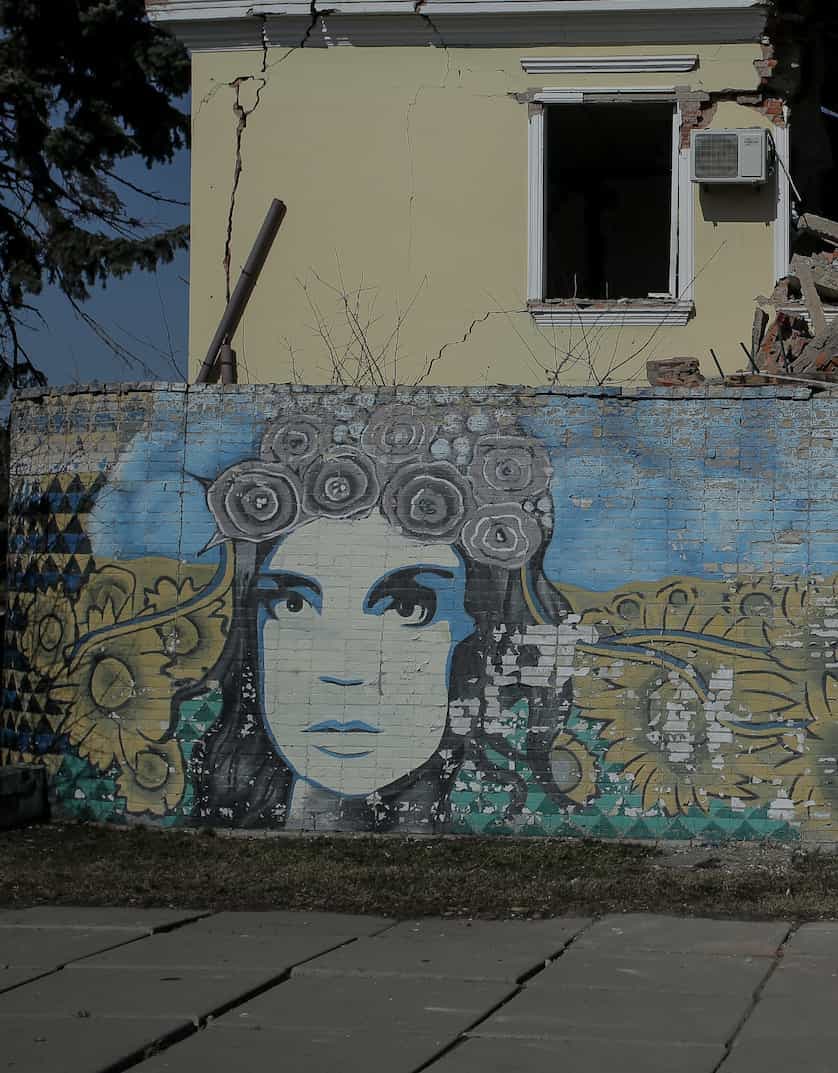
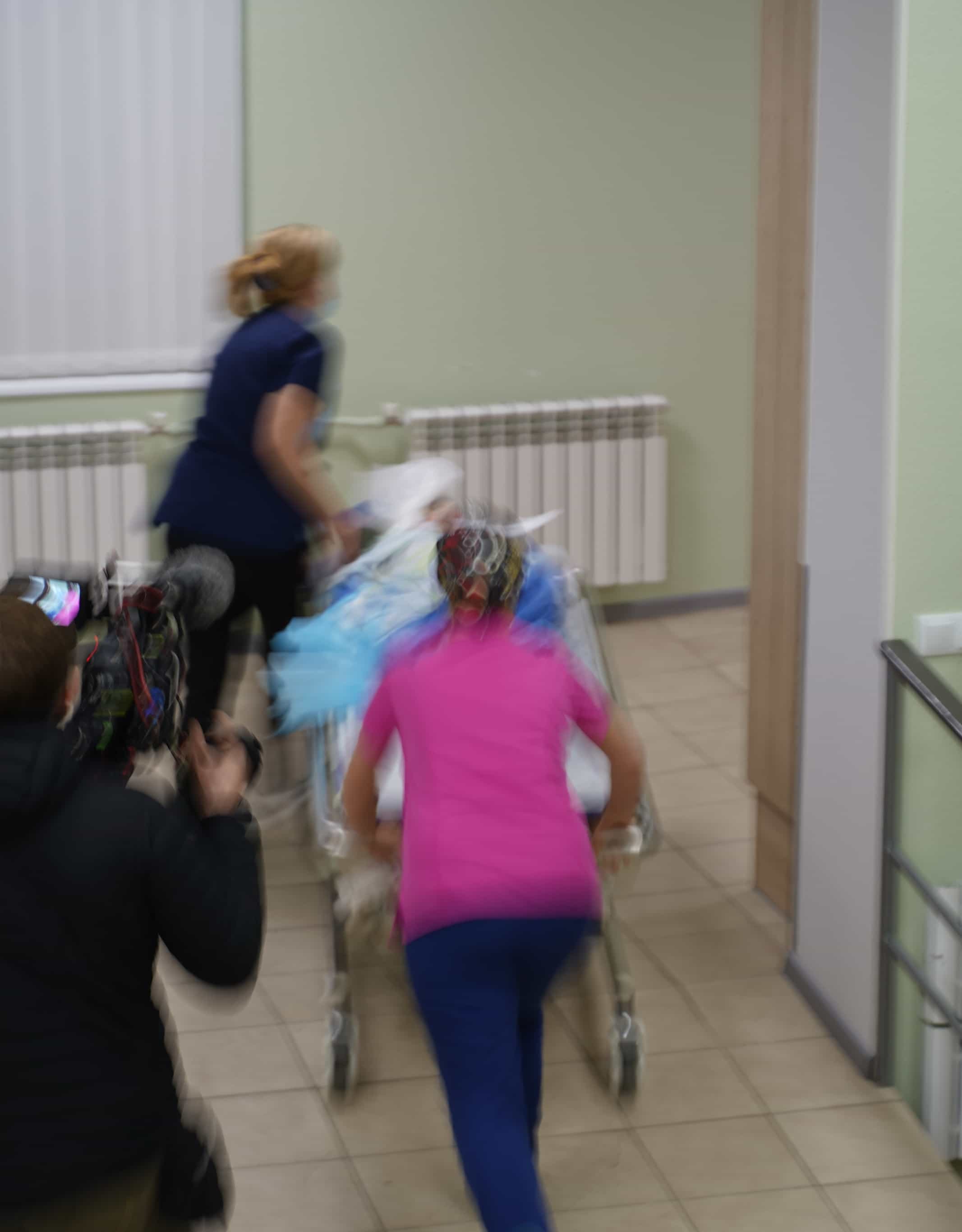
Other Testimonies from the Archive
- Recording
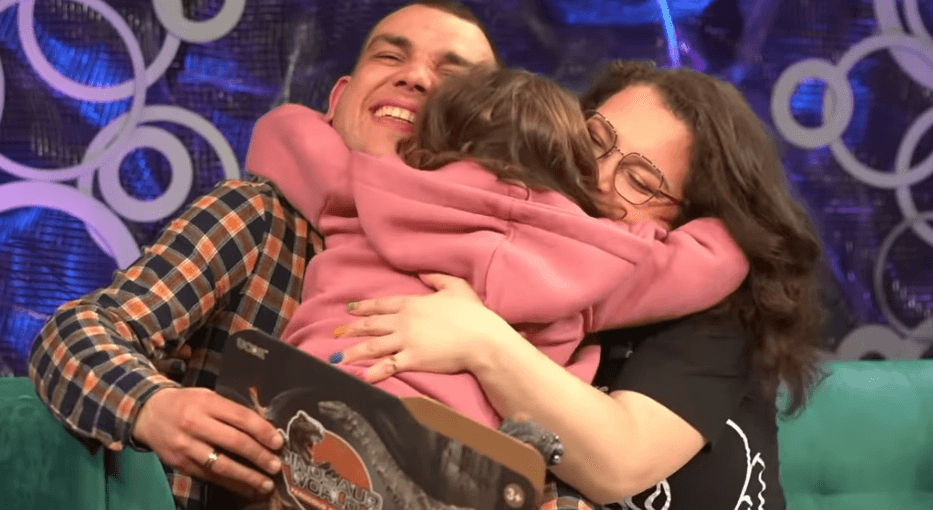
Mom, who is Uncle Vova and why is he the president of the whole world?
A Ukrainian servicewoman went through captivity and brought back her children from occupation
Kateryna Skopina06/22/23 - Recording
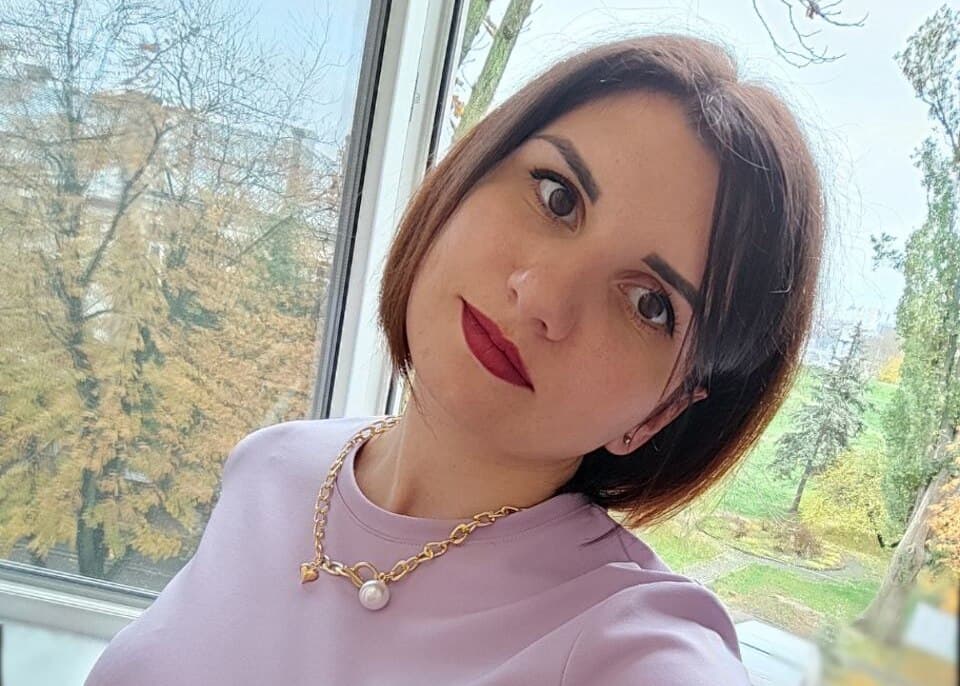
I was sent to the transit prison, and my daughter to Zaporizhzhia
A military paramedic from Azovstal was separated from her daughter and sent into Russian captivity
Viktoriia Obidina11/01/22 - Recording
I realized: they’d taken me out to be executed
An anesthesiologist about being in captivity in Olenivka
Yurik Mkrtchian11/22/22 - Recording
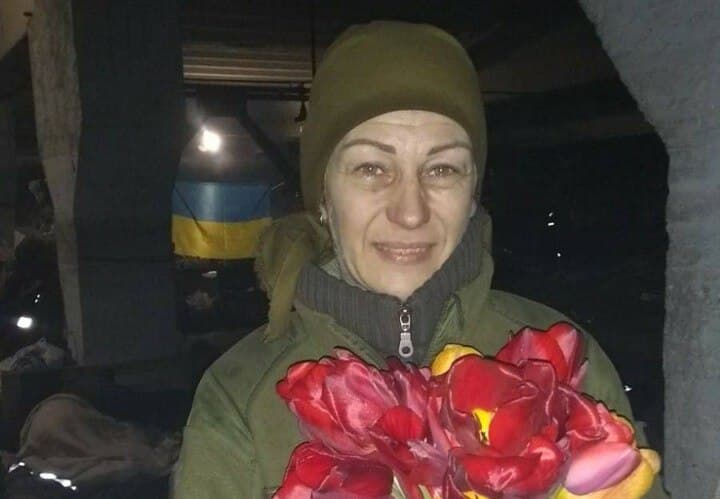
No matter where a woman is, she always stays a woman on the inside
A female paramedic from Azovstal described what Russian captivity is like for a woman
Tetiana Vasylchenko11/02/22 - Recording
I’m in Mariupol, don’t tell Mom
A Ukrainian woman about her brother, an anesthesiologist, who was taken captive
Karina Mkrtchian07/01/22 - Recording
They beat one fighter from Azov for three days. In the morning the guard called him a hearse
A volunteer from Mariupol who endured captivity and torture in Olenivka
Vitalii Sitnikov07/22/22