Recording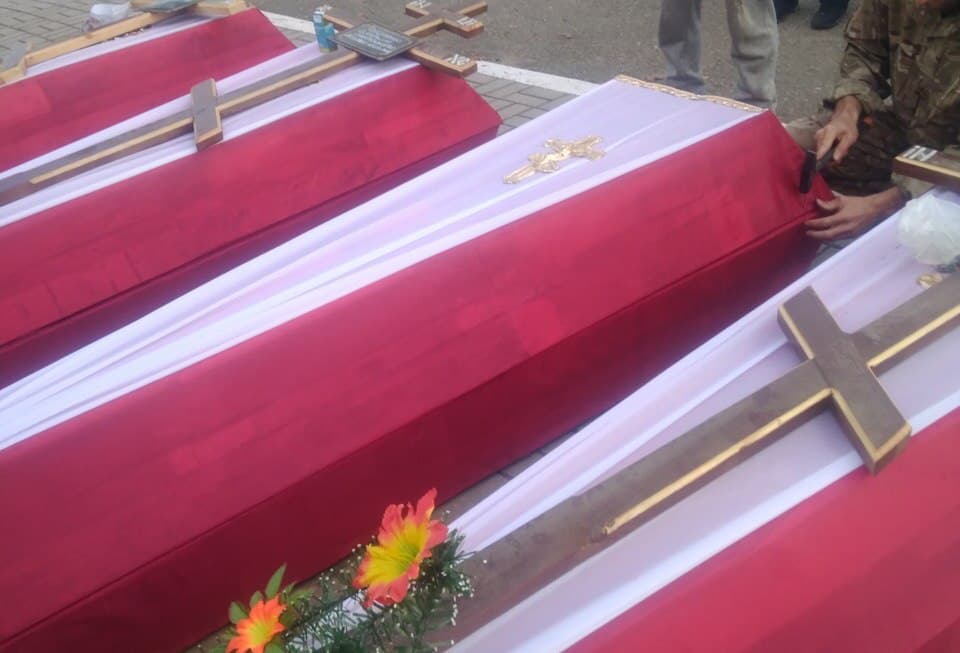
For me they’re alive — I talk to them constantly
A Ukrainian who lost his family returned to Mariupol to rebury his relatives
Serhii Demchenko12/12/22
A resident of Mariupol lost nearly his entire family during a shelling
Serhii Demchenko came from Cherkasy to visit his mother and children before the start of the full-scale war and was unable to go back again. His entire family — his ex-wife, mother, disabled son, and two daughters — sheltered from the bombings in his house. In the first weeks of the siege of Mariupol, the house was hit: the family ran to a shelter, but Serhii’s mother, ex-wife, and daughters came under fire. When he ran out, his daughters and ex-wife were already dead. His mother died in his arms over several days — he could not reach the hospital because of the shelling. After burying his entire family in the yard, he barely managed to leave occupied Mariupol with his son. His son was also wounded and went to Germany for treatment, while Serhii stayed in Ukraine. Every day he remembers his family who perished.
Attention! Translation was done using AI, mistakes are possible
КА: Hello? Hello? Hello?
С: Hello?
КА: Hello, Sergey, good day.
С: Good day, Katya.
КА: Thank you for agreeing to speak with me. I know this isn't very easy. I'd like to ask you right away, do you have any questions for me that you'd like to clarify?
С: No questions for now. Maybe some will come up along the way, I'll ask them, okay?
КА: Okay, yes, of course.
С: Well, what questions could I have? You're covering this matter. I think that people, maybe, will need to know this kind of thing.
КА: It's very important to know.
С: Maybe someone will draw conclusions. You understand. There aren't many questions here. So, how will we conduct our dialogue?
КА: I'll ask questions, you'll tell your story. That is, I'll guide you, don't worry.
С: I understand. Good.
КА: Let's start from the very beginning. How did it all begin in Mariupol, when you were there? What was happening?
С: You're not from Mariupol yourself?
КА: No, I'm not from Mariupol.
С: Well, you know that Mariupol is not a very small city, somewhere around 500,000 [population]. How did it all begin? February, around the 20th, I arrived in Mariupol, I was at a resort in Bulgaria. At a ski resort, I love skiing. Usually I go with my daughters, but this time I went alone, they were busy with work. Plus with one of my daughters... Before New Year I went with her to Bukovel [editor's note: Bukovel is the largest ski resort in Ukraine]. We went with one of my daughters, also vacationed skiing. I arrived, the Bulgarians were [saying] that there would be war, there would be war. Well, we all kind of... Will there be or won't there be - that's such a thing. You never want to believe in bad things. I arrived in Mariupol on the 20th or 21st [of February], I can't remember exactly. On the way from Bulgaria I stopped... In Cherkasy Oblast my wife [lives]. Well, near Cherkasy [she lives]. I stopped there for a few days. My wife lives there recently. This is my second wife, we've been living together for 12 years. We moved in 2015, when there was shelling of Mariupol from the side of the Donetsk People's Republic. We decided to [move] to central Ukraine, and bought a little house there. Well, a small house, rebuilt some things. She liked it there, well, me too. So I lived part of the time in Mariupol, the bigger part, the smaller part there in Cherkasy. I stopped there, returned to Mariupol. Here I see commotion, everyone's running around shops, buying food and so on. I didn't manage to stock up on much there. Well, and I thought, what I need... With me lives... Lived at this time and all the time my son. My son is disabled, he doesn't walk, he's in a wheelchair. Long story, childhood trauma, he used to walk, but then worse and worse. In the end, problems with the spine. I bought something for the two of us. Fruits there, such things. And my daughters live, lived rather... We're in the house with my son, and the daughters are across in a nine-story building with their mother. Well, with my former wife, with whom I lived 25 years. Well, relationships with the daughters are normal and so on, but with my wife we saw each other, but rarely. Normal relationships in principle, we decided everything regarding the children.
On the 24th the war began, like for everyone. At first we... We'd already lived through one in Mariupol. Everyone thought: "Mariupol is a Russian-speaking city, half the residents are from Russia." I myself was also born in Russia. I didn't live there, only visited, there are many relatives there. In Bryansk itself, in Bryansk Oblast mainly, and I was born in Bryansk Oblast. My mother basically took care of my son and helped. Well, grandmother, 84 years old. She was small, thin, Kingdom of Heaven to her. That is, she still ran around well, took care of animals, fed cats and dogs, took care of my son. My son's name is [inaudible]. That is, she cleaned for him, cooked something. He didn't cook himself. Quiet, measured life. I worked, business.
The war began. My wife, Lilya, with whom I'm now here in Poland, who was in Cherkasy. We called each other 20 times a day anyway, and she immediately: "What are we going to do?" Lilya's son, well her son from her first marriage, he lives in Poland. I sent my daughters to Poland too at one time. They studied in Poland. That is, I paid for this whole thing completely, they studied four years in Poland, but didn't want to stay, however much I insisted. They didn't want to, they came to Mariupol. Actually, they came in early 2021 or late 2020. That is, a year to year and a half maximum. Actually, they both got jobs, one and the other.
Lilya calls from Cherkasy - "What are we going to do?" I say: "Well, I don't know yet." It started rumbling, shelling began somewhere far away at first. There was still communication. After two-three days everything [got] closer and closer, explosions already began near the city. We lived in the city center. There's the old city, new city, all together. We lived nearby near the center. Old merchant city. I have a house built in the 19th century. And new neighborhoods here, nine-story buildings across the road. [Everything rumbled] closer, closer. Then explosions began on the outskirts. I helped transport... A worker who worked with me, I transported him from the outskirts to the center to his relatives. Now let's say, I drove around the city by car, there were already broken cars here and there, there was already damage. That is, things were already landing.
Then, this was somewhere at the end of February, after a few days my daughters come. For some reason I thought that they would go somewhere with their mother, evacuate, maybe. They come, they say: "We haven't left anywhere yet. What are we going to do?" First the daughters came. I say: "Well, you didn't leave. We're sort of still here. Well, come on. Join us. A house is safer than an apartment."
КА: Yes. That's for sure.
С: With that same calculation I [thought] too. Moreover, in the house I have a basement. Not in the house itself, but in the garage that I built. There's a two-story garage and under it a big basement. Basement for tools and for this [everything else]. There back in 2014-2015 we equipped... Then too there was Donetsk People's Republic shelling. There are some bunks, chairs. Since then there's a water supply. Before this war I changed the water, threw out cookies that had been lying there for seven or eight years. Put candles there. Well, kind of prepared a little. I thought that if we had to. But still, it didn't fit in my head that we'd have to sit here, because...
КА: That is, you prepared for war, because there was shelling of Mariupol in 2014-2015, but you didn't fully believe that such a full-scale war would begin?
С: Of course. Nobody believed in this. Absolutely nobody believed. Absolutely. Everyone I talked with said: "Well, they'll shoot there on the outskirts. This or that will be decided, the rulers will come to an agreement." In Mariupol, of course, many were for Russia, but again, for what Russia. Depends what Russia, right? Still, many Russians. I, let's say, although I'm Ukrainian by passport, but born in Russia, I wasn't for Russia initially, I wasn't for the Donetsk People's Republic. And I bought a little house in Cherkasy, in Ukraine, and many already then left for Russia. Many remained, who are of the older generation, my generation, who caught the Soviet Union, they believed that Russia is good. Everyone has their own opinion. These language issues especially, which were being inflamed, everything got muddied [editor's note: equivalent to "stirred up"]. Here practically everyone speaks Russian. Ukrainian speakers were only in villages, and even then, I remember in childhood, I ran around the village, there even then they speak more in surzhik. So about 30 percent, I think, were for Russia. Well, depending on what Russia. People simply couldn't imagine what this was, and what it's eaten with.
Then they started cutting off. I don't remember anymore what and in what sequence. Either they cut off electricity first, or water. No, electricity, probably, they cut off first - we were left without electricity. First they cut off the suburbs, in the center there was still electricity. Then they cut off electricity in the center too. Then they cut off water. Well, good, we already electricity... when they cut it off - they cut it off temporarily at first. They'd cut it off, turn it on. This was already when bombings were going on the outskirts already concretely. I walked with the dogs every evening, and it was very audible. That is, they were already bombing the outskirts concretely. I was relocating people to the center. I transported things by car, because there already was... Well, there it was already basically impossible to live, because shells were already flying in there. These are settlements around the city.
КА: Was there gasoline? You say you transported people.
С: The thing is, I have two cars. Well, I got one for my son. These are electric cars. Electric. Like, in recent years I don't go anywhere, only to the dacha 40 kilometers. The electric car allowed it. There the range is 100-130 kilometers. No problem, I stuck it in the outlet, charged it. Plus I had two charged cars: one stood in the yard, one in the garage. And then, when they were shelling the suburbs still, there was electricity, I charged them. Well, and there was still gasoline then. I communicated with people, friends, acquaintances.
Then, when my daughters came, acquaintances also came from the neighborhood from the outskirt of the city, which is from the side of Novoazovsk - from that side, closer to the Donetsk People's Republic. There it was already impossible, they were already shooting. This is that neighborhood that they shelled in 2015, when they damaged many nine-story buildings there. People also died plenty then. Civilians. I say: "Well, here, second floor of the garage." I had it, like a two-room apartment. I say: "But only gas remained." And he came - six or seven people there: him, his family, sister, girlfriend, two little dogs, two cats. Please, take it. That is, I freed it up for them. But the thing is that there was gas, but the gas was already running out. Heating wasn't working anymore, weak pressure. Apparently, they already damaged something somewhere. That is, the stove burned with a weak flame. Accordingly, cold. There were frosts then surprisingly, 10-15 degrees below zero. In Mariupol such frosts are generally rare. Actually, they lived a day and a half or two days, and he found somewhere in Mariupol nearby in the private sector a little house with stove heating, and they had little space there. That is, seven people, and there were only two beds - a sofa and a bed. And then he says: "We found [something]." Well thank God, they found and glory to God. They moved there, to the private sector.
Then the children say: "Mom is alone in the apartment - well, my former wife - can she come here too?" I say: "Well, of course. How can we leave mom?" Mom, they took the cat. At first they didn't take it, left it in the apartment, because cats get more attached to place than to people. Well, we all hoped that it would end soon.
Then they cut off gas. Big frosts. Big frosts...
КА: Am I understanding correctly that your former wife, two daughters, you with your disabled son and also your mother moved into your house?
С: Also my mother, who... she has a one-room apartment, somewhere a kilometer and a half, if you walk. This is in the neighborhood, a one-room apartment just across from the famous "Azovstal" plant.
КА: Oh God.
С: The "Azovstal" plant is basically in the city center, because it was built on the outskirt, but then behind it there's a whole very big district of the city, like a separate city still - behind it. The "Azovstal" plant is at the mouth of the river. Here's the sea and the mouth of the river. And they have their own port for small vessels, there are fishermen and so on. And we're not far from Azovstal, because all this was built, the city center was all built on elevated ground, and below is "Azovstal." From me in a straight line about three kilometers - "Azovstal." Actually, across the bridge over the river from my house. Well the whole center is located like that.
КА: It turns out that your wife stayed in that city where you bought a house?
С: We all initially lived in Mariupol. When we separated, the girls were nine years old. Well, this is life absolutely. The son stayed with me. We divided property and divided other things. Although basically, what was there to divide. She says: "I stay with the girls, you stay with Artur, with the son."
First I built something there. Built a sauna with a summer kitchen. Then I rebuilt part of the house. Then, when we divorced, this is 2009, she left for another city with the girls. The girls are twins. They're different, but were born at the same time. She carried them at the same time. They were born at the same moment. Although they're absolutely different: one is thin, the other is fat. My wife left for another city, got married in Donetsk Oblast, [village] Pokrovskoe. Now it's Pokrovskoe, before it was called something else.
КА: I was just asking about the wife you're currently married to. She was in a different city.
С: Well, I'll get to that. I thought you were asking about my former wife.
КА: No. You said that at the time the war began you were separated from her.
С: Well, yes. I stopped in Cherkasy, and came here. She was supposed to come to Mariupol in early March. That is, March 8th - women's holiday and so on. For maybe two weeks. Well, we would have decided there. Actually, we even bought her train tickets. There's a direct train Kyiv-Mariupol that goes right through this Smela [editor's note: Smela is a city in Cherkasy Oblast]. That's how we traveled. I didn't go by car, because by train is more convenient, you lie down, sleep, sleep through the night and you're there.
КА: She couldn't come?
С: Well of course. The war began. We call each other every day - what to do, what to do? I asked my son: "Should we leave? Lilya is waiting for us in Cherkasy." He: "No, I'm not going anywhere." Well, understandably, he's in a wheelchair, it's hard for him. It's problematic - on trains. Well, everyone hoped that everything would end quickly. Then our mom: "Should we leave?" She says: "No-no, I'm not going anywhere. Where to?! I'm so old. I don't want to in short." I call back, I say: "Artur doesn't want to go anywhere, grandmother doesn't either." I say: "I probably [will stay] too." Well, not "probably too," [but] "I'm staying here. We'll wait it out somehow." She tells me: "My son - well, Artem, who [lives] here in Poland - directly demands that I leave for him in Poland." He's in Lublin, where they studied, there he works. He works for some French company. Well, not bad. She says: "Then I'll be leaving there, moving." Well okay, we decided with her. "Move there. If anything, leave the keys with the neighbors." Actually, we talked with her on March 2nd or 3rd. This was already the end of communication. And even then we talked already on Vodafone. She has Kyivstar, and I have two cards. We talked on Vodafone, because Kyivstar already didn't work in our Mariupol. They already destroyed the towers, communication was cut off.
When she told me that she was leaving, communication was interrupted. I never knew whether she got there or not. She took with her another acquaintance with two children to Poland here. Today this acquaintance is already in Ukraine again, yesterday she left, returned back. Today she wrote that she reached Lviv, everything is normal.
While there was water... We collected a lot of water with one of my daughters, with Olya. Private house, bottles, I have a fountain near the house. Well, such - mini, but there's a figure, water constantly. There are about 500 liters, probably. Tanks, bottles, with my daughter we stocked up - [we didn't know] will there be water further or not. Let there be. We stocked up. Probably a ton, one and a half tons... One and a half no, but we collected a ton. Before this I also bought drinking water in bottles, but it went fast. Then from the tap... then we were happy even that it existed at least. Because then from the tap there wasn't any. Then this was already considered oh-oh-oh [what luxury, if there's water from the tap].
Then concrete shelling of Mariupol itself began. Already concrete. There was already no communication, nothing absolutely. There was no communication, no gas, nothing. There was still food, we cooked something. I had a gas cylinder, we rigged up something, some little stove, burner, cooked food on it for now.
КА: But you cooked food from supplies?
С: Yes, well of course. From supplies, what there was, but there were few supplies. Let's say, private house... I lived there alone with my son. What supplies? Lilya sends preserves and so on from Cherkasy, what she cans. I gave it all to my daughters. There were no supplies. If beforehand... Let's say, in 2014, when it was starting, there were big supplies: canned goods, other things. This time I was away, I was at a resort, I didn't have time. Well and everyone again hoped that this would pass quickly, briefly, somehow would be resolved, that they would agree on something, the European Union would intervene, America would sit at the negotiating table with Russia and somehow this would be resolved. Everyone hoped for this absolutely, both those who were for the Russians and those who weren't for the Russians. Therefore, why did few people leave Mariupol? When I was already with my daughters, with the cat, we moved to the house... At first the house wasn't very cold, they slept at their place. I built the third floor especially for them. Two rooms, shower, toilet, storage rooms, other things, other things. This was somewhere in 2012 or 2013 I built. They slept there. Then, when it got cold, they moved downstairs. We all slept in the living room, in one room - some on the floor, some on sofas. There we spread blankets, covered ourselves on top with blankets, jackets. And plus we heated with a gas cylinder. We heated a little in the evening, but the ceilings are high, these are old houses, four meter ceilings, there it especially didn't [warm up]. Well, in any case we somehow waited it out.
Then, when concrete bombing of the city began, we started running to the basement under the garage. Here again: in the house it's cold, and in the basement it was generally very cold, because the temperature was minus 10 - minus 15. Well we sit there for an hour, while they bomb, we freeze. A neighbor from the neighboring house also hid with us. Then children came to the neighbor, a nephew, niece with a little child. They too. Then someone else came to her. Well, also from relatives. In short, we packed in there about 12 people.
КА: Wow.
С: Well kind of, we put these little chairs there. Basically, we fit. The thing is not that, the thing is that the basement wasn't adapted for this. The descent into it... This isn't that basement that they used to dig with steps. Tools were stored there, shelves stood. Above it a car, above the entrance. It's inconvenient to go down, to go up too. Many people... The neighbor, let's say, is also already aged, she's 70 [years old]. For her to go down and up - this is problematic. No light, we ran at night. It starts at seven in the evening, from seven in the evening till eight shelling. So we sit then another 20 minutes. We went home, because it's cold there. At 11 it starts again, again we go there. And so during the night... Four-five in the morning we go there again. Actually, from the beginning of March somewhere until the middle of March we exhausted ourselves running. Plus a disabled son. He has a wheelchair. The wheelchair stands under the house, to quickly transport him, I drag him to the wheelchair, there on his knees he [goes] to the exit. Running there to the basement running 40 meters, to the garage, no less, because between the house and the basement there are two more buildings. Well all this - time. Until you drag the wheelchair down. There to climb down on knees by iron ladder by angle iron. He scraped up all his knees, they were already sick.
КА: God.
For him this was very torturous. Well while there were candles, we lit candles. There were some flashlights in the house. Flashlights need to be charged. Lamps, let's say, several pieces I had from those times [from 2014]. Well again, kerosene that I bought, old kerosene burns, new kerosene doesn't burn. It sputters. I had half a bottle of old kerosene. In the house a kerosene lamp, in the basement a kerosene lamp. Well plus, my mother, grandmother, 84 years old. Yes, she runs around, she would have lived still. Another ten years she would have lived. Small, thin. She has a healthy heart. Yes, joints hurt, this and that. She would have lived still.
And so - we got used to this tempo. During the night two-three times to the basement. They bombed the city center concretely too, and at our place. The first corpses already started appearing on the streets, which weren't removed. People already [went] to shops... Well, you have to eat something. What shops? Somewhere it hit, somewhere the first nine-story building - we saw near us, that a shell hit it. This was wild. Then I drove out by car, saw tramway tracks mangled. Landmines are falling. With grandmother we drove to her apartment, she was saying goodbye to her neighbor. A neighbor of the same age. She herself stayed, but then her children took her - I went to her myself already. Something was burning there, they broke a gas pipeline, it's burning in the middle of the street. Well, gas is burning. This was until the middle of March.
Then my son said that he wouldn't run anywhere, all his knees and elbows are already scraped. He says: "I'll be in the house. The walls here are thick. Whether they hit the house or not is unknown." A day or two he was in the house, until air raids began. They bombed a school nearby, 300 meters from us, a new school. A bomb hit it directly. Shelling began such that the house shook, although there are meter-thick walls. Windows started flying out from blast waves already, although they were all taped up. I taped up all the windows. But blast wave - this is such a thing that nothing saves you.
Concretely, when the children died, this was the 18th. We sat the night in the basement. We froze. We froze... We sat the night, somewhere from four till six. We moved to the house, there we lay under blankets, but nobody undressed anymore - what undressing already. Already everyone lay under blankets in jackets. Somewhere at half past seven - twenty to eight shelling began again. Shelling began again. Shelling began again very strong, because the house shook, the ceiling started crumbling. Grandmother kept worrying that in the living room a huge chandelier hangs at my place. I say: "There's a good hook, because I looked myself, because the chandelier is heavy." I controlled how they mounted this hook. She kept worrying that the chandelier would fall and kill someone.
Shelling began, we started running to get ready, to run to the basement. Here's grandmother, children, wife, Alya, well former wife Alevtina. I shout at everyone: "Run, run," but I'm watching Artur. If I, maybe, hadn't shouted: "Faster, faster"... I don't know. They jumped out first, and I was pulling Artur to the entrance.
Well and here a very strong explosion, such that doors that opened outward, they were practically pushed inward. Then they swung open, with staggering steps comes in... somehow I saw with peripheral vision, I was somehow looking at Artur, urging him on, comes up, falls inward grandmother, she's smoking all over, hair is smoking, clothes are smoking. And she falls here at the entrance. I ran dragged her, dragged her away from the entrance from the corridor. And running to the street.
When I jumped out to the street, near the threshold lay one of my daughters, Anya, everything was in blood. She was lying, she already... she nothing absolutely. Plus she was... I don't know, is this necessary or not. A leg was torn off. Already the whole house is in blood, this is right near the house. There stood my son's car, I moved it to the yard. Grandmother maybe wasn't killed because she stood a little behind the car, the car covered her.
I jumped out, and my second daughter and former wife, Alya, were lying near the sauna. There's a summer kitchen and sauna in one building. The second daughter was already, Olya, she was already gray. That is, she died. Alevtina was still moving. She opened her eyes, I thought she was whole. She opened her eyes, but immediately closed them.
Shelling was still continuing. Here at the neighbors something exploded there, and the neighbors jumped out. Something exploded in their yard. I started shouting: "Help! Something has to be done." A neighbor jumps over to me. I already [took] Alevtina, who was moving...
We, when we turned her over... Well, I knew she was alive. I felt, felt her pulse still, she's still alive. We, when we turned her over, shrapnel stuck out of her back, [inaudible] blood. I tell this neighbor: "Let's do something." Here another neighbor from the nine-story building where they lived [daughters with their mother] - this is across the street, let's say 100 meters from the yard this nine-story building. I say: "Grisha, something has to be done. What to do?" He says: "I'll run to the district department." There's a district department near us. Well, central district police department. Sasha [editor's note: Sasha is also a neighbor] tells him: "Well what, if we start doing something now, start moving, start removing shrapnel, she'll immediately bleed out. No, she can't be touched. Doctors are needed, we need to know what to do. If it were an arm or leg, then we would tie it off." I went back with this Sasha to the first daughter [who was] near the entrance. At first her... [inaudible] blood. And she, as she lay uncovered... He says: "We need to cover her with something." We started covering her, he says: "What is this?" I saw that this was the torn off leg. I covered it, found some plaid, covered her, so that at least this... And put some these, so as not to step in pools of blood, this is right in front of the entrance. There's blood, I don't know. There the door is splattered. The wheelchair that stood nearby near the entrance, bent. A fragment, apparently, hit it. Also all in blood, in this. Actually, he ran to his place through the fence, there the fence was destroyed. I [went] into the house. I started looking at grandmother, she asks me: "What's there?" I say: "Better not to ask." We started examining grandmother: a piece of leg torn out. What's burned is this. Well, she was shell-shocked, naturally. We bandaged her, tied it off. I was in such shock that I don't even know. I went out to this Alevtina, I look, she moved a little, like she crawled away, but she's already not coming to herself. To these daughters what... Well both, both dead. This was such shock that I can't convey.
Here comes this neighbor, Sasha, who's younger, with whom we turned over Alevtina. He's younger, he's somewhere around 40-something years old. And Grisha, who ran to the district department, he's older than me, he was somewhere around 66 years old. Grisha comes running, says: "I ran to the district department, there's one scared policeman sitting, says: 'I don't know what to do, here are corpses... People are stacking them here.' What next - how, what? He's not informed. This was still Ukraine in the city center. The outskirts were already under the Russians.
Here I remember little especially, because there was such shock, what to do, how to do, where to do. Good thing this Sasha comes running, says: "In the five-story building across the street... - a five-story building of Stalin type, built still under Stalin, it's alone there - ... in the basement there are places." Although my wife, Alevtina, went there before this, they said: "Places only for our own, everything's packed." Well okay, we have our own basement. I say: "What do we need there?" He says: "It's warm there." Because the cold was wild, everything got chilled. We already wrapped ourselves in whatever. Wild cold. Already totally. He says: "At least it's warm there." I say: "How will I? Artur can't walk." Sasha knew my Artur. They're approximately the same age. My Artur is 37, Sasha is also around 40 somewhere. Probably a little younger. Yes, he's younger than Artur, because Artur knew his younger brother better... No wait, I'm saying everything correctly, he's around 40, because Artur was more acquainted with his younger brother. That's not the point. Sasha says: "Well what, shall I help?" He hoists Artur up... I say: "Are there definitely places and so on there?" He says: "We'll fit. There are very many people there, but it's warm. This is definite. Today I moved my family there." Well his family - that's also two families: three children, five adults. That is, mother, two daughters of this mother, adults and three children. He says: "We'll find places." He takes Artur first on his shoulders, and ran there. I wait for him, I say: "When you come back, then we'll [do something] with grandmother." And there the basement is deep, 11 steps. Such a basement, they used to build basements so that there would be rooms for storage for residents.
Then he came back, we took grandmother, also under the arms, and ran there. There people saw, took her. Basically, I knew some, some I didn't know. There was a grandmother there, whom my mother helped, went to the store for her. I say: "Hello, baba Shura." She says: "Seryozha, is that you?" I say - yes, it's me. Well there was no water, nothing, I was already unshaven like that, yes and she already - age already doesn't [allow easily recognizing people]. She asks: "How are the girls?" I say: "The girls are gone and Alevtina is gone." She knew everyone, not one year we lived together. She - "It can't be!" "Well, that's how it is." Well we brought grandmother into the basement too. In the basement there's no light, 40 people in the basement. There are several rooms: one big one, a little corridor. We put grandmother in the passage. Put, well this is saying it mildly. Well, in the passage. There's a folding such... Well like a small ottoman, something like that. She needs... Good thing, a guy was found who understood a little about medicine. He immediately looked at the leg, says: "Yes, nothing terrible. But half the calf is torn out by a fragment and the bone is completely broken lower, where the foot is, this little bone dangled like that... He says: "I don't know what to do, here injections are needed. And even then this probably won't help." Well actually, then Artur still had some medicines. Artur always kept medicines with him. Then there were still some medicines. He, actually, gave grandmother an injection. Grandmother - yes, it hurts. Well she was such a courageous woman. Never complained that something hurt. Yes, it hurts, well what - age!
Well actually, we moved to this basement. Yes, it was warm there. Well, warm how? There at least you could sit. Somewhere +10-+12, but there were very many people. Some lay, some sat in the passages, everywhere.
Somewhere after two-three days near the five-story building Russians already appeared. They cooked on fires, near the entrance. People cooked, Russians appeared. They came immediately: "So, we are liberators. We came to liberate you." Someone there started saying: "Thank God," someone there was silent, someone, like me - just were silent, watched. They near this entrance, we were in the basement of the first entrance, near this entrance they set up a type of headquarters. Well like headquarters for military actions, because military actions were going right here in the center.
From this five-story building across from my house, from the five-story building to the entrance to the house, probably 60 meters. Then to [inaudible] 40 meters. There's already my yard, gates of my house.
Actually, life in the basement: dirt, no light, nothing. On me two bedridden: grandmother, who groans, falls into delirium. Plus darkness - it presses. We lit these splinters, oil, wick. Well, what does it give? Well, it illuminates a little. There, somewhere rooms, there families with children. Little rooms like that, storage rooms. There too some on the floor, some on chairs. There they brought from all over... Before us they brought still. Grandmother here was given this - like a folding...
КА: Ottoman?
С: Well not ottoman. For an ottoman there's no room. This is like a chair, but folding. And on it were loungers. Like an armchair-bed, but very-very small, without armrests. And there it props up, such these, like on a folding bed. Like a folding bed... Maybe, some mini one. Well she [grandmother] is small, maybe it was enough for her, if it hadn't been so broken, she constantly wobbled. I put some little props, so that not this. She constantly fell from there.
КА: Oh, my God. Was there no possibility to somehow move her to a hospital?
С: What hospitals? There was nothing, nothing worked. Everything. There were no hospitals. Plus shelling. There were no hospitals. This is later... ... Well in order.
So, there police. I have to somehow bury them. I prayed that it wouldn't warm up, so that this... I didn't think of it in time. I wasn't afraid, I walked, looked. Only on the third day we covered with sheets with a neighbor, on the second-third day, covered hands and legs, because they lay each in whatever position.
Former wife, Alevtina, already after about an hour and a half, I probably came to her for the next time. This was already the fifth or tenth time. She was already gray too. Everything was already clear, that she died, but she crawled about two meters from the place where she was lying. I didn't see how she and what she, how she crawled. Well I'm near grandmother, near Artur. Artur was near the entrance too. I don't know how nothing hit me. [Inaudible] in the back, in the buttocks, in the leg small fragments. Where are they from? Then they picked them out. There he had several operations on his back long ago already. Plus this. It started festering later.
On the second day, as we moved there, Russians already arrived there. They blocked with bricks near the corner of the house. Put up a sentry, made like a checkpoint. They started immediately breaking down apartments, looking for snipers. All apartments absolutely they broke down, what didn't yield to blows. If there were neighbors who had keys to neighboring apartments, they opened them. If people left or people are somewhere here, but didn't open in time, they broke them down or blew them up, if the doors were armored. Same thing with all garages that stood nearby. That is, they broke down everything, looked for snipers. Right here they checked several times through basements and such. Plus their entire negotiation group on radios, their commanders of these groups. Plus tanks near this... They're behind the five-story building, and ours, the Armed Forces of Ukraine, they're on the neighboring street, 100 meters away. And this five-story building kind of covered them. They these tanks... APCs would come, reload, reload their cannons, their heavy-caliber ones, heavy-caliber machine guns that are on APCs. They'd reload, then go. So they clear this sector. These ones, let's say, rest, those went. Infantry, snipers. And Sevastopol marines were stationed near us. These at least somehow looked like an army. When the Donetsk People's Republic entered, these are complete riffraff. Complete riffraff, fuck.
КА: And did they somehow contact you? Did they try to search you?
S: Yes. They checked documents. Well, passports, they immediately, unambiguously, that passports should be with everyone. If you're not registered here, not in Mariupol or somewhere... Well, at first they would take them. They'd stop you on the street. And how. There's no water, you have to go to a well for water. There was a broken house there. It's about 20 minutes walking downhill, and then you fill up containers, and you stand in line for an hour and a half. Well this is the closest at least.
You had to go for water, somewhere you had to look for food in bombed stores, warehouses, people ran there. Someone took food, someone took vodka and wine. We also had such people in the basement who, let's say... Well there were no incidents, but alcohol lasted for the first while. Well, our nurse then gave injections. She's an animal lover. A terrible lover. She says: "Here I am, fool, fool. Someone takes food, and I drag cat food." She sat across from grandma.
It turned out that I had picked up two kitties to my yard before this. People fed them. Girls brought one cat into the house, well my daughter, Olya: "Dad, well take her. Let her live." And my old cat died of old age, two cats remained. Well okay, I love animals. Then she says: "There's also her sister, the same." I then walked with dogs and took her sister to my yard. I sterilized them, visited the vet, and they all live peacefully in the yard. Then this Natasha, the nurse, when she learned that it turns out these are her cats at my place, says: "Oh, and I was planning to come, see how they live." I showed them to her when we came to my yard. Well these are animal lovers. She always walked, and she always had animal food in her pocket or bag. She says: "Here I am fool, fool. Someone takes food, and I drag cat food." At home in her apartment she has 10 or 12 cats and, by the way, when I went to my house, I also had food. She would say: "Don't you have food at home?" I'd say I'll look: "The girls seemed to bring something." Then I found some, I also gave to her. And she injected my Artur too, while there were medicines, she had something then too. And she injected grandma.
On the fourth day Russian military said that... Well it was impossible not to talk there, because they speak Russian, we speak Russian. We asked: "When will this all end?" They're like: "Yes, a day or two." This day or two dragged on very long. They say: "Yes, we'll kill them all." I think to myself: "Yeah, right, you'll kill them all." Impossible... I, let's say, asked - there were Dagestanis or whoever was there - I asked their commander: "Can I take mine to the cemetery?" They answered me: "Drag them to the roadside, then morgue trucks will drive around, pick everyone up." I say: "Into mass graves?" He says: "Well, I don't know. I might help, but not now, we have our own tasks." Well yes, they fought constantly. Fought specifically, because ours were on the neighboring street. They said "a day or two," but this "day or two" wasn't "a day or two." The next day they told me that a hospital on the outskirts of the city works, it was regional, that military surgeons receive there. Military. Wounded.
КА: And you took mom there?
S: No, I went first myself, because what people say... I was already convinced that what military say isn't always truth. Some say one thing, others another. I first brought out the car and went myself. I wanted to drive through the center, went through the center, everything's destroyed there. You can drive on one road, on another there are blockages. I got onto the highway, there I had to go by detour routes. I went through the center, looked at the Drama Theater, where the bomb hit... Where, by the way, we went several times with Alevtina when they announced there would be evacuation. Hundreds of people would gather there, and then evacuation would be cancelled. I don't know who's to blame for this.
Now the city mayor [they accuse], many say he didn't deal with this, it could have been solved. But there was no evacuation. I went once, she twice. Well, there's the city center, the Drama Theater right nearby, [unintelligible] She went there two more times, but there was still no evacuation. People would gather, then bombing, people would scatter. Such evacuation, which would be on buses and such - there wasn't.
Some tried to leave by car. This nurse Natasha I was talking about, the animal lover, she threw her daughter into a car with strangers under bombing. Took their phone number. I learned this here, that someone informed her. There's no connection, nothing - no phone, no internet. Someone informed her that her daughter is in Chornobyl. When I learned here, it turns out they told her wrong, the daughter is in Ternopil. I wrote in telegram: "If someone meets her, tell her the daughter is in Ternopil, they're planning to take her to Sweden." I don't know if they passed it on or not, because I can't contact Mariupol. Well, maybe someone through this... I wrote how to find her, where she lives. I think they passed it on.
I went to the hospital by detour routes, somehow got to the hospital. No one's at the hospital. What did they tell me there? There's some orderly there. I say: "What to do? I have a wounded grandmother." [He says:] "Bring her. Military surgeons are here, they'll decide" - "Good. What to do with the dead?" - "The dead? Here they are. Morgues are already full, they bury in front of the hospital. Then it'll be possible... Anyway, whether you bury or don't bury. No one gives any certificates. Figure it out yourselves." When I came back... Well let's say, I got to the hospital more or less without incidents. When I was driving back, fighting began right on our streets in the center. I went around first, good that people stopped me, said: "You're driving straight into landmines."
КА: Oh lord!
S: Yes. I didn't see at the intersection. Well, some spikes stick out, I don't see the mines themselves. Good that they shouted to me, I heard it, because I was driving slowly, because you can only drive there slowly and with hazard lights on, with emergency lights, because that's how they shot cars one-two-three. If a car drives fast, without anything, because I saw this simply - they shoot immediately. I went around, went down that street I used to get to my place. Fighting there. Went back. Came back, and I have no other way to get home. Through the block 300 meters, here the road is all in debris, you can't pass, and through the bottom tanks stand, APCs shoot. On my block, there where I am - Russians, and across the road right there - Ukrainians. And they fight.
A tank backed up, I entered this street, kind of an intermediate street, and drove past these tanks, APCs. As a result I have two shrapnel pieces in the car, glass broken, hood was also broken. I made it, I drove on sidewalks among trees. They shouted at me, I don't know who shouted there "where are you going?!" In the end I somehow broke through. Well, broke through here, I can't take grandma back to the hospital, because they're fighting here. There's no other road.
The next day... Grandma gets worse and worse. She's constantly delirious, comes to her senses. Today she cries for the granddaughters: "Why did I stay alive. The granddaughters are gone." Then she forgets they're gone, talks. Doesn't sleep at night. At night she'll fall, crawls on this floor. It's dark there, you can't see anything. Then she screams something, people wake me. I lift her up, lay her down, sit near her, give some sleeping pills, painkillers, wake the nurse. The nurse also sleeps sitting. Well, or she wakes me - here, your mom [needs help]. There was something for a toilet set up in this basement. I understood this was once a toilet, because an old tank hung there. I knocked down two bunks there - there were shelves for jars or something - for myself and my son. But I understood there was once a toilet there, because an old toilet tank hung there. I knocked down two bunks for myself and my son. There were shelves, I just reinforced them, propped them up. Then they collapsed along with these jars on us. Then people were asked, carried something out, threw out. And so he [son Artur] lay on the first one, on this floor, and I on the second, to run back and forth. To him... you carry in your arms, I lift her all the time. Slept 20 minutes, [then] she'll wake up. Here's Artur, also shrapnel in his back, inflammation, fever. And plus he's disabled, he needs medicines.
On this day I couldn't leave with grandma. On the second day I kept waiting for fighting to stop, but it doesn't stop and doesn't stop. Plus right here nearby these... They reload, right here these on radio in front of me conversation: "We got into an ambush. Don't spare anyone. Fuck them all up."
КА: Fuck...
And here we look - planes, right here nearby, 300 meters maybe, hitting private houses. Here tanks began shooting. Tanks stand near us. A tank shot - it deafens completely. Planes began there... Here in the basement with us - these two families I was talking about, neighbors moved over - his father was killed. He didn't want to go to the basement. And his father was killed in a private house. Then they found him buried after five-six days. It calmed down a little. A little - this means that right here they don't bomb, don't shoot specifically. So I run to the house. I went all the time to the daughters, to Alevtina, looked. I run to the house, snipers, don't know whose, won't say, but it was dangerous to move, because bullet either into a pole, or knocks off a branch. Well, most likely Russians, because they stood above on that side, because ours stood lower already.
On the second day... Well here's also how... I couldn't drive the same road. Fighting was going there, everything's blocked. I see, the crossing is completely destroyed. Well, Russians for their tanks and APCs between nine-story buildings cleared, with what they cleared I don't know. Well, probably drove through with tanks, trampled a road. I think this way - I'll be able to pass. It stopped a little there, I run for the car. I approach this house through debris. I asked the guys, they lift grandma on a blanket. And she has a leg, naturally... Every movement for her is wild pain. While they carried her upstairs, while they put her in the car, she lost consciousness. So I drove. This time I drove a slightly different road through the private sector - what they cleared - then to this neighborhood. There too there are craters... Then went there, there's a road, huge crater. Can't go through the cemetery, we have an old cemetery in city center. Well, no one's buried there anymore, weren't burying. I look, everything's overturned, right here everything's mined... Well, got to the hospital. Crowds of people stand there already, but they don't shoot in that part of the city. Fighting was right in the city center where we were. They ask me: "Where did you come from?" - "From the center" - "What's there?" I say: "Well, you hear what's there." It's five kilometers, if straight, maybe a bit more. If straight, by roads.
Well here they put her on stretchers and wounded... Two convicts, I understood DPR fighters... DPR fighters came as second echelon, riffraff. They didn't fight while we were there, they didn't fight. Russians fought, Kadyrovites... No, Kadyrovites were second echelon too. Some Dagestanis were there. Kadyrovites also didn't fight, they came second echelon. Also liberators, said: "We're liberating you." Such. Lots of arrogance.
They brought [mom] to surgeons. I stand, they didn't let me in there. An orderly comes out, asks my surname. Says: "Grandma needs her leg cut off." I ask: "Can I talk with the doctor and with grandma?" - "Yes." Doctor comes out: "Let's go. Cut off her leg." I say: "Did you tell her this?" He says: "Yes" - "What did she say?" - "She refuses completely" - "Let's go to her. Can I go to her?" - "Yes." She lies on these stretchers on the floor, here are wounded, they operate - military surgeons. This is a military hospital. That is, it's a hospital, but it doesn't work. Some bedridden, naturally, were there who got there.
We approach grandma, I say: "Mom" - "What? I won't let them cut my leg. I'll be 84. I don't know who will take care of me." Well, it really is like that. She saw how we drove. [Unintelligible] good it didn't explode, and we drive past nine-story buildings, all nine-story buildings [destroyed]. I say: "What will we do?" I ask the doctor: "What's the prognosis?" - "Well three-four days, they say, and she'll die." All this in front of her. I say: "Mom, what will we do?" - "I'd rather die." I say: "Mom. This isn't a solution." She: "No, I said and that's it." I see she's in sound mind. When [unintelligible] her into light, she came to her senses. There back and forth, while we drove, fresh air with open windows, while we drove. I see she talks normally, I say: "Good." Here they ran for my car. I parked it near the entrance. [They ask:] "Whose car?" - "Mine. Brought grandma." Well in short: "We'll take you here now, we'll take you there now. You think you're somebody special?" I say: "I brought a person" - "Now we'll crush it there. We'll take you to Volodarka now." To this... to isolation camp. Well, I drove the car away, they carried grandma out, put her in the car. Put her in the car, I say: "Well let's go."
Here the sun warmed up too. This is the first time, probably. Put her in the car, the sun warmed up. She sits, crowds of people for evacuation. They evacuate to Volodarske. Buses ran, two-three buses. Lines of thousands. I found out, lines really of thousands. They write down there a thousand something, and in a day they take out 150 people. They took then to Zaporizhzhia. Not from here, not from Mariupol, but from Volodarske. 20 kilometers from Mariupol. Well anyway, where do I go? With two bedridden. Who will take me. How will they be on buses? This is unrealistic. Simply unrealistic.
КА: Sorry for the question. I understand this is unbearable and very painful. Why did she say she doesn't want to live anymore?
S: Why did she say? Because the granddaughters were killed, Alevtina was killed. She says: "What am I, old?" She didn't want to live. She cried all the time. She didn't want to live.
КА: And how did you tell her everyone was killed?
S: Well it was in front of her.
КА: You just said you didn't tell her at first.
S: At first I didn't, then I told. Where to? They're on the streets. We enter the house where she is. Then I told, naturally. Then I told. What? Where? Here they are lying on the street. We enter the house... Then I told naturally. Then I told. What, we carried her out, she saw they're lying. When we dragged her to the basement, here she lies. It was impossible not to tell or hide something there.
КА: You left the hospital with mom...
S: Yes. We sat in the car. I say: "Mom, sit, at least look at the light, because now if we get there, if they don't shoot us, then again to the basement in darkness. How are you now?" - "I'm in full mind" - "Did you make the right decision? Look, this is your decision" - "Yes. I don't want to. If I have three-four days left, then I'd rather die. I'll meet them there sooner. What about me? Well they'll cut off my leg. And then what? Where? How? Who will take care [of me?] You have Artur on you. Where will you take him? You need to take him somewhere at least." Well we went home. We went a slightly different road, because on the road I drove, I thought I'd puncture tires. I think, I'll go a slightly different road. This is a slightly more central road. Two or three checkpoints. They searched us. I say: "Wounded grandmother" - "No. Come on." Well, this is Donetsk People's Republic. These are scum. Some snotty kid stands there, and begins. And he has a machine gun and such. Riffraff. Well anyway, okay. I brought her to the basement. Again guys helped, again her down to the basement. We put her again on this same couch. There was some painkiller either at Natasha's, or... Well all apartments are broken into. Everyone began going through apartments. How to go? In those which we... There wasn't looting yet. They took, let's say, looked for medicines, took water, maybe someone has in apartment, because everyone from these same neighboring houses. Didn't take such things that aren't this, that aren't needed, no one especially rummaged through things. In apartments windows already knocked out, these doors knocked out. They knocked out once, then came second time: "There's a sniper in your house." Again they began there, where doors aren't knocked out, but closed at neighbors', began opening. They injected grandma, she dozed off.
So, Katya, I need to step away. I'll go up now. Can we take a break?
КА: Yes, yes. Let's in 5-10 minutes, good, of course.

A female medic from the Armed Forces of Ukraine went through captivity while pregnant
An anesthesiologist about being in captivity in Olenivka
An resident of Izium on life under occupation, her husband’s death, and evacuation
A mother of three lost her husband during the bombing of Mariupol
A volunteer from Mariupol who endured captivity and torture in Olenivka
A Ukrainian man lost seven family members in one day. He couldn’t bury them for over a year