Back
Finding him was the last tribute I could pay
A Red Cross worker who discovered the body of a fallen colleague while clearing rubble after a shelling
Arkadii Dabagian, deputy head of the Mykolaiv regional Red Cross, remembers his friend Valentyn — a volunteer who was killed in a missile strike along with his parents. He took part in searching for Valentyn’s body under the rubble and drove his body to the morgue. He also shares his experience of daily response trips after strikes, the role of the Red Cross in rescuing and supporting people, as well as reflections on the value of human life and the strength of the Ukrainian volunteer movement.
Interview
Transcript
Transcript
Attention! Translation was done using AI, mistakes are possible
КА: Arkady, hello.
АД: Hello, Katya. I, to be honest, was extremely busy, so I didn't quite understand your colleague. Can you tell me what you would like?
КА: The thing is, we read the story that you wrote about your friend whom you had to transport. We would very much like to talk with you about your work in Mykolaiv and specifically about this case. As far as I understand, he also worked for the Red Cross. We would like to tell through this story about what is happening now in Mykolaiv and about what war is.
АД: Everything is clear to me. The only thing I wanted to add: the thing is that the deceased volunteer was a friend... The concept of "friend" is quite broad. This is my colleague and comrade. Why is it important to talk about this? Because he has friends. If I were now calling myself his friend, then I would probably, in their place, wonder how true this is. This is my comrade, this is my colleague in the volunteer movement. Here you need to understand that a friend is a person with whom you have lived your whole life. If this changes something, then I would like to clarify this now.
КА: Thank you for clarifying. I just from the context of the post thought, apparently, that you were friends.
АД: I really deeply grieve the loss of my colleagues, because here we in any case position ourselves as very close people, but I will emphasize once again, I would like to make an accent, because he really has friends with whom he has been acquainted for 15 years, 20 years. If somewhere the phrase appeared that I am his friend, they would look at me with misunderstanding.
КА: Then let's record that this is your comrade and colleague.
АД: Yes. This is my comrade in the volunteer movement. This doesn't diminish my grief, but I wouldn't want to offend anyone. Or God forbid, that I'm promoting myself through this status or position, because this is definitely not about me.
КА: Good, everything is recorded.
АД: All right, let's go. I'm ready to answer questions then.
КА: Can you tell us about the Red Cross, about the movement? How did you come to volunteering?
АД: Look. If we're talking about the Red Cross itself, this is well-known information. This is a huge worldwide organization that is a little less than 150 years old, works on the entire planet Earth. This is the largest humanitarian organization on the planet. As far as I know, after Coca Cola, this is the second most recognizable brand. This we're talking about some international community. If we're talking about the national community, I am the deputy head of the regional organization of this society for operational work. I am a volunteer, I don't receive a salary. This is absolutely my voluntary decision. As for how I came here. Volunteering itself is not an alien direction for me. I started it back in 2014, being a volunteer here in Mykolaiv. I actively supported the army, social projects. Then, when the war moved into a more prolonged phase, this was already not quite volunteering, rather patronage. I opened a charitable foundation. In this foundation I continued the work. I am a businessman, this foundation is part of the financial structure that I, as a businessman, created. Therefore it's hard to call me a volunteer, rather I was a patron. We dealt primarily with the issue of orphanages. Children are a special weakness for me. Also we supported the army, old people to a considerable degree. You can talk about this for a long time, because we're talking about a path of 8 years and some huge number of projects. As for my coming to the Red Cross? On the 24th we had the first explosions, I saw this glow.
КА: We're talking about February now, yes?
АД: Yes, yes. On February 24th I took a weapon, which I legally possess, and went to a checkpoint, spent this night at the checkpoint. I'll say frankly, I had time to think. And I understood for myself that in this war my skills in handling firearms would be of little use. Therefore on the 25th I made several phone calls. Together with my comrades, colleagues, in the city center we opened a volunteer center. Already on the 25th around 11 the first shipments began to hospitals, where theoretically the first wounded should have arrived. February 25th this began, the center began working, began growing with volunteers, people who were nearby. The population very actively joined in, unexpectedly actively. We practically worked as a distribution center. We received everything from the population and passed it on. We didn't even really have time to purchase anything, it was a flow. This, naturally, was the first reaction, this was predictable. We then synchronized the work inside. At some point in time next to us they set up a Red Cross tent and began carrying out humanitarian activities. We approached, got acquainted, talked. I can't say that before this I was deeply familiar with Red Cross activities. I met their leader. The head of the organization came there, Andrey Skorokhod, who personally began dealing with this. At first we were more connected with the fact that they actively joined in helping. Some volume of humanitarian cargo was in warehouses, and we began working together. Further, as events progressed, I came to the conclusion that the volunteer movement itself, which by that moment was familiar to me since 2014, having experience since 2014, it was necessary to direct it into some organized channel. Most importantly, it became clear to me then that this war is for a long time. I understood, again relying on experience from 2014, that without organization, without some serious base, this would fall apart. People are people, they will stop recognizing, they will stop reacting, they can be under shelling, in a state of fear. In this situation I approached Andrey Olegovich with a proposal that I and those people who by this moment were working in my center, simply join the composition of this organization as volunteers. We went through appropriate training, because you can only become a volunteer by passing certain training. We passed it. After this each of us took a certain place in the structure being created. Taking into account my position, my skills, abilities, knowledge, in a good sense connections, we decided that I in this system would take the role of Andrey Olegovich's deputy for operational activities, which I did. Actually, until now, throughout all this time, I head the Red Cross operational headquarters, which is located in the same place where we met and created it. I continue to deal with issues of Red Cross operational response to all emergency situations that are connected with war and not only.
КА: It turns out that you head that Red Cross division in Mykolaiv that goes out to something urgent? For example, after bombs fall.
АД: I'll explain. The Red Cross system is quite structured. In the Red Cross system there exists a rapid response team. It was formed long ago, this is an organization and system that was organized even after Maidan. These guys, as soon as an emergency situation happens, they go out there. On many trips we simply arrive simultaneously, on some trips we act like this: they go out, they should according to rules deal with the first situation, give some first information to the organization about those needs that arise. If there exists a necessity to work with the wounded, they work with them. Within 4 hours the organization should form an operational headquarters, which includes, among others, a team that should work together with state emergency service bodies, together with disaster medicine. Together in this headquarters we each deal with our task. This follows from the Law of Ukraine "On the Red Cross." As a result my task is: (a) organize this headquarters, (b) provide it with everything necessary, (c) probably, I head this headquarters. The team itself, after forming the headquarters, should leave a representative and be on operational duty, because there might be another emergency situation. They don't have the right to sit in headquarters, they need to be on operational duty. What do I head? I head operational response. First response is headed by the rapid response team. I have operational response. This is two days, three days, five days. The last emergency that we worked, we've been working there for three days already.
КА: All the months of full-scale invasion, unfortunately, it's not getting calmer in Mykolaiv, the situation is steadily very tense, there's a lot of shelling. How often do you have to go out? I'm trying to understand the scale of what's happening in Mykolaiv through you.
АД: After every shelling, after every one, I want to emphasize this, and there's shelling literally every day, practically every day. The rapid response team, and we talked about it a bit, goes out to absolutely every noise. Together with it from the operational headquarters goes out a specialist from the service I form within the operational headquarters. This is an emergency rescue team that we're only now forming. I emphasize once again, there is a rapid response team, their obligation is to act quickly. These are such sprinters. Their task is to run and very quickly figure out what needs to be done. Within the emergency rescue service that we're now trying to form, I have already formed an air reconnaissance team. These are people who deal with issues of studying emergency situations with the help of specialized equipment, drones. They go out together with them. In case we have building destruction, or some other large-scale damage, then, of course, with coordination with the state emergency service, drones take off that begin investigating possible damage, looking for people. Our main task consists, of course, not in restoring damage, but in looking for people, sometimes alive, which also happens. So every time, every day. The answer to your question sounds like this: every day.
КА: I in some sense want to confirm my words that in Mykolaiv practically during these 5 months it hasn't gotten calmer. That is, you don't have any decline, any relief of some sort?
АД: You know, probably about whether there are any objective reliefs, one should speak with the military. If we're talking about the visual side of the question, I can judge only by visual facts, then obviously you're right.
КА: Here I also want to talk a bit about Mykolaiv. I read that quite a lot of houses now remain without roofs. People live literally under the open sky. How great are the destruction in Mykolaiv now? This will rather be an impressionistic answer, I understand. What condition are the houses in the city and the residents in?
АД: The answer will be this. Actually, I can't say that the number of residential buildings that received damage, and in which people live, without roofs or with completely blown out windows, today is so significant. First, there exists quite large activity from the side of, including the Red Cross, but not only it of course. What pleases me is how the city government works today in this issue, providing necessary materials, and the engineering service. Within the operational response that I told you about, there is also an engineering component.
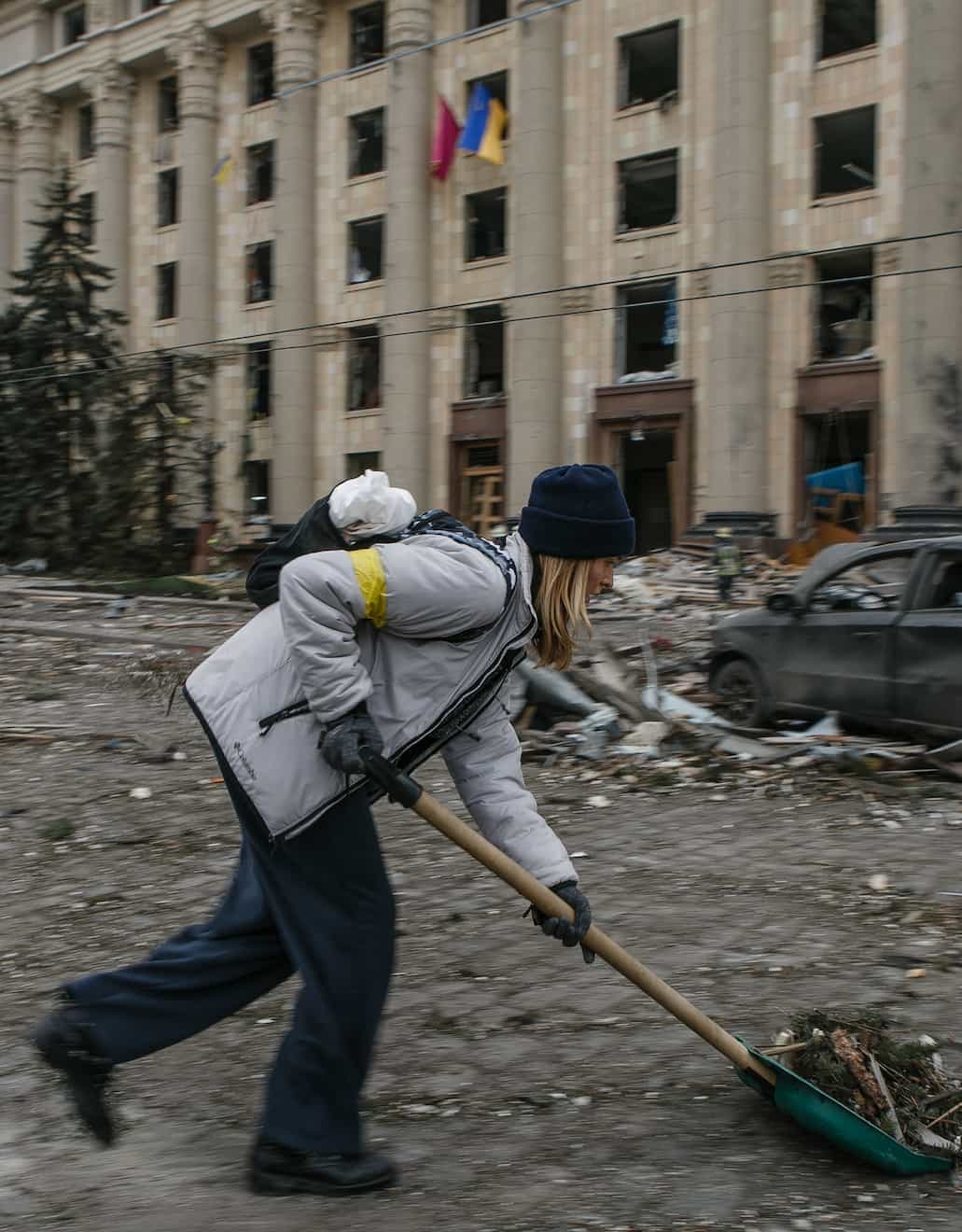
Testimony Photos

Other Testimonies from the Archive
- Recording
Ma’am, brace yourself — we’re going to pass you through the window
A volunteer from Kramatorsk on the city’s shelling and front-line evacuations
Bohdan Zuiakov02/02/23 - Recording
Not a day goes by that I don’t think about it. Especially about the dead girl
An actor from the Mariupol Theater on how the theater became a shelter and how the Russians bombed it
Serhii Zabohonskyi03/14/23 - Recording
I realized I was standing in a minefield
A Kharkiv sapper was about to retire but instead defused a 500-kilogram bomb
Anatolii Kolesnyk12/18/22 - Recording
For me, bread means sweat and calluses. And now blood, too
A Ukrainian helped his family work the fields and nearly went blind after stepping on a mine
Dmytro Yeliseienko04/25/23 - Recording
All we have left of Vova are rubber slippers
An resident of Izium on life under occupation, her husband’s death, and evacuation
Liliia Maichenko09/09/22 - Recording
They beat one fighter from Azov for three days. In the morning the guard called him a hearse
A volunteer from Mariupol who endured captivity and torture in Olenivka
Vitalii Sitnikov07/22/22